“ If I were to imagine that when I said ‘I am pleased,’ I meant that I was exactly the same thing as ‘pleased,’ I should not indeed call that a naturalistic fallacy, although it would be the same fallacy as I have called naturalistic with reference to Ethics. The reason of this is obvious enough. When a man confuses two natural objects with one another, defining the one, by the other, if for instance, he confuses himself, who is one natural object, with ‘pleased’ or with ‘pleasure’ which are others, then there is no reason to call the fallacy naturalistic. ”
Naturalistic fallacy
Definition and stakes
The theme of “naturalistic fallacy” has been addressed by authors such as George Edward Moore, St. George William Joseph Stock, G. E. Moore, John Wesley Powell and John Stuart Mill. It is often associated with terms like metaphysics, ethics, philosophy, reason and causality.
Quotes about “naturalistic fallacy”
“ To declare it to be obvious is to suggest the naturalistic fallacy: just as, in some recent books, a proof that genius is diseased, abnormal, has been used in order to suggest that genius ought not to be encouraged. Such reasoning is fallacious, and dangerously fallacious. The fact is that in the very words ‘health’ and ‘disease’ we do commonly include the notion that the one is good and the other bad. ”
 George Edward Moore,
Principia Ethica — Chapter IV
(1903)
George Edward Moore,
Principia Ethica — Chapter IV
(1903)
“ Here, then, we have the root of the naturalistic fallacy. The metaphysicians have the merit of seeing that when you say ‘This would be good, if it existed,’ you can’t mean merely ‘This has existed and was desired,’ however many times that may have been the case. They will admit that some good things have not existed in this world, and even that some may not have been desired. ”
George Edward Moore,
Principia Ethica — Chapter I
(1903)
“ But if he confuses ‘good,’ which is not in the same sense a natural object, with any natural object whatever, then there is a reason for calling that a naturalistic fallacy; its being made with regard to ‘good’ marks it as something quite specific, and this specific mistake deserves a name because it is so common. As for the reasons why good is not to be considered a natural object, they may be reserved for discussion in another place. ”
George Edward Moore,
Principia Ethica — Chapter V
(1903)
“ Almost all ethical writers have committed the naturalistic fallacy—they have failed to perceive that the notion of intrinsic value is simple and unique; and almost all have failed, in consequence, to distinguish clearly between means and end—they have discussed, as if it were simple and unambiguous, the question ‘What ought we to do?’ or ‘What ought to exist now?’ without distinguishing whether the reason why a thing ought to be done or to exist now, is that it is itself possessed of intrinsic value, or that it is a means to what has intrinsic value. ”
George Edward Moore,
Principia Ethica — Chapter IV
(1903)
“ Precisely the same error which leads them to suppose that there must exist a supersensible Reality, leads them to commit the naturalistic fallacy with regard to the meaning of ‘good.’ Every truth, they think, must mean somehow that something exists; and since, unlike the empiricists, they recognise some truths which do not mean which do not mean that anything exists here and now, these they think must mean that something exists not here and now. ”
“ But that is not what is meant by this phrase; nature is again used to mean a mere part of nature; only this time the part meant is not so much the normal as an arbitrary minimum of what is necessary for life. And when this minimum is recommended as ‘natural’—as the way of life to which Nature points her finger—then the naturalistic fallacy is used. ”
George Edward Moore,
Principia Ethica — Chapter I
(1903)
“ This view I propose to call the ‘naturalistic fallacy’ and of it I shall now endeavour to dispose. 11. Let us consider what it is such philosophers say. And first it is to be noticed that they do not agree among themselves. They not only say that they are right as to what good is, but they endeavour to prove that other people who say that it is something else, are wrong. One, for instance, will affirm that good is pleasure, another, perhaps, that good is that which is desired ”
George Edward Moore,
Principia Ethica — Contents
(1903)
“ But the theory, by which I have defined Metaphysical Ethics, is not that Metaphysics has a logical bearing upon the question involved in practical Ethics 'What effects will my action produce?,' but that it has such a bearing upon the fundamental ethical question, 'What is good in itself?.' This theory has been refuted by the proof, in Chap. I, that the naturalistic fallacy is a fallacy ”
George Edward Moore,
Principia Ethica — Chapter III
(1903)
“ In this argument the naturalistic fallacy is plainly involved. That fallacy, I explained, consists in the contention that good means nothing but some simple or complex notion, that can be defined in terms of natural qualities. In Mill’s case, good is thus supposed to mean simply what is desired; and what is desired is something which can thus be defined in natural terms. Mill tells us that we ought to desire something (an ethical proposition) , because we actually do desire it ”
George Edward Moore,
Principia Ethica — Chapter II
(1903)
“ In this chapter I have begun the criticism of certain ethical views, which seem to owe their influence mainly to the naturalistic fallacy—the fallacy which consists in identifying the simple notion which we mean by ‘good’ with some other notion. They are views which profess to tell us what is good in itself ”
George Edward Moore,
Principia Ethica — Chapter II
(1903)
“ For I cannot hope to recommend the doctrine that things which are good do not owe their goodness to their common possession of any other property, without a criticism of the main doctrines, opposed to this, whose power to recommend themselves is proved by their wide prevalence. 25. The theories I propose to discuss may be conveniently divided into two groups. The naturalistic fallacy always implies that when we think ‘This is good,’ what we are thinking is that the thing in question bears a definite relation to some one other thing. ”
 Walter Pater,
Appreciations, with an Essay on Style
Walter Pater,
Appreciations, with an Essay on Style
“ And while one feels that no real logic of fallacies has been achieved by him, one feels still more how little the construction of that branch of logical inquiry really helps men's minds; fallacy, like truth itself, being a matter so dependent on innate gift of apprehension, so extra-logical and personal; the original perception counting for almost everything, the mere inference for so little! Yes! "A man may be in as just possession of truth as of a city, and yet be forced to surrender," even in controversies not necessarily maladroit. ”
William James, The Will to Believe and Other Essays in Popular Philosophy… (1897)
“ Now, I say that these theorizers are guilty of precisely the same fallacy as he who should ascribe the death of his friend to the dinner with thirteen, or the fall of the sparrow to the milky way. Like the dog in the fable, who drops his real bone to snatch at its image, they drop the real causes to snatch at others, which from no possible human point of view are available or attainable. ”
 John Stuart Mill,
A System of Logic: Ratiocinative and Inductive…
John Stuart Mill,
A System of Logic: Ratiocinative and Inductive…
“ I am indeed disposed to think that the fallacy now under consideration has been the cause of two-thirds of the bad philosophy, and especially of the bad metaphysics, which the human mind has never ceased to produce. Our general ideas contain nothing but what has been put into them, either by our passive experience, or by our active habits of thought ”
John Stuart Mill,
A System of Logic, Ratiocinative and Inductive
“ But, in all except the most eminently philosophical minds, it is infected with precisely the same kind of fallacy as that is. For we must remember that even this other and better generalization, the progressive change in the condition of the human species, is, after all, but an empirical law ”
John Stuart Mill,
A System of Logic, Ratiocinative and Inductive
(1881)
“ Passing from physics to metaphysics, we may notice among the most remarkable fruits of this a priori fallacy two closely analogous theories, employed in ancient and modern times to bridge over the chasm between the world of mind and that of matter; the species sensibiles of the Epicureans, and the modern doctrine of perception by means of ideas. These theories are indeed, probably, indebted for their existence not solely to the fallacy in question, but to that fallacy combined with another natural prejudice already adverted to, that a thing can not act where it is not. ”
John Stuart Mill,
A System of Logic: Ratiocinative and Inductive…
“ And he proceeds to say, that independently of the love of the marvellous, or any other bias in the inclinations, there is a natural tendency in the intellect itself to this kind of fallacy; since the mind is more moved by affirmative instances, though negative ones are of most use in philosophy ”
William Hazlitt, The collected works of William Hazlitt… (1902)
“ In supposing that we combine these different impressions together, that we compare different objects, that we reason upon them, it seems we only deceive ourselves, and mistake a rapid and mechanical transition from one idea to another for the actual perception of the relations between them. Thus have these philosophers sacrificed all the known facts and conscious operations of the mind to a literal deduction from a gross verbal fallacy. ”
John Stuart Mill,
A System of Logic, Ratiocinative and Inductive
“ In this way all deeply-rooted opinions and feelings are enabled to create apparent demonstrations of their truth and reasonableness, as it were, out of their own substance. The other form of the fallacy: Things which we can not think of together can not exist together—including as one of its branches, that what we can not think of as existing can not exist at all—may thus be briefly expressed: Whatever is inconceivable must be false. ”
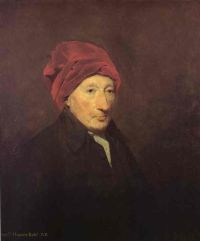 Thomas Reid,
An Inquiry into the Human Mind…
Thomas Reid,
An Inquiry into the Human Mind…
“ This is the case in all the phenomena which we call fallacies of the senses; and particularly in those which are called fallacies in vision. The appearance of things to the eye, always corresponds to the fixed laws of nature; therefore, if we speak properly, there is no fallacy in the senses. Nature always speaketh the same language, and useth the same signs in the same circumstances: but we sometimes mistake the meaning of the signs, either through ignorance of the laws of nature, or through ignorance of the circumstances which attend the signs. ”
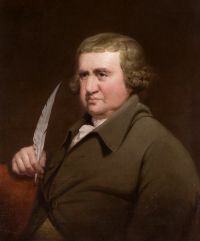 Erasmus Darwin,
Zoonomia, or, the Laws of Organic Life…
(1796)
Erasmus Darwin,
Zoonomia, or, the Laws of Organic Life…
(1796)
“ A third great source of error is the vivacity of our ideas of imagination, which perpetually intrude themselves by various associations, and compose the farrago of our dreams; in which, by the suspension of volition, we are precluded from comparing the ideas of one sense with those of another, or the incongruity of their successions with the usual course of nature, and thus to detect their fallacy. Which we do in our waking hours by a perpetual voluntary exertion, a process of the mind above mentioned, which we have termed intuitive analogy. ”
baron d' Paul Henri Thiry Holbach, The System of Nature, or, the Laws of the Moral and Physical World…
“ Thus, every rational thinker, who renounces his prejudices, will be enabled to feel the inutility, to comprehend the fallacy of so many abstract systems; he will perceive that they have hitherto answered no other purpose than to confound the notions of mankind ”
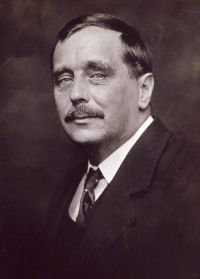 H. G. Wells,
First and Last Things: A Confession of Faith and Rule of Life
H. G. Wells,
First and Last Things: A Confession of Faith and Rule of Life
“ Every species is vague, every term goes cloudy at its edges; and so in my way of thinking, relentless logic is only another name for a stupidity—for a sort of intellectual pigheadedness. If you push a philosophical or metaphysical inquiry through a series of valid syllogisms—never committing any generally recognised fallacy—you nevertheless leave behind you at each step a certain rubbing and marginal loss of objective truth, and you get deflections that are difficult to trace at each phase in the process. ”
W. R. Sorley, On the Ethics of Naturalism
“ But that it should be needed to make that thinking 'objective' is quite another matter. 'Green-after-red-and-other-than-it' is an absolutely complete object of thought, ideally considered, and needs no added element. The fallacy seems to arise from some such reflection as this, that since the feeling is what it feels itself to be, so it must feel itself to be what it is—namely, related to each of its objects. That the last is covers much more ground than the first, the philosopher here does not notice. ”
John Stuart Mill,
A System of Logic, Ratiocinative and Inductive
“ Since every case where a conclusion which can only be proved from certain premises is used for the proof of those premises, is a case of petitio principii, that fallacy includes a very great proportion of all incorrect reasoning. It is necessary, for completing our view of the fallacy, to exemplify some of the disguises under which it is accustomed to mask itself, and to escape exposure. ”
 Frederik van Eeden,
The Bride of Dreams
Frederik van Eeden,
The Bride of Dreams
“ The mightiest and most prodigious fallacy of men in this age, that cripples their aspirations, and like a deadly frost bends low and kills the tender blossoms of their young growing wisdom, erecting cruel steep walls between heart and heart, between group and group - is the fallacy that in this struggle between belief and unbelief a verdict can be reached through something that they call Reason and that bears as its weapon the True Word. ”
 James Frederick Ferrier,
Philosophical Works of the Late James Frederick Ferrier
(1875)
James Frederick Ferrier,
Philosophical Works of the Late James Frederick Ferrier
(1875)
“ The common division of the sciences into the two leading categories,—the science of mind and the science of matter,—when regarded as more than a mere verbal, and to a certain extent convenient distinction, is founded on the fallacy contained in this psychological deliverance, and partakes of its fallaciousness. Indeed, to lay down the dualism of subject and object as complete and absolute, (that is, as an out-and-out duality which is not also a unity) , which psychology not unfrequently does, is to extinguish every glimmering of the scientific reason ”
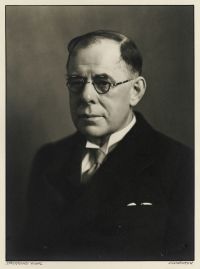 A. E. Taylor,
Elements of metaphysics
(1903)
A. E. Taylor,
Elements of metaphysics
(1903)
“ Just as we learned that the existence of our fellow-men is the cardinal fact of experience which affords the most immediate refutation of the subjectivist theory, so the original source of the subjectivist fallacy is failure to recognise their experience as being on the same level of reality as our own. ”
Carveth Read, Logic: Deductive and Inductive
“ A negative use of this fallacy is very common. Some general doctrine, such as Positivism, Transcendentalism, Utilitarianism, or Darwinism, is held in common by a group of men; who, however, all judge independently, and therefore are likely to differ in details. An opponent exhibits their differences of opinion, and thereupon pretends to have refuted the theory they agree in supporting. This is an argumentum ad scholam, and pushes too far the [Pg 400] demand for consistency. ”
 John Wesley Powell,
Truth and Error — Chapter XVII.
(1898)
John Wesley Powell,
Truth and Error — Chapter XVII.
(1898)
“ In this manner the experiences of sensation, perception, and apprehension are connate, they spring up together, and yet concepts of sensation precede concepts of understanding, and concepts of apprehension precede concepts of reflection. One part of the doctrine of presupposition, as it is put in metaphysics, is a fallacy, and is replaced by the doctrine of causation, which explains that that which was supposed to be antecedent is consequent, or that which was supposed to be cause is effect. This is the great contribution made by science in demonstrating the laws of evolution. ”
 David Hume,
Treatise of Human Nature/Book 3…
(1739)
David Hume,
Treatise of Human Nature/Book 3…
(1739)
“ That we may discover the fallacy of his hypothesis, we need only consider, that a false conclusion is drawn from an action, only by means of an obscurity of natural principles, which makes a cause be secretly interrupted in its operation, by contrary causes, and renders the connection betwixt two objects uncertain and variable. ”
Thomas Brown, Lectures on the Philosophy of the Human Mind…
“ Since the exposure of the fallacy, on which these objections are founded, would, however, afford only a sort of negative evidence of that great truth which they oppose, it will be of advantage, before entering on an examination of the objections themselves, to state, in the first place, the nature of that positive evidence, which does not, indeed, lead us to the belief of the unity and permanence of our spiritual being, by that slow process which is denominated reasoning, but constitutes to us, primarily and directly, an impossibility of disbelieving it. ”
 Timothy East,
The Sheepfold and the Common; Or…
Timothy East,
The Sheepfold and the Common; Or…
“ Suppose another person proceed on the same principle, he must infer, that his future condition will be a most painful and unfortunate one, simply because his present condition is so. There is, then, a self-evident and a dangerous fallacy in the proposition which allows two persons to draw from it such opposite inferences, the one for, and the other against himself, and without any reference to personal conduct or character. ”
Related terms
Authors who wrote about “naturalistic fallacy”
George Edward MooreSt. George William Joseph Stock G. E. MooreJohn Wesley PowellJohn Stuart MillDavid Hume
 John RuskinWilliam HazlittWilliam JamesErasmus Darwin
 Bertrand Russell
 George Jacob HolyoakeWalter PaterJames Frederick FerrierFrederik van EedenCarveth ReadA. E. TaylorH. G. WellsW. R. SorleyThomas Reid