Nerve (biology)

Definition and stakes

Portrait of Herbert Spencer Herbert Spencer,  The Principles of Biology — Chapter I.3 (1898)

“ And our evidence that nerve-force is thus originated, consists not only of such facts as the above, but also of more conclusive facts established by direct experiments on nerves—experiments which show that nerve-force results when the cut end of a nerve is either mechanically irritated, or acted on by some chemical agent, or subject to the galvanic current—experiments which prove that nerve-force is generated by whatever disturbs the molecular equilibrium of nerve-substance. ”
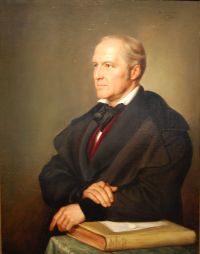
Source: Wikisource

Portrait of Herbert Spencer Herbert Spencer,  The Principles of Biology, Volume 1…

“ Whether a nerve is merely a conductor, which delivers at one of its extremities an impulse received at the other, or whether, as some now think, it is itself a generator of force {56}which is initiated at one extremity and accumulates in its course to the other extremity, are questions which cannot yet be answered. All we know is that agencies capable of working molecular changes in nerves are capable of calling forth from them manifestations of activity. ”
Source: Gutenberg

Robert Hunt,  The Poetry of Science; or, Studies of the Physical Phenomena of Nature

“ By the separation of a main branch of one of the nerves of sensation, although all the operations of life will still proceed, the organ to which that nerve goes is dead to its particular sense. In like manner, if one of the nerves of volition is divided, the member will not obey the inclination of the brain. It is evident, therefore, although many of the great phenomena of vital force are dependent on the nervous system, and the paralysis of a member ensues upon the separation or the disease of a nerve, that the nerves are but the channels through which certain influences are carried. ”
Source: Gutenberg

Get perspective with Kwize: daily news enlightened by great literature