“ It grows best in sunny open groves on ground covered with ferns, chokecherry, brier rose, rubus, mints, goldenrods, etc. Few, if any, of the famous oak groves of Europe, however extensive, surpass these in the size and strength and bright, airy beauty of the trees, the color and fragrance of the vegetation beneath them, the quality of the light that fills their leafy arches, and in the grandeur of the surrounding scenery. The finest grove in the park is in one of the little Yosemite valleys of the Tuolumne Cañon, a few miles above Hetch-Hetchy. ”
Oak grove
Definition and stakes
Quotes about “oak grove”
Various, Graham's Magazine Vol XXXII No…
“ The slope down to the river's brink is covered with a wilderness of shrubbery; while to the right of the garden-fence spreads a magnificent grove of white pines, once making a famous play-ground for us children. Down yonder, in that old field waving with long grass, beyond the grove, is a patch of splendid blackberry bushes; and near that old ivy-bound oak on the bank, leaning so gracefully over the placid waters, as if to greet his image reflected in its vast mirror, is a fine place to hunt summer grapes. ”
Josephine Clifford, Overland Tales
“ The modest but cheerful houses are just within sight of each other, separated by orchards, grainfields, vineyards; a grove of white oaks here and there, a single live oak, and clumps of willow and sycamore, make the landscape as pleasing as any in the country. Nearer the first rise of the mountain, the view of grainfields, fenced in by the same dry board fence, would become monotonous were it not for the ever-fresh, ever-beautiful white oak [Pg 102] that stands, sentinel-like, scattered through the golden fields, its lower branches sometimes hidden in the full-bearing garbs. ”
Various, Graham's Magazine, Vol. XXI, No… (1842)
“ A magnificent grove of white pines stoops and murmurs to the wind as it draws down the valley, the tufted boughs give out a healthy odor, and in their shadows are a thousand grassy nooks and hollows filled with wild blossoms that give a richer fragrance to the air. I have said there was but one house in the river vale. A little back from the river’s brink, and just beyond the clump of chesnuts at the end of the bridge, are two large oak trees, sheltering, and almost hiding a low cottage house. ”
Rufus B. Richardson, Vacation days in Greece
“ The whole vast enclosure is covered with a grove of great oaks, which, in some cases, have pushed down the walls. In one case, the growing oak has pulled out one stone from its place and carried it up in its embrace several feet above the rest of the wall. So luxuriant is the vegetation all over the hill that one who will see the whole wall outside and inside—and no less will satisfy one—must give up a whole day to the task, and force his way through thorns and briers that scratch and tear, paying with his person. ”
Henry Blake Fuller,
With the Procession
“ A grove of oak and maple came almost to the water's edge, and within it a number of barrack-like structures of clean yellow pine were taking shape and substance. The odor of the pine mingled with the earthy smells of the grove; now and then a little pile of sawdust was taken swirlingly by the breeze, and here and there a long, fresh shaving was seen caught upon the prickly branches of some June rose. ”
Robert Tyas, Woodland Gleanings: Being an Account of British Forest-Trees
“ Of all the hues of autumn, those of the oak are commonly the most harmonious. In an oaken wood, you see every variety of green and brown, owing either to the different exposure of the tree, the difference of the soil, or its own nature. In the beechen grove, this variety is not to be found. In early autumn, when the extremities of the trees are slightly tinged with orange, it may be partially produced; but late the eye is usually fatigued with one deep monotonous shade of orange, though perhaps it is the most beautiful among all the hues of autumn. ”
George Washington Cable,
The Amateur Garden
“ Also each new path has made it easier to bring up, for the lawn garden, sand, clay, or leaf-mould, or for hearth consumption all the wood which the grove's natural mortality each year requires to be disposed of. There is a superior spiritual quality in the warmth of a fire of h-oak, h-ash, and even h-ellum gathered from your own acre, especially if the acre is very small and has contour paths. ”
John Muir,
My First Summer in the Sierra
“ One may fancy the clouds themselves are plants, springing up in the sky-fields at the call of the sun, growing in beauty until they reach their prime, scattering rain and hail like berries and seeds, then wilting and dying.The mountain live oak, common here and a thousand feet or so higher, is like the live oak of Florida, not only in general appearance, foliage, bark, and wide-branching habit, but in its tough, knotty, unwedgeable wood. ”
Winthrop Packard, Florida trails as seen from Jacksonville to Key West and from November to April inclusive
“ With the tender green of the young ash leaves come the blossoms of these air plants, giving the angular, awkward trees the appearance of putting out tropic spikes of purple-stemmed, blue-flowered beauty.Here and there the live-oaks, never very numerous in this region, show dark green on the higher banks. The live-oak is the symbol of stability and even virility, if you please, but it is at the best somber and glum. It drops its leaves grudgingly, one by one, putting out its new ones in the same way, thus always retaining its cloth of dark green. ”
William Howitt,
The Rural Life of England
“ Forest smells, that rise up deliciously as you cross dim thickets or tread the spongy turf all fragrant with thyme, and sprinkled with the light harebell. Huge limbs of oak riven off by tempests, or the old oak itself, a vast, knotty, and decayed mass, lying on the ground, and perhaps the woodman gravely labouring upon it, lopping its boughs, riving its huge, misshapen stem, piling it in stacks of cord-wood, or binding them into billets. ”
Frank Belknap Long,
Mating center
(1961)
“ The foliage at the far end of the forest aisle, a hundred feet from the massive oak tree, was merely enveloped for an instant in a blinding glare that spread outward until it filled every shadowed crevice and swaying vine-canopy between the tree and its point of origin. As it spread it became more diffuse and less blinding, until every boulder, plant and fallen log that it touched began to glow with a cold, almost spectral radiance. ”
The German Classics of the Nineteenth and Twentieth Centuries…
“ An oak-forest like the above, which, as soon as the trees begin to grow really strong and sturdy, stretches forth toward the wanderer only slim, bark-stripped trunks with withered remnants of leaves, interspersed with rank miserable meadow-trees, with hazel-nut thickets and dog-rose bushes, a piece of woodland in which husbandry and forestry are completely jumbled, is actually no longer a real forest. ”
H. G. Nicholls, The Forest of Dean: An Historical and Descriptive Account
“ May 28th.—The most extraordinary blight is now upon the trees that I believe ever was known: it is confined entirely to the oak, and chiefly to the large trees, although in some parts it is extending to the young plantations. The whole of the High Meadow woods and great part of the Forest, particularly Russell’s Enclosure, and where the timber is thick, are entirely stripped of their leaves, and look as if fire had passed through them. Where a beech stands amongst them, it is perfectly green, and the oaks all around quite brown. ”
Harry Marshall Ward,
The Oak
(1892)
“ The forester usually gets over these difficulties by planting beech, or silver fir, or some other species among the oaks, but in such a way that the oaks are never completely shaded by the other trees—that is to say, he keeps the trees at different ages, the beach, hornbeam, silver fir, spruce, etc., only being allowed to just close in the forest, leaving the leaf-crowns of the oaks to be fully exposed to the light above. ”
Edward Payson Roe,
The Home Acre
“ There is one objection to the beech which also lies against the white oak—it does not drop its leaves within the space of a few autumn days. The bleached foliage is falling all winter long, thus giving the ground near an untidy aspect. With some, the question of absolute neatness is paramount; with others, leaves are clean dirt, and their rustle in the wind does not cease to be music even after they have fallen. ”
Vernon L. Kellogg,
Insect Stories
“ Although, as I have already said, there are eight different kinds of oak-trees growing in our valley and mountains, two of these kinds, the live-oaks and the white oaks, are by far the most common and numerous. As one stands upon the mountain tops or foothills and looks down and over the broad valley, all still and drowsy under the warm afternoon sun, it seems as if you were looking at a single great orchard with the trees in it in close-set regular lines and plots in some places, and irregularly scattered and farther apart in other places. ”
Arthur Cleveland Bent, Life histories of North American woodpeckers (1939)
“ What he accomplishes the photographs show well enough,—the close, methodical studding of bark or wood of any kind with acorns, chiefly those of live-oaks, [Pg 216] over immense areas. The cultures, once started, are wrought upon continuously year by year, as material avails or the colony flourishes. Live-oaks themselves are the commonest hosts, together with the white, or post, oak, and the black oak of the southern counties. After these come sycamore and yellow pine or, more rarely, eucalyptus. ”
Various, Scientific American Supplement…
“ The only pine forests where oaks are not intermixed are either in land so sandy that oaks cannot be made to grow on them at all, or so far north that they are beyond their northern limit. In the Green Mountains and in the New England forests, in the pine forests in Pennsylvania, in the Adirondacks, in Wisconsin and Michigan—except in sand—I have found oaks mixed with the pines and spruces. In northwestern Minnesota and in northern Dakota the oaks are near their northern limit, but even there the burr oak drags on a bare existence among the pines and spruces. ”
Frederick Law Olmsted,
Frederick Law Olmsted
(1922)
“ The live-oak is almost the only tree away from the river bottoms, and everywhere gives the marked features to the landscape.The live-oaks are often short, and even stunted in growth, lacking the rich vigor and full foliage of those further east. Occasionally, a tree is met with, which has escaped its share of injury from prairie burnings and northers, and has grown into a symmetrical and glorious beauty. ”
John Richard de Capel Wise,
The New Forest: its history and its scenery
(1863)
“ Nowhere in England rise such oak-woods, their boughs rimed with the frostwork of lichens, and dark beech-groves with their floor of red brown leaves, on which the branches weave their own warp and woof of light and shade. ”
Richard Jefferies,
The Hills and the Vale
“ On this side by the hedge the ground is a little higher and dry, hung over with the lengthy boughs of an oak which give some shade. I always feel a sense of regret when I see a seedling oak in the grass. The two green leaves—the little stem so upright and confident, and though but a few inches high, already so completely a tree—are in themselves beautiful. Power, endurance, grandeur are there; you can grasp all with your hand and take a ship between the finger and thumb. ”
Various, The Irish Penny Journal, Vol. 1 No…
“ Looking northwards, the sloping banks of the river, at the opposite sides of an extensive meadow, are thickly planted with larch, fir, beech, and ash, from the midst of which, an aged oak is here and there seen to rise above its younger and less aspiring companions ”
John Evelyn,
Sylva; Or, A Discourse of Forest Trees…
“ It is in the mean time the propagation of these large spreading oaks, which is especially recommended for the excellency of the timber, and that his Majesties forests were well and plentifully stor’d with them; because they require room, and space to amplifie and expand themselves, and would therefore be planted at more remote distances, and free from all encumbrances: And this upon consideration how slowly a full-grown oak mounts upwards, and how speedily they spread, and dilate themselves to all quarters, by dressing and due culture ”
Bayard Taylor,
The Lands of the Saracen
“ The sides of the mountain are covered with clumps of oak, hawthorn and other trees, in many places overrun with the white honeysuckle, its fingers dropping with odor of nutmeg and cloves. The ascent, by a steep and winding path, occupied an hour. The summit is nearly level, and resembles some overgrown American field, or "oak opening." The grass is more than knee-deep; the trees grow high and strong, and there are tangled thickets and bowers of vines without end. ”
Lewis Falley Allen,
Rural Architecture
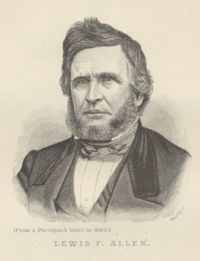
“ Small yards, picketed in for small uses, have no business in sight of the grounds in front, and all minor concerns should be thrown into the rear, beyond observation from the main approach to the dwelling. The trees that shade the entrance park, or lawn, should be chiefly forest trees, as the oak, in its varieties, the elm, the maple, the chestnut, walnut, butternut, hickory, or beech. If the soil be favorable, a few weeping willows may throw their drooping spray around the house ”
Harry Marshall Ward,
The Oak
(1892)
“ As we have seen, the forester has to exercise considerable forethought—the outcome of long experience—in growing oak so as to obtain long, clean stems. The natural habit of the tree is to form a short, thick bole and a widely spreading crown, the main branches of which come off not far from the ground. To compel the stem to elongate into a long pole he has to plant other trees with it (as we have seen, beech, spruce, etc.) ”
Will Levington Comfort,
Child and Country: A Book of the Younger Generation
“ You can't expect to get anything out of an oak-tree without working for it. I have seen an oak-log softened to punk, the bark gone, having lain in a woodland shadow, doubtless for thirty or forty years, but still holding fast to its unmistakable grain and formation, though you could rub it to powder between the fingers. ”
John Williams Streeter,
The Fat of the Land: The Story of an American Farm
“ Well, down in the wood yonder there's enough dead white oak, standing or on the ground, to make three thousand, nine-foot posts, and one seasoned white oak will outlast two cedars, and it is twice as strong. ”
Arthur Herbert Savory, Grain and Chaff from an English Manor
“ The new owner spared it, and later when it became my property I did likewise, for I should have considered it sacrilege to destroy the finest oak in the neighbourhood. Some years after I had sold the farm I heard that the tree was blown down in a gale, its enormous head and widespread branches must have offered immense resistance to the wind, and the fall of it must have been great.The most celebrated, if not the biggest oak in the New Forest is the Knightwood oak, not far from Lyndhurst; it is 17 feet in circumference, which would make it not less than 450 years old by the above rule. ”
Sarah Orne Jewett,
Deephaven and Selected Stories & Sketches
“ The roads cross it here and there, and one can sometimes see small and lonely farms hiding away in the heart of it. The trees are for the most part young growth of oak or pine, though I could show you yet many a noble company of great pines that once would have been marked with the king's arrow, and many a royal old oak which has been overlooked in the search for ships' knees and plank for the navy yard, and piles for the always shaky, up-hill and down, pleasant old Portsmouth bridge. ”
Charles Lathrop Pack, The School Book of Forestry
“ Among our most useful and valuable trees are the white oak, and its close kin, the red oak, which produce a brown-colored, hard wood of remarkable durability. The white oak is the monarch of the forest, as it lives very long and is larger and stronger than the majority of its associates. The timber is used for railroad ties, furniture, and in general construction work where tough, durable lumber is needed. Many of our wooden ships have been built of oak. The white oaks often grow as high as 100 feet and attain massive dimensions. ”
Henry S. Fitch, The Forest Habitat of the University of Kansas Natural History Reservation
“ Along both the upper and lower outcrops, elm and hackberry are especially prominent. Chestnut oak is abundant along the outcrops and on the rocky slope between them in some situations. Ash grows abundantly on some upper slopes but there are few growing on the upper outcrop. On the terrace, elm, ash, hackberry, honey locust, coffee-tree and black oak are abundant. On the lower slopes grow most of the blackjack oaks, post oaks, red oaks and mulberries.Even greater differences in the local aspect of woodland on the hillsides are caused by slope exposure. ”