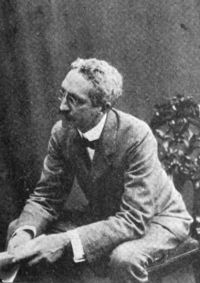
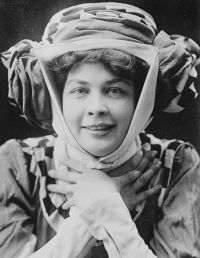
“ Two or three opera singers of repute were already there, among them an Italian singer and sorceress of great beauty, a veritable queen of the genus adventuress, who was setting the town by the ears not only by her loveliness but her voice. Her beauty was so remarkable that the Sunday papers were giving full pages to her face and torso alone. There were to be several light opera and stage beauties there also, a basso profundo to sing, writers, artists, poets. ”
Opera singer
Definition and stakes
Quotes about “opera singer”
Enrico Caruso, Caruso and Tetrazzini on the Art of Singing
“ The most visible phase of the opera singer's life when he or she is in view of the public on the stage is naturally the one most intimately connected in the minds of the majority of people with the singer's personality, and yet there are many happenings, amusing or tragic, from the artist's point of view, which, though often seen, are as often not realized in their true significance by the audience in front of the orchestra. ”
H. Sutherland Edwards,
History of the Opera from its Origin in Italy to the present Time
“ The words of an opera ought to be good, and yet need not of necessity be heard. They should be poetical that they may inspire first the composer and afterwards the singer; and they should be ryhthmical and sonorous in order that the latter may be able to sing them with due effect. Above all they ought not to be ridiculous, lest the public should hear them and laugh at the music, just where it was intended that it should affect them to tears. Everything ought to be good at the opera down to the rosin of the fiddlers, and including the words of the libretto. ”
W. E. Haslam, Style in Singing
“ The first requisite for the aspirant who wishes to follow the operatic career is undoubtedly a voice possessed of the three essential factors of Quality, Power and Compass; what is termed in Italy a “voce di teatro,” or voice for the theatre.But an opera-singer is actor as well as singer, and in this direction more—much more—is now demanded of him than formerly. But to those possessed of what is known as the Instinct of the Theatre, or Scenic Instinct, the gestures and attitudes of the operatic stage, being largely conventional, are soon acquired. ”
Lewis Clinton Strang, Famous Prima Donnas
“ The vocal art of the average light opera singer is imperfect, and the histrionic methods in vogue show little evidence of careful training: they are neither subtle nor complex. Indeed, the average woman in light opera is not an actress at all in the full meaning of the word. She does not fit herself into the parts that she is called upon to play, and she does not attempt expositions of character that will stand even the most superficial analysis. She acts herself under every circumstance. Describe in detail her work in a single rôle, and she is written down for all time. ”
James Francis Cooke,
Great Singers on the Art of Singing
“ There was a time in the halcyon days of the old coloratura singers when the opera singer was not expected to have very much more intelligence than a parrot. Any singer who could warble away at runs and trills was a great artist. The situation has changed entirely to-day. The modern opera-goer demands great acting as well as great singing. The opera house calls for brains as well as voices. There should properly be great and sincere rivalry among fine singers. ”
Kathleen Howard,
Confessions of an Opera Singer
“ I remember that a well-known American writer, living in Paris, said patronizingly to my mother à propos of my first appearance, "Let us hope that she will make a real début later, for this can hardly be called one, can it?" "Well, after all," answered my mother, "who knows where most of the great singers of today made their débuts?"Contemporary fiction is full of opera singing heroines who jump into fame in a single night, like Minerva springing full armed from the head of Jupiter. ”
Harriette Brower, Vocal Mastery
“ Claudia Muzio, who was just about to take her place among the personnel of the Metropolitan, is truly to the manner born,—a real child of the opera. She has lived in opera all her life, has imbibed the operatic atmosphere from her earliest remembrance. It must be as necessary for a singer who aspires to fill a high place in this field of artistic endeavor, to live amid congenial surroundings, as for a pianist, violinist or composer to be environed by musical influences. ”
James Francis Cooke,
Great Singers on the Art of Singing
“ Is it not better to learn the profession of opera singing in its one great school, and learn it so thoroughly that one can advance in the profession, just as one may advance in every other profession? The singer in the small opera company who, night after night, says to herself, "To-morrow it must be better," is the one who will be the Lilli Lehmann, the Galli-Curci, or the Schumann-Heink of to-morrow; not the important person who insists upon postponing her début until she can appear at the Metropolitan or at Covent Garden. ”
Various, Once a Week (1861)
“ Dingy scenery, shabby and anachronistic costumes, an inefficient chorus, and a scanty orchestra had aided a small constellation of eminent singers to maintain Italian Opera at the King’s Theatre for the entertainment of a clique, not for the pleasure of a public. This was to be changed. The new undertaking promised perfection in every thing. Art was to be considered as well as the artist—the composer as well as the singer. ”
James M. Trotter,
Music and Some Highly Musical People
“ The part of a performer in opera (and here I refer not alone to one who acts the leading rôle) is a most exacting one; for the artist must unite in himself the qualities of both the singer and the actor. While called upon to demonstrate with proper melody of voice and expression the meaning of the music of the opera, he is also required to portray by suitable dramatic movements its corresponding meaning as found in the libretto. ”
Kathleen Howard,
Confessions of an Opera Singer
“ Its beautiful creamy colour and thick softness cannot be improved upon, to my mind.Marie Muelle is now the first operatic costumer of the world. This reputation she has built unaided through her own unfailing energy. Through her rooms pass the most fabulous-priced opera singers, the greatest actors, the stage beauties, famous managers, producers, and designers, the ladies of the great world seeking costumes for wonderful private fêtes—and gentlemen seeking the ladies—all the varied crowd of many nationalities to whom the old childish pastime of "dressing up" is a business or a pleasure. ”
Gustav Kobbé,
The Complete Opera Book
“ Consider that, when Wagner first projected his theory of the music-drama, singers were accustomed in opera to step into the limelight and, standing there, deliver themselves of set melodies, acknowledge applause and give as many encores as were called for, in fact were "it," while the real creative thing, the opera, was but secondary, and it is easy to comprehend the opposition which his works aroused among the personnel of the lyric stage; for music-drama demands a singer's absorption not only in the music but also in the action. ”
Kathleen Howard,
Confessions of an Opera Singer
“ Still, if a rôle definitely belongs to the Fach of a certain singer, he is supposed to have first right to it. Difficulties arise in apportioning the parts in very modern operas, whose composers seem no longer disposed to write definitely for a coloratura soprano or a serious bass, but mix up the voice range and styles of singing indiscriminately in one part. ”
H. Sutherland Edwards,
History of the Opera from its Origin in Italy to the present Time
“ They have even been known to complain during or after the performance that they could not hear the words, as if it were through the mere logical meaning of the words that the composer proposed to excite the emotion of the audience. The only pity is that it is necessary in an opera to have words at all, but it is evident that a singer could not enter into the spirit of a dramatic situation if he had a mere string of meaningless syllables or any sort of inappropriate nonsense to utter. ”
Millie Ryan, What Every Singer Should Know
“ These men and women, whose names stand out as brilliant stars in the firmament of music, studied and sang before and in their early teens, and these are the voices that have been everlasting.Within the past six or eight years some beautiful singers have appeared in the grand opera—one tenor who claims to have studied less than six months before he appeared in grand opera, and a soprano, making the same claim, and this study is supposed to have taken place after they were out of their teens. ”
Various, The Strand Magazine (1891)
“ The morning preceding the opera she will go through every note to be sung in the evening. After all this individual work it is possible that she may get three piano rehearsals at the theatre, two fully orchestral, and one for action and situations. She likes "Otello" best of any opera. She learnt the music of it in a fortnight. "But," once more resumes the artiste, "there is much more to think about besides words and music. I read my Shakespeare well, and the operatic singer must realise the character to be 'sung,' just as much as the actor must realise the part he is to play. ”
Lewis Clinton Strang, Famous Prima Donnas
“ One is that the operatic singer who has a chance to study naturally enough seeks first of all to improve the voice on which he is so dependent. Acting he regards as something that can be quickly acquired from the ubiquitous stage manager. The second reason is that, even in the case of singers who can act, the artificiality of the operatic scheme—drama united with music—is bound to affect the player's art. The player in opera acts, not as men and women act, but as operatic tenors or sopranos or bassos have acted ever since opera came into being. ”
Kathleen Howard,
Confessions of an Opera Singer
“ Not all of them, by any means, have been through as severe a school as mine; few American singers at any rate, have made a career in a foreign country exactly as if they had been a native of it. Many have been engaged for special rôles in one of the larger opera houses, and after several years of experience, have sung but a few parts, all of which have been those most suited to them. I have sung, on the contrary, the entire repertoire of a typical German opera house, where operas are regularly given of which the Metropolitan audience has never even heard. ”
Kathleen Howard,
Confessions of an Opera Singer
“ And how I did work that winter! I had two singing lessons a week, and a session with the opera class lasting three hours in which we went through the dramatic action of our rôles. I slaved at my repertoire working three hours a week with a coach, and spending hours and hours a day learning by heart at home. Of course I began with the very biggest rôles—we all do. The personalities of Amneris, Carmen, Dalila, Azucena in turn, all in their French version of course, occupied my mind waking and sleeping. ”
James Francis Cooke,
Great Singers on the Art of Singing
“ It would be a great gratification for all who are interested in opera to see more fine opera houses erected in America with more opportunities for the people. The performances at the Metropolitan are exceedingly fine, but only a comparatively few people can possibly hear them and there is little opportunity for the performance of a wide variety of operas. The opera singer naturally gets tired of singing a few rôles over and over again. The American people should develop a taste for more and more different operas. ”
Geraldine Farrar,
Geraldine Farrar: The Story of an American Singer
“ But no artist can hope to escape permanently the evil tongue and jealousy of those who envy her the success she has won. Thus it happened that the sudden interest in grand opera manifested by the Crown Prince was made the baseless pretext of a wild rumor of the romantic attachment of the youthful heir for a certain American prima donna singing at the Royal Opera. ”
Woman of the Century — Emma Wixon Nevada (1893)
“ She repeated her triumphs in Paris, in the Opera Comique and the Italian Opera, a concert tour and an operatic tour in the United States, in a tour in Portugal, in a tour in Spain, and in a remarkably successful season in Italy. She has a soprano voice of great range, flexibility, purity and sweetness. She is an intensely dramatic singer, and her repertory includes all the standard operas. ”
Kathleen Howard,
Confessions of an Opera Singer
“ Every one in the audience, however, understood the text, and surely this is the important thing. How can they enter into the spirit of an opera when they are guessing whether that is a love phrase or an insult that the tenor is singing? The prejudice against translating into the vernacular has had to be overcome in nearly all European countries and will, I suppose, be only a question of time with us. In Russia, operatic composers flowered and reached their world prominence only after the Russian language was used for the libretto. ”
Kathleen Howard,
Confessions of an Opera Singer
“ CHAPTER VIII MY ONE LONE IMPROPOSITION “WHEN I make my début” was the phrase that I had heard so often on the lips of my American fellow students. Each one had chosen her opera house, and decided in which rôle she would dazzle a clamouring public. Sometimes one more modest would choose Monte Carlo in preference to Paris, or if she intended to make a career in Germany, she might hesitate between the rival merits of Dresden and Berlin. But that the theatre should be one of the half-dozen leading ones in the world, and the rôle her favourite, were foregone conclusions before she left America. ”
James Francis Cooke,
Great Singers on the Art of Singing
“ The question is a most interesting one to me, as I think that I know what the open door to opera in this country might be—what it may be if enough patriotic Americans could be found to cut through the hard walls of materialism, conventionalism and indifference. It lies through the small opera company—the only real and great school which the opera singer of the future can have. ”
Kathleen Howard,
Confessions of an Opera Singer
“ The repertoire was limited and old-fashioned—the standard French operas, "Faust," "Mignon," "Carmen," "Hamlet," were performed, with "Traviata," "Trovatore," "Aida," "The Barber," some Meyerbeer, and many of the lighter works, like "La Fille du Regiment." Among the more modern works were "Werther" and "Manon" of Massenet, with "Bohème" and "Butterfly" and perhaps "Louise." "Lohengrin" and "Tannhäuser" were sometimes given, but the big Wagner dramas, the classics of Mozart, Weber and Gluck, and the moderns like Debussy, Dukas, Strauss, Humperdinck, seemed neglected. ”
Lewis Clinton Strang, Famous Prima Donnas
“ If I have a trace of French accent in speaking English, as some claim, it is not my fault."But, do you know," she continued, "if it were purely a matter of inclination, I think I should much rather be an actress than to be a singer. Of course, I love music, but what can be more gratifying than to portray the heroines of Shakespeare and other great dramatists? But my natural endowment as a singer led me toward the operatic career. In opera I prefer a strong dramatic rôle, a part which has only one grand song if it afford plenty of opportunity for acting."When did I first sing in public? ”
Gustav Kobbé,
The Complete Opera Book
“ This rôle of the deformed court jester, Rigoletto, the hunchback, not only figures in the opera, but has been vividly characterized by Verdi in his music. It is a vital, centralizing force in the opera, concentrating and holding attention, a character creation that appeals strongly both to the singer who enacts it and to the audience who sees and hears it. The rôle has appealed to famous artists. ”
Kathleen Howard,
Confessions of an Opera Singer
“ The small parts are usually filled by chorus men and women, and the opera soubrette or the operetta tenor, have to double and do the cheeky maids or giggly school girls and giddy young officers in the plays. Many of the minor actors were, or were assumed to be, sufficiently musical to take small parts in operas requiring a large cast, appearing as Telramund's four nobles, and as Meister in the first act of "Meistersingers" or as competitors in the Preissingen in "Tannhäuser." The opera gains very much by having these experienced actors in the small rôles. ”
Kathleen Howard,
Confessions of an Opera Singer
“ There is a large, thoroughly trained chorus, each with a repertoire of over fifty operas, whose members are paid, as a rule, about 125 marks a month ($26) , everything but modern dress supplied. None receives more, except those who fill small "speaking parts." In a ballet of forty the dancers receive from 75 to 80 marks apiece with all costumes furnished. Knowing these figures, as I do, it is hard for me to credit those I once saw quoted in a music journal from a German book on the subject. ”