“ Parenthetic Expressions.—The use of long parenthetic expressions within a sentence is also a frequent cause of lack of clearness. In general, sentences within parentheses should be avoided in news articles. ”
Parentheses
Definition and stakes
The theme of “parentheses” has been addressed by authors such as William Livingston Klein, M. Lyle Spencer and Samuel Richardson. It is often associated with terms like verb, case, sentence, noun and predicate.
Quotes about “parentheses”
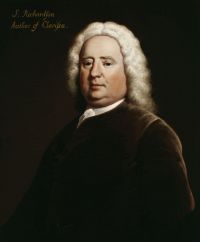 Samuel Richardson,
Clarissa Harlowe; or the history of a young lady…
Samuel Richardson,
Clarissa Harlowe; or the history of a young lady…
“ [Within parentheses let me tell thee, that I have often thought, that the little words in the republic of letters, like the little folks in a nation, are the most significant. ”
William Livingston Klein, Why We Punctuate; or, Reason Versus Rule in the Use of Marks
“ Those who adopt the English style apparently always use the commas when the matter within parentheses or brackets falls within the sentence, even though the relation between what follows and what precedes the parentheses or brackets does not require a comma. We consider such punctuation bad, for it appears to treat the matter so enclosed as both slightly and wholly parenthetical. Our next example (No. 6) , a quotation, illustrates this point.5. We do not know why “Tristam Shandy” takes marks of quotation (single marks in the example) , while the names of the other books take none. ”
William Livingston Klein, Why We Punctuate; or, Reason Versus Rule in the Use of Marks
“ The author’s main purpose in this book is to teach precision in writing; and of good writing (which, essentially, is clear thinking made visible) precision is the point of capital concern.From our point of view the principal faults of this sentence are the following:1. The and relation between the two clauses “and” here connects, is a strained one. The real relation between them would be better expressed by a period without the conjunction.2. The explanatory group of words set off by parentheses is not a parenthesis, and therefore should not be enclosed in marks of parenthesis. ”
 Edwin Abbott Abbott,
How to Write Clearly: Rules and Exercises on English Composition
Edwin Abbott Abbott,
How to Write Clearly: Rules and Exercises on English Composition
“ Parenthesis may be used with advantage to brevity.*"We are all (and who would not be?) offended at the treatment we have received," is shorter and more forcible than the sentence would have been if the parenthesis had been appended in a separate sentence: "Who, indeed, would not be offended?"Extreme care must, however, be taken that a parenthesis may not obscure the meaning of a long sentence.*56. Caution: let clearness be the first consideration.* It is best, at all events for beginners, not to aim so much at being brief, or forcible, as at being perfectly clear. ”
 Goold Brown,
The Grammar of English Grammars
Goold Brown,
The Grammar of English Grammars
“ The objective case is that form or state of a noun or pronoun which usually denotes the object of a verb, participle, or preposition: as, I know the boy, having seen him at school; and he knows me.The object of a verb, participle, or preposition, is that which answers to whom or what after it; as, "I know the boy."—I know whom? "The boy." Boy is therefore here in the objective case.The nominative and the objective of nouns, are always alike in form, being distinguishable from each other only by their place in a sentence, or by their simple dependence according to the sense. ”
Anonymous, The fourth progressive reader (1871)
“ The tone employed in reading parenthetical clauses, should, generally, be lower than that in which the other parts of the sentence are read. The monotone [41] is most suitable for parenthesis, but when inflections are used, as they sometimes are in short clauses, the inflection should be the same as that used at the pause immediately preceding the parenthesis, which is generally the rising inflection. EXAMPLES.1. Rememˊber (continued she with a sighˊ) your dearˊ absent friendˋ.2. Know then, this truthˊ, (enough for man to knowˊ,) Virtue aloneˋ is happiness belowˋ. ”
William Malone Baskervill, An English Grammar
“ See that the sentence and all its parts are placed in the natural order of subject, predicate, object, and modifiers. (2) First take the sentence as a whole; find the principal subject and principal predicate; then treat noun clauses as nouns, adjective clauses as adjectives modifying certain words, and adverb clauses as single modifying adverbs. (3) Analyze each clause as a simple sentence. For example, in the sentence, "Cannot we conceive that Odin was a reality?" we is the principal subject; cannot conceive is the principal predicate ”
William Livingston Klein, Why We Punctuate; or, Reason Versus Rule in the Use of Marks
“ The Century gives a definition that is based upon the Greek roots of the word parenthesis, as well as upon its use by good writers. According to this definition, a parenthesis has no grammatical relation with the language into which it is “put.” (The word thrust would perhaps give a clearer idea of the original.) We “parenthesize” in spoken, as well as in written or printed, language; but in the former we convey the meaning by inflections and pauses, while in the latter we convey the meaning by marks of punctuation. ”
Frederick W. Hamilton, Punctuation
“ The parenthesis, commonly used in pairs, encloses expressions which have no essential connection with the rest of the sentence, but are important to its full comprehension. It is liable to be neglected by writers because the dash is easier to make, and by printers because it is generally thought to mar the beauty of the line. ”
Frank Edgar Farley, An Advanced English Grammar with Exercises
“ The elements which make up a sentence are: (1) the simple subject; (2) the simple predicate; (3) modifiers; (4) the complements,—direct object, predicate objective, predicate adjective, predicate nominative; and (5) the so-called independent elements,—the interjection, the vocative (or nominative of direct address) , the exclamatory nominative, and various parenthetical expressions (§ 501) .449. The absolute essentials for a sentence are a substantive as subject and a verb as predicate (§ 35) . ”
Frank Edgar Farley, An Advanced English Grammar with Exercises
“ Clothes! clothes! you are always wanting clothes. Lucky she! we are all envious of her prospects. The first two sentences contain interjections (§ 372) ; the second two, vocatives (or nominatives by direct address) (§ 88, 3) ; the last three, exclamatory nominatives (§ 88, 4) .When the independent word has a modifier (as in the fifth and seventh examples) , the whole phrase may be treated as an independent element.502. A word or group of words attached to or inserted in a sentence as a mere comment, without belonging either to the subject or the predicate, is said to be parenthetical. ”
William Livingston Klein, Why We Punctuate; or, Reason Versus Rule in the Use of Marks
“ By reserving dashes for the large groups of words which are purely parenthetical in nature, but are tied to what precedes by a connective, generally a conjunction or a preposition, we do not violate the fundamental meaning of either the dash or the marks of parenthesis ”
Henry Watson Fowler, The King's English (1906)
“ If two single independent dashes are placed near each other, still more if they are in the same sentence, the reader naturally takes them for a pair constituting a parenthesis, and has to reconsider the sentence when he finds that his first reading gives nonsense. ”
William Malone Baskervill, An English Grammar
“ Since the relatives hold the sentence together, we can, by taking them out, let the sentence fall apart into three divisions: (1) "He uttered truths;" (2) "The truths wrought upon and molded the lives of the people;" (3) "These people heard him."That evidently refers to truths, consequently is neuter, third person, plural number. Who plainly stands for those or the people, either of which would be neuter, third person, plural number. Here the relative agrees with its antecedent. ”
Edwin Abbott Abbott,
How to Write Clearly: Rules and Exercises on English Composition
“ What.*—"Let me repeat that which [9] you ought to know, that that which is worth doing is worth doing well." "Let me repeat, what you ought to know, that what is worth doing is worth doing well."* (g) Omission of Relative.*—It is sometimes thought ungrammatical to omit the relative, as in "The man (that) you speak of." On the contrary, that when an object (not when a subject) may be omitted, wherever the antecedent and the subject of the relative sentence are brought into juxtaposition by the omission. ”
Brainerd Kellogg, Higher Lessons in English: A work on English grammar and composition
“ An adjective or a possessive modifier precedes its noun, and an explanatory modifier follows it.+Examples+.—Man's life is a brief span. Moses, the lawgiver, came down from the Mount.+Direction+.—Observing this order, write four sentences, two with possessive modifiers and two with explanatory, each sentence containing an adjective.The attribute complement, whether noun or adjective, follows the verb, the objective complement follows the object complement, and the indirect object precedes the direct.+Examples+.—Egypt is the valley of the Nile. Eastern life is dreamy. ”
George Carver, Writing and rewriting (1923)
“ Earn their way through college makes the assertion about Many students, and is, therefore, the predicate.Although the sentence may contain other elements, although the subject or the predicate or both may be long and complicated, and although the elements making up the subject and the predicate may be variously arranged, nevertheless every normal declarative sentence contains these two parts, and can be divided into these two parts.SubjectsThe fundamental word or element in the subject is a noun, a pronoun, a gerund, an infinitive, or a clause. [44] A noun is simply a name word. ”
“ An exclamation point is often found preceding the first mark of parenthesis.“Ay, here now! (exclaimed the Critic,) here come Coleridge’s metaphysics!”—Biographia Literaria.“I am, sir, sensible”—“Hear! Hear!” (they cheer him.) {p93}When a parenthesis occurs within a parenthesis, brackets should be substituted for the first and last parenthetic marks. ”
Samuel Kirkham, English Grammar in Familiar Lectures
“ Whoever is a compound relative; he, the antecedent part, is nominative to "will behold." Take agrees with you understood. Forsake is in the infinitive mood after "see:" Rule 25. REMARKS ON RELATIVE PRONOUNS.Which sometimes relates to a member of a sentence, or to a whole sentence, for its antecedent: as, "We are required to fear God and keep his commandments, which is the whole duty of man." What is the whole duty of man? "To fear God and keep his commandments:" therefore, this phrase is the antecedent to which. ”
R. G. Latham, The English Language
“ Every sentence wherein a relative occurs, is complex, i.e., it consists of two propositions—the man who rides is come= (1) the man is come; (2) who rides. Here the relative who has no meaning in itself, but takes a meaning from the noun of the preceding clause.2. The relative is the demonstrative or personal pronoun under another form.—The two propositions (1) the man is come; (2) who rides= (1) the man is come ”
Goold Brown,
The Grammar of English Grammars
“ This gloss therefore I wholly disapprove, judging the position more tenable, to deny, if we consequently must, that either a phrase or a participle, as such, can consistently govern the possessive case. For whatever word or term gives rise to the direct relation of property, and is rightly made to govern the possessive case, ought in reason to be a noun—ought to be the name of some substance, quality, state, action, passion, being, or thing. ”
 Stratton D. Brooks,
Composition-Rhetoric
Stratton D. Brooks,
Composition-Rhetoric
“ If the parenthetical expression is long and not very closely related to the rest of the sentence, dashes or marks of parenthesis are frequently used. Some writers use them even when the connection is somewhat close.5. The comma is frequently used to separate the parts of a long compound predicate. Pine torches have no glass to break, and are within the reach of any man who can wield an ax.6. A comma is often used to separate a subject with several modifiers, or with a long modifier, from the predicate verb. ”
Frank Edgar Farley, An Advanced English Grammar with Exercises
“ Verbs of choosing, calling, naming, making, and thinking may take two objects referring to the same person or thing.The first of these is the direct object, and the second, which completes the sense of the predicate, is called a predicate objective. We chose Oscar president. [Oscar is the direct object of chose; president is the predicate objective.] I call John my friend. They thought the man a coward. Make my house your home. The predicate objective is often called the complementary object or the objective attribute. It is classed as a complement. ”
William Malone Baskervill, An English Grammar
“ The relative what is handled differently, because it has usually no antecedent, but is singular, neuter, third person. Its case is determined exactly as that of other relatives. In the sentence, "What can't be cured must be endured," the verb must be endured is the predicate of something. What must be endured? Answer, What can't be cured. The whole expression is its subject. ”
L. P. Meredith, Every-Day Errors of Speech
“ Raise—Rise. Raise is a transitive verb, or one in which the action passes over to an object. Present tense, raise; imperfect tense and past participle, raised; present participle, raising. Rise is an intransitive verb, the action not passing over to an object. Present tense, rise; imperfect tense, rose; past participle, risen; present participle, rising. Errors in the use of these words ought to be avoided by remembering the following rules ”
George Carver, Writing and rewriting (1923)
“ The car looks cheap.He is in the house.Home is where the heart is.In these sentences, red, a house, cheap, in the house, and where the heart is, are parts of the predicate, though they characterize the subject. Such elements are called complements because they complete the assertion of the verb; if adjectives, they are called adjective [47] complements, or better, predicated adjectives; if nouns, they are called noun complements, or predicated nouns; if clauses or phrases, they are called complements, or predicated phrases or clauses. ”
W. J. Cocker, Hand-book of punctuation (1878)
“ Relative clauses are generally introduced by the relative pronouns who, which, that, or what.2. A comma should be placed before the relative clause, even when it is necessary to complete the meaning of the antecedent,— a. When the relative is immediately followed by a word or an expression inclosed in commas; as, “As a man, he may not have deserved the admiration which he [9] received from those, who, bewitched by his fascinating society, worshiped him nightly in his favorite temple at Button’s.”—Macaulay. ”
Lillian Kimball, The structure of the English sentence (1900)
“ Function.—When we wish to assert that a thing possesses a certain quality, we do it by a predicate made up of some form of the verb be together with an adjective; as in the sentence, “The very name was uncanny.”—Page. Here the idea words are the subject noun and the adjective in the predicate; the verb was serves merely as a copula, or tie-word, necessary for the grammatical structure of the sentence, but having little, if any, meaning. ”
 George Martin Lane,
A Latin Grammar for Schools and Colleges
George Martin Lane,
A Latin Grammar for Schools and Colleges
“ In a main sentence, the indicative present, future, and future perfect, and the imperative, are called Primary Tenses; the indicative imperfect, historical perfect, and pluperfect, and the infinitive of intimation, are called Secondary Tenses. The perfect definite and the present of vivid narration are sometimes regarded as primary tenses, oftener as secondary tenses. ”
Thomas Wood, Practical Grammar and Composition
“ In the sentence, The man that I mentioned has come, the relative clause, that I mentioned, is an adjective clause modifying man. In the sentence, Whom she means, I do not know, the relative clause is, whom she means, and is a noun clause forming the object of the verb know. Page 18 The relative pronouns are who (whose, whom) , which, that and what. But and as are sometimes relative pronouns. There are, also, compound relative pronouns, which will be mentioned later. 24. Who (with its possessive and objective forms, whose and whom) should be used when the antecedent denotes persons. ”
Nugent Robinson, Collier's Cyclopedia of Commercial and Social Information (1882)
“ In the expression, "to take for granted," we have a participle attached to a verb by means of a preposition, as an object needful to complete it; and the next group shows two nouns, "talk and discourse," combined by the conjunction "and," so as to spare the repetition of the verb "to find," to which they both serve as "objects." ”
Frank Edgar Farley, An Advanced English Grammar with Exercises
“ Substantives enable us to name or designate persons, places, or things, and verbs enable us to make statements about them. Both substantives and verbs, then, are absolutely necessary in framing sentences. Without a substantive, there can be no subject; without a verb, there can be no predicate: and both a subject and a predicate, as we have seen, are needed to make a sentence. ”
