Modifier

Definition and stakes

Brainerd Kellogg,  Graded Lessons in English

“ As all modifiers are joined by slanting lines, to the words they modify, you learn from this diagram that who is wise is a modifier of man.
+Oral Analysis+.—This is a complex sentence, because it consists of an independent clause and a dependent clause. A man will be honored is the independent clause; who is wise is the dependent clause. Man is the subject of the independent clause; will be honored is the predicate. The word A and the clause, who is wise, are modifiers of the subject. A points out man, and who is wise tells the kind of man. A man who is wise is the modified subject
”
Source: Gutenberg

Frank Edgar Farley,  An Advanced English Grammar with Exercises

“ The topics will be taken up in the following order:— (1) modifiers,—of the subject, of the predicate; (2) complements; (3) modifiers of complements; (4) modifiers of modifiers.
463. A word or group of words that changes or modifies the meaning of another word is called a modifier (§ 19) .
{Men | Able men | Men of ability} can always find employment. {Walls | Battlemented walls | Walls with battlements} usually enclosed mediæval cities. {Cottages | English cottages | Cottages in England} are often thatched.
”
Source: Gutenberg

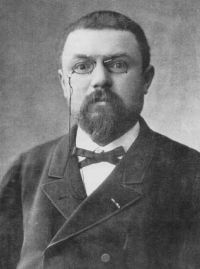
Portrait of Henri Poincaré Henri Poincaré,  Science and Hypothesis (1905)

“ We see at first that our impressions are subject to change; but among the changes that we ascertain, we are very soon led to make a distinction. Sometimes we say that the objects, the causes of these impressions, have changed their state, sometimes that they have changed their position, that they have only been displaced. Whether an object changes its state or only its position, this is always translated for us in the same manner, by a modification in an aggregate of impressions. ”
Source: Wikisource

Get perspective with Kwize: daily news enlightened by great literature