Perfect participle

Definition and stakes

Samuel Kirkham,  English Grammar in Familiar Lectures

“ A participle with its adjuncts, may sometimes be considered as a substantive or participial phrase, which phrase may be the subject of a verb, or the object of a verb or preposition; as, "Taking from another without his knowledge or assent, is called stealing; He studied to avoid expressing himself too severely; I cannot fail of having money, &c.; By promising much and performing but little, we become despicable."
3. As the perfect participle and the imperfect tense of irregular verbs, are sometimes different in their form, care must be taken that they be not indiscriminately used.
”
Source: Gutenberg

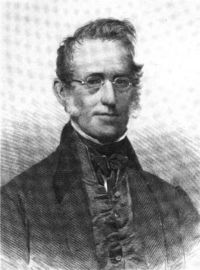
Portrait of Goold Brown Goold Brown,  The Grammar of English Grammars (1882)

“ The adjective or participle that follows, always relates to the preceding objective; and if a noun is used, it is but an other objective in apposition with the former: as, "I considered it an imposition." The verb to be, with the perfect participle, forms the passive infinitive; and the supposition of such an ellipsis, extensively affects one's mode of parsing. ”
Source: Wikisource

Portrait of Goold Brown Goold Brown,  The Grammar of English Grammars (1882)

“ Understood is a perfect participle, from the irregular active-transitive verb, understand, understood, understanding, understood. 1. A participle is a word derived from a verb, participating the properties of a verb, and of an adjective or a noun; and is generally formed by adding ing, d, or ed, to the verb. 2. The perfect participle is that which ends commonly in ed or en, and implies a completion of the being, action, or passion. ”
Source: Wikisource

Get perspective with Kwize: daily news enlightened by great literature