Alexander Pope,
The Dunciad
(1743)
Alexander Pope,
The Dunciad
(1743)
“ Poetic Justice, with her lifted scale,Where, in nice balance, truth with gold she weighs,And solid pudding against empty praise. ”
Alexander Pope,
The Dunciad
(1743)
“ Poetic Justice, with her lifted scale,Where, in nice balance, truth with gold she weighs,And solid pudding against empty praise. ”
William Rounseville Alger, The Destiny of the Soul: A Critical History of the Doctrine of a Future Life
“ As an ethical scheme clearing up on principles of poetic justice the most perplexed and awful problems in the world, it throws streams of light through the abysses of evil, gives dramatic solution to many a puzzle, and, abstractly considered, charms the understanding and the conscience. ”
 Frances Chamberlaine Sheridan,
Memoirs of Miss Sidney Biddulph
Frances Chamberlaine Sheridan,
Memoirs of Miss Sidney Biddulph
“ I say therefore, I do not take upon me to defend an opposite conduct upon principles of poetic justice, but surely the poet who prefers that course, may be justified in it from every day’s experience. If we always saw virtuous people successful in their pursuits, and their days crowned with prosperity, there would be more force in your objection; but the direct contrary is a truth, which every body who has lived but a moderate number of years, must have been convinced of from their own observation. ”
Porter Lander MacClintock, Literature in the Elementary School
“ Logical justice—the natural, uninterrupted working of the forces and motives to a conclusion, or to their absorption into a new combination—is both too slow and not striking enough. Besides, logical justice, working in its impersonal, [Pg 74] undiscriminating way, is too likely to hurt someone in the piece whom we love, or to spare somebody we hate. In short, your elementary class demands poetic justice—demands it strong and desires it quick. Now, poetic justice is, on the whole, the way of art, until we come practically to the realistic art of our own generation. ”
Porter Lander MacClintock, Literature in the Elementary School
“ To guard against these effects we should see to it that the children do not have an unduly large amount of literature; and we should select those stories in which the operation of poetic justice is as little misleading as possible. Poetic justice may be, and usually is, an ideal, an artistic distribution of rewards and punishments ”
The World's Best Poetry, Volume 08…
“ The other parallels the actual with a suggestion of an ideal rhythmically consonant with the motive underlying the fact. Justice, for example, deals in prose fashion with a crime and awards the punishment which the law allows; poetic justice suggests such recompense as would come of itself in a community perfectly organized. The prose of life is honest living, a worthy endeavor to do the best one can in the world as it is; the poetry of life is the feeling for, and the striving after, the bringing of this life into harmony with a nobler living. ”
Baron Edward Bulwer Lytton Lytton, The Last of the Barons — Complete
“ Out, then, upon that vulgar craving of those who comprehend neither the vast truths of life nor the grandeur of ideal art, and who ask from poet or narrator the poor and petty morality of “Poetical Justice,”—a justice existing not in our work-day world ”
 Samuel Johnson,
Johnson's Lives of the Poets — Volume 1
Samuel Johnson,
Johnson's Lives of the Poets — Volume 1
“ He then condemns the neglect of poetical justice, which is one of his favourite principles:—“’Tis certainly the duty of every tragic poet, by the exact distribution of poetical justice, to imitate the Divine Dispensation, and to inculcate a particular Providence. ’Tis true, indeed, upon the stage of the world, the wicked sometimes prosper and the guiltless suffer ”
 George Alfred Townsend,
The Entailed Hat; Or, Patty Cannon's Times
George Alfred Townsend,
The Entailed Hat; Or, Patty Cannon's Times
“ We can look for but little from the aged, who have been accustomed to these things, like second nature. Without justice there can be no virtue. Oh, justice, justice, how art thou abused everywhere! Men make justice, like a nose of wax, to satisfy their desires. ”
 Charles Kingsley,
The Saint's Tragedy
Charles Kingsley,
The Saint's Tragedy
“ No nice adjustments of success and failure to right and wrong must constitute its poetical justice; the conscience of the readers must be satisfied in some deeper way than this, that there is an order in the universe, and that the poet has perceived and asserted it. ”
 Percy Bysshe Shelley,
The Complete Poetical Works of Percy Bysshe Shelley…
Percy Bysshe Shelley,
The Complete Poetical Works of Percy Bysshe Shelley…
“ I have sought to enlist the harmony of metrical language, the ethereal combinations of the fancy, the rapid and subtle transitions of human passion, all those elements which essentially compose a Poem, in the cause of a liberal and comprehensive morality; and in the view of kindling within the bosoms of my readers a virtuous enthusiasm for those doctrines of liberty and justice, that faith and hope in something good, which neither violence nor misrepresentation nor prejudice can ever totally extinguish among mankind. ”
 Victor Cousin,
Lectures on the true, the beautiful and the good
Victor Cousin,
Lectures on the true, the beautiful and the good
“ What can be the principle of intellectual beauty, that splendor of the true, except the principle of all truth?Moral beauty comprises, as we shall subsequently see, [110] two distinct elements, equally but diversely beautiful, justice and charity, respect and love of men. He who expresses in his conduct justice and charity, accomplishes the most beautiful of all works; the good man is, in his way, the greatest of all artists. But what shall we say of him who is the very substance of justice and the exhaustless source of love? ”
Donald G. French, Highways of Canadian Literature
“ But if one elects the office of poet, then to perfect oneself, as far as possible, in poetic artistry for the sake of beautifully or compellingly embodying in verse whatsoever is lovely in Nature or noble in ideas, is to attain to high moral dignity in one’s own soul as a poet and to impress on the world the high spiritual function of poetry. ”
Albert Mordell, The Literature of Ecstasy
“ No literature that is heartless or brutal, or confuses an appeal to the murderous instincts with real love of country, or love of liberty, with self-sacrifice for justice or loved ones, can be valuable to us either practically or aesthetically. ”
 Walter Pater,
Appreciations, with an Essay on Style
Walter Pater,
Appreciations, with an Essay on Style
“ It is not always that poetry can be the exponent of morality; but it is this aspect of morals which it represents most naturally, for this true justice is dependent on just those finer appreciations which poetry cultivates in us the power of making, those peculiar valuations of action and its effect which poetry actually requires. ”
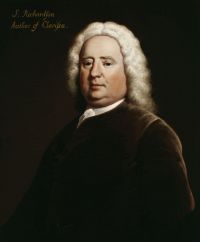 Samuel Richardson,
Clarissa: Preface, Hints of Prefaces…
Samuel Richardson,
Clarissa: Preface, Hints of Prefaces…
“ And shall man, presuming to alter the common course of nature, and, so far as he is able, to elude the tenure by which frail mortality indispensibly holds, imagine, that he can make a better dispensation; and by calling it Poetical Justice, indirectly reflect on the Divine?'The more pains have been taken to obviate the objections arising from the notion of Poetical Justice, as the doctrine built upon it had obtained general credit among us; and as it must be confessed to have the appearance of humanity and good-nature for its supports. ”
 Ralph Waldo Emerson,
Essays by Ralph Waldo Emerson
Ralph Waldo Emerson,
Essays by Ralph Waldo Emerson
“ Thou art not Being, as Truth is, as Justice is,—thou art not my soul, but a picture and effigy of that. Thou hast come to me lately, and already thou art seizing thy hat and cloak. It is not that the soul puts forth friends, as the tree puts forth leaves, and presently, by the germination of new buds, extrudes the old leaf? ”
 Mathilde Blind,
Madame Roland
(1886)
Mathilde Blind,
Madame Roland
(1886)
“ Yet, though we must admit many of his premises to be false and many of his arguments shallow, his conclusion is neverthless in harmony with the highest conception of justice—justice which, like music, has its origin in the soul of man only, the most purely human of the virtues, and which is the goal towards which society is slowly and painfully working its way. ”
Judith Drake, An Essay in Defence of the Female Sex (1696)
“ In this Capacity he is as just to the World as in the other Injurious. For as the Critick wrong’d ev’ry Body in his Censure, and snarl’d, and grin’d at their Writings, the Poet gives ’em Opportunity to do themselves Justice, to return the Compliment and laugh at or despise his. ”
 Johann Wolfgang von Goethe,
The Autobiography of Goethe
Johann Wolfgang von Goethe,
The Autobiography of Goethe
“ May the literary-artistical undertakings of this kind be duly patronized by all who have power, wealth, and influence, that the great and gigantic views of our forefathers may be presented to our contemplation, and that we may be able to form a conception of what they dared to desire. The insight resulting from this will not remain fruitless, and the judgment will, for once at least, be in a condition to exercise itself on these works with justice. ”
 Ainsworth Rand Spofford,
A Book for All Readers
Ainsworth Rand Spofford,
A Book for All Readers
“ But some faint idea of it may be gained from the wondrous stimulus given through them to the imaginative power, and from the fact that those sentiments of human sympathy, justice, virtue, and freedom, which inspire the best poetry of all nations, become sooner or later incarnated in their institutions. ”
Henry Norman Hudson, Shakespeare: His Life, Art, And Characters…
“ For a poet has a right to the benefit of being tried by the moral sense and reason of mankind: it is indeed to that seat of judgment that every great poet virtually appeals; and the verdict of that tribunal must be an ultimate ruling to us as well as to him.But one of the first things to be considered here is the natural relation of Morality to Art. Now I believe Art cannot be better defined than as the creation or the expression of the Beautiful. And truth is the first principle of all Beauty. ”
Walter Pater,
Appreciations, with an Essay on Style
“ But at bottom rights are equivalent to that which really is, to facts; and the recognition of his rights therefore, the justice he requires of our hands, or our thoughts, is the recognition of that which the person, in his inmost nature, really is; and as sympathy alone can discover that which really is in matters of feeling and thought, true justice is in its essence a finer knowledge through love. ”
vicomte de Eugène-Melchior Vogüé, The Russian novelists (1887)
“ Not one of these novelists aims merely at literary fame, but all are governed by a love of truth as well as of justice,—a combination of great importance, and well worth our serious reflection, betraying and explaining to us, moreover, the philosophical conceptions of this race. ”
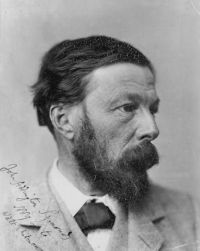 John Addington Symonds,
Renaissance in Italy, Volume 4…
John Addington Symonds,
Renaissance in Italy, Volume 4…
“ All times, ages, countries, races of men are alike before the tribunal of God's justice. Accordingly, the poet who had taken man's moral nature for his theme, and was bound by his theory to present this theme symbolically, could bring to view a multitude of concrete persons, arranged (whatever else may issue from their converse with the protagonist) according to gradations of merit or demerit. ”
 George Augustus Sala,
Twice round the clock; or, The hours of the day and night in London
(1862)
George Augustus Sala,
Twice round the clock; or, The hours of the day and night in London
(1862)
“ In dramas, I declare and maintain, in which, for all the jargon, silliness, and buffoonery, the immutable principles of right and justice are asserted; in which virtue, in the end, is always triumphant, and vice is punished; in which cowardice and falsehood are hissed, and bravery and integrity vehemently applauded; in which, were we to sift away the bad grammar, and the extravagant action, we should find the dictates of the purest and highest morality. ”
Philip H. Wicksteed, Dante: Six Sermons
“ Literally it is 'The state of souls after death,' and allegorically 'Man, as rendering himself liable to rewarding or punishing justice, by good or ill desert in the exercise of his free will.' The ideal requirements of Divine Justice, then, form the central subject of this poem, the one theme to which, amidst infinite diversity of application, the poet remains ever true; and these requirements he works out in detail and enforces with all the might, the penetration, the sweetness of his song, under the conditions of mediæval belief as to the future life. ”
 Friedrich Nietzsche,
Richard Wagner in Bayreuth
(1909)
Friedrich Nietzsche,
Richard Wagner in Bayreuth
(1909)
“ When love and justice have become powerful in one department of life, namely in art, they must, in accordance with the law of their inner being, spread their influence around them, and can no more return to the stiff stillness of their former pupal condition. ”
“ In the personages which illustrate the different virtues, Holiness, Justice, Courtesy, and the rest, the distinction is not in nicely discriminated features or shades of expression, but in the trials and the occasions which call forth a particular action or effort: yet the manliness which is at the foundation of all that is good in them is a universal quality common to them all, rooted and imbedded in the governing idea or standard of moral character in the poem. It is not merely courage, it is not merely energy, it is not merely strength. ”
 William Wordsworth,
Poems
(1815)
William Wordsworth,
Poems
(1815)
“ Is it the result of the whole that, in the opinion of the Writer, the judgment of the People is not to be respected? The thought is most injurious; and could the charge be brought against him, he would repel it with indignation. The People have already been justified, and their eulogium pronounced by implication, when it was said, above—that, of good Poetry, the individual, as well as the species, survives. And how does it survive but through the People? what preserves it but their intellect and their wisdom? ”
Baron Thomas Babington Macaulay Macaulay, Critical and Historical Essays…
“ Poetry inflamed the passions; philosophy undermined the principles; divinity itself, inculcating an abject reverence for the Court, gave additional effect to the licentious example of the Court. We look in vain for those qualities which lend a charm to the errors of high and ardent natures, for the generosity, the tenderness, the chivalrous delicacy, which ennoble appetites into passions, and impart to vice itself a portion of the majesty of virtue. ”
Mrs. Hemans, The Poems of Felicia Hemans
“ To demand that what is called poetical justice should be found in every performance may be unreasonable, since the events of life do not warrant us in expecting it; but we may demand what is of much more importance, moral justice—a consistency of character, a conformity of the mind to its career of action. ”
 Friedrich Schiller,
The Works of Frederick Schiller
Friedrich Schiller,
The Works of Frederick Schiller
“ In consequence of the remarkable catastrophe which ends my play, I may justly claim for it a place among books of morality, for crime meets at last with the punishment it deserves; the lost one enters again within the pale of the law, and virtue is triumphant. Whoever will but be courteous enough towards me to read my work through with a desire to understand it, from him I may expect—not that he will admire the poet, but that he will esteem the honest man. ”
Baron Edward Bulwer Lytton Lytton, The Disowned — Complete
“ I looked round the world, and saw often Virtue in rags and Vice in purple: the former conduces to happiness, it is true, but the happiness lies within and not in externals. I contemned the deceitful folly with which writers have termed it poetical justice to make the good ultimately prosperous in wealth, honour, fortunate love, or successful desires. Nothing false, even in poetry, can be just ”
 Henry Osborn Taylor,
The Mediaeval Mind (Volume 2 of 2…
Henry Osborn Taylor,
The Mediaeval Mind (Volume 2 of 2…
“ He knows his good unbending temper which will not endure to hear ill spoken of the upright. But he thinks, what is the use? why speak so sweetly, why sing, when virtue and beauty are so lightly held, and every one does evil, fearing nought? The verse which carries these reflections is tossing in the squally haven of Society; soon the poet will encounter the wild sea without. ”
Various, The Catholic World, Vol. 15, Nos…
“ And what is goodness but the perfection of the heart? In the scheme of ethics, vice is ugliness, error a discord, and weakness disproportion, character means equipoise, and virtue expresses harmony. But how shall art or ethics discern a moral symmetry, and crown a spiritual perfection, without a right conception of man’s nature, of his place and purpose, his relation to the universe and to God? So far as he portrays the heart, the poet must be a moralist. Within this domain the truest art will utter the purest morals. ”
Henry Norman Hudson, Shakespeare: His Life, Art, And Characters…
“ Such is the right form, such the normal process, of what may be called intellectual and artistic righteousness. A soul of perfect veracity lies at the bottom of the thing, and is the source and the life of all that is good and beautiful in it. ”
Lyons McLeod, Travels in Eastern Africa, volume 2…
“ A high, pure tone of morality pervades each set of verses, and each strikes the reader as inspired by some real event, or condition of mind, and not by some idle fancy or fleeting sentiment.”—Spectator. ”
Mrs. Sutherland Orr, A Handbook to the Works of Browning…
“ Your nature, too, is kingly." She concludes with a tribute to the "Poet's Power," which is one with creative law, above and behind all potencies of heaven and earth; and to that inherent royalty of truth, in which alone she could venture to approach one so great as he. He too, as poet, must reign by truth, if he assert his proper sway. ”
Sir Nizamat Jung, Sonnets by the Nawab Nizamat Jung Bahadur
“ His love of poetry and history, if on the one hand it has intensified his realisation of the sorrows and tragedies of earthly life, on the other hand has equipped him with a power to awake in others a vivid consciousness of the moral value of literature,—through which (for the mere asking) we any of us can find our way into a kingdom of great ideas. ”
 PlatoVictor CousinPhilip H. WicksteedAlexander PopeBaron Edward Bulwer Lytton LyttonPorter Lander MacClintockWalter PaterCharles KingsleyGeorge Alfred TownsendWilliam Rounseville AlgerSamuel JohnsonDonald G. FrenchAlbert MordellSamuel RichardsonRalph Waldo EmersonMathilde BlindPercy Bysshe ShelleyFrances Chamberlaine SheridanJohann Wolfgang von GoetheJudith Drake