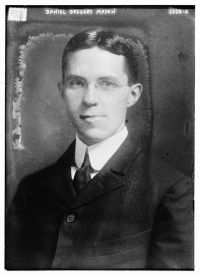
“ I call this form the duocapet because it is, in a sense, double-headed, having two rhyming words in every line—one at each end. I have discarded rhythm but retained rhyme. I had good reasons for adopting this course. I regard meter as a useless encumbrance. It is meter, not rhyme, which hampers the true poet. The poet should be free—free as the air—free as the birds. It is a crime against art to bind him with silly meaningless meters and rhythms which distract his attention from his theme and serve only to furnish critics with an excuse for picking flaws. ”
Poetic meter
Definition and stakes
Quotes about “poetic meter”
William Wordsworth,
Lyrical Ballads, with Other Poems…
“ If it be affirmed that rhyme and metrical arrangement of themselves constitute a distinction which overturns what I have been saying on the strict affinity of metrical language with that of prose, and paves the way for other distinctions which the mind voluntarily admits, I answer that the distinction of rhyme and metre is regular and uniform, and not, like that which is produced by what is usually called poetic diction, arbitrary and subject to infinite caprices upon which no calculation whatever can be made. ”
S. S. Curry,
Browning and the Dramatic Monologue
“ Metre is a difficult subject in which to lay down general principles, lest they become artificial rules. Every poem that is really great shows something new in the way of combining imperfect feet, and the student must study the movement for himself.Many will be tempted to ask, “What has metre to do with the monologue?” It is true that metre belongs to all poetry, but the monologue has some specific and peculiar uses of metre, and, more than any other form of poetry except the poetic drama, demands the living voice. ”
Bliss Perry,
A Study of Poetry
“ In modern prosody the arrangement of the rhymes and the length of the lines in any rhymed metrical passage may be determined either by a fixed stanzaic law, or by a law infinitely deeper—by the law which impels the soul, in a state of poetic exultation, to seize hold of every kind of metrical aid, such as rhyme, caesura, etc., for the purpose of accentuating and marking off each shade of emotion as it arises, regardless of any demands of stanza.... If a metrical passage does not gain immensely by being written independently of stanzaic law, it loses immensely ”
James Douglas, Theodore Watts-Dunton: Poet, Novelist…
“ It must, in a word, have all the qualities of what we technically call poetry except metre. We have, indeed, said before that while the poet’s object is to arouse in the listener an expectancy of cæsuric effects, the great goal before the writer of poetic prose is in the very opposite direction; it is to make use of the concrete figures and impassioned diction that are the poet’s vehicle, but at the same time to avoid the expectancy of metrical bars. The moment that the regular bars assert themselves and lead the reader’s ears to expect other bars of the like kind, sincerity ends. ”
Edward Albert,
A history of English literature
(1923)
“ His meter is among the most discussed in our literature. Its merits and demerits are quite clear to view. Against it we can urge its artificiality, its lack of originality, and the vile creeping paralysis that it communicated to the other metrical forms. Yet in its favor we must recognize its strength, unbreakable and pliable, like a strong bow, its clearness, point, and artistic brevity, and its incomparable excellence in some forms of satire and narrative. It is unprofitable to compare it with blank verse and other forms. We must recognize it as in a class apart. ”
S. S. Curry,
Browning and the Dramatic Monologue
“ One aid in realizing metre as an element of expression is to examine a poem printed as prose and attempt to discover the peculiar value and force of the metric forms, length of lines, length of the stanzas, and even the rhymes. All these in a true poem are expressive. There is nothing really artificial or accidental in a true poetic or artistic form. ”
Robert Browning,
Selections from the Poems and Plays of Robert Browning
“ But a poet has a right of appeal to the sum of his manifest excellencies rather than to his defects, and if we take Browning's best work we find a harmony of movement superior in musical effect to a more technically regular meter. In many poems the meter is indissolubly fused with the pictures, the ideas, the events. Take, for instance, "The Pied Piper of Hamelin," where the hurry-skurry of the verse is in complete harmony with the quaint, rapid tale. The hoof-beats of galloping horses is heard all through "How They Brought the Good News from Ghent to Aix." ”
Raymond MacDonald Alden, English Verse: Specimens Illustrating its Principles and History
“ Metre, therefore, having been connected with poetry most often, and by a peculiar fitness, whatever else is combined with metre must, though it be not itself essentially poetic, have nevertheless some property in common with poetry, as an intermedium of affinity. (Coleridge: Biographia Literaria, chap. xviii.) In the youth of the world, men dance and sing and imitate natural objects, observing in these actions, as in all others, a certain rhythm or order. ”
Charles Herbert Sylvester, Journeys Through Bookland, Vol…
“ At first you will probably accent the syllables too strongly, and then people will say that you are reading in a sing-song way, a thing to be avoided. Of course you will understand that the only way to bring out the meter of a poem is to read it aloud, but after you have become familiar with the various meters and have read aloud a great deal, you will be conscious of the rhythm when you read to yourself. It is this consciousness of rhythm that gives much of the enjoyment to those who love poetry, even when they do not read it aloud. ”
Rabindranath Tagore,
Glimpses of Bengal
“ Thus bondage creates beauty of form, motion, and music; bounds make not only for beauty but power. Poetry gives itself up to the control of metre, not led by blind habit, but because it thus finds the joy of motion. There are foolish persons who think that metre is a species of verbal gymnastics, or legerdemain, of which the object is to win the admiration of the crowd. That is not so. Metre is born as all beauty is born the universe through. The current set up within well-defined bounds gives metrical verse power to move the minds of men as vague and indefinite prose cannot. ”
Gilbert Norwood, Greek tragedy (1920)
“ METRE AND RHYTHM IN GREEK TRAGEDY § I. IntroductionPoetry is illuminating utterance consisting of words the successive sounds of which are arranged according to a recurrent pattern. The soul of poetry is this illumination, its body this recurrent pattern of sounds; and it is with the body that we are now to deal. At the outset we must distinguish carefully between rhythm and metre. Rhythm is the recurrence just mentioned—the structure; metre is the gathering together of sounds into masses upon which rhythm shall do its work. Metre, so to put it, makes the bricks, while rhythm makes the arch. ”
Friedrich Nietzsche,
HUMAN, ALL TOO HUMAN, 'A Book For Free Spirits' Part I
(1909)
“ HOW METER BEAUTIFIES.— Meter casts a veil over reality [See: Goethe to Schiller, May 5, 1798.] ; it causes various artificialities of speech and obscurities of thought; by the shadow it throws upon thought it sometimes conceals it, and sometimes brings it into prominence. As shadow is necessary to beauty, so the “dull" is necessary to lucidity. Art makes the aspect of life endurable by throwing over it the veil of obscure thought. ”
John William Mackail,
The Life of William Morris
(1899)
“ To make the different planes of action distinct, each has its own metre. These metres are the short octosyllabic couplet, the heroic decasyllable, the alliterative unrhymed verse of the body of the play, and, for the "Music," an exquisite invention of rhymed dactylics. The way in which they are interwoven is a masterpiece of metrical device. In the two scenes of the induction (to use the appropriate term of the Renaissance dramatists) the ground is laid of the whole metrical system of the poem; in the first scene by a single phrase of the Music ”
S. S. Curry,
Browning and the Dramatic Monologue
“ The sublimer the poem, the painting, or any work of art, the more will the smallest detail be consistent with the whole and a necessary part of the expression.Metre has been studied too much as a matter of print. Few recognize the fact that metre is necessarily a part of vocal rather than of verbal expression, and can only be suggested in print.Metre can be revealed only by the human voice. As a printed word is only a sign, so print can afford a hint only of the nature of metre. Its study, accordingly, must be associated with the living voice and the vocal interpretation of literature. ”
H. P. Lovecraft,
Metrical Regularity
“ What the radicals so wantonly disregard in their eccentric performances is unity of thought. Amidst their wildly repeated leaps from one rough metre to another, they ignore the underlying uniformity of each of their poems. Scene may change; atmosphere may vary; yet one poem cannot carry but one definite message, and to suit this ultimate and fundamental message but one metre must be selected and sustained. To accommodate the minor inequalities of tone in a poem, one regular metre will amply lend itself to diversity. ”
Arthur Schopenhauer,
The World as Will and Representation…
“ Metre and rhyme are a fetter, but also a veil which the poet throws round him, and under which he is permitted to speak as he otherwise dared not do; and that is what gives us pleasure. He is only half responsible for all that he says; metre and rhyme must answer for the other half. Metre, or measure, as mere rhythm, has its existence only in time, which is a pure perception a priori, thus, to use Kant s language, belongs merely to pure sensibility; rhyme, on the other hand, is an affair of sensation, in the organ of hearing, thus of empirical sensibility. ”
William Wordsworth,
Poems
(1815)
“ This is unquestionably true, and hence, though the opinion will at first appear paradoxical, from the tendency of metre to divest language in a certain degree of its reality, and thus to throw a sort of half consciousness of unsubstantial existence over the whole composition, there can be little doubt but that more pathetic situations and sentiments, that is, those which have a greater proportion of pain connected with them, may be endured in metrical composition, especially in rhyme, than in prose. The metre of the old ballads is very artless ”
Theodor Nöldeke,
1911 Encyclopædia Britannica
(1911)
“ It is a phenomenon which deserves the fullest recognition, that the needy inhabitants of a barren country should thus have produced an artistic poetry distinguished by so high a degree of uniformity. Even the extraordinary strict metrical system, observed by poets who had no inkling of theory and no knowledge of an alphabet, excites surprise. In the most ancient poems the metrical form is as scrupulously regarded as in later compositions. The only poem which shows unusual metrical freedom is the above-mentioned song of ‛Abīd. ”
Various, Popular Science Monthly (1893)
“ Thus poetry, which was at first merely the spontaneous rhythmic expression of excited feeling, with little restraint of law and almost unlimited license, is modulated at last to the stringent requirements of exact meter, a prescribed sequence of feet, and the artifice of terminal rhyme. The interval between the first wild lyric of prehistoric man and the chastened symmetry of the modern sonnet is measured by the whole diameter of human culture. ”
Walter Pater,
Appreciations, with an Essay on Style
“ The music of mere metre performs but a limited, yet a very peculiar and subtly ascertained function, in Wordsworth's poetry. With him, metre is but an additional grace, accessory to that deeper music of words and sounds, that moving power, which they exercise in the nobler prose no less than in formal poetry. ”
Raymond MacDonald Alden, English Verse: Specimens Illustrating its Principles and History
“ Why do we so often find men in these days, either using metre ... where they ought to have expressed themselves in prose, or expressing themselves in verse in a style so far remote from the standard of diction established in society that they fail to touch the heart? I think the explanation of this curious phenomenon is that, though metre can only properly be used for the expression of universal ideas, there is in modern society an eccentric or monastic principle at work, which leads men to pervert metre into a luxurious instrument for the expression of merely private ideas. ”
Aristotle,
The Poetics of Aristotle
“ On the same principle, even if a writer in his poetic imitation were to combine all metres, as Chaeremon did in his Centaur, which is a medley composed of metres of all kinds, we should bring him too under the general term poet. So much then for these distinctions. There are, again, some arts which employ all the means above mentioned, namely, rhythm, tune, and metre. Such are Dithyrambic and Nomic poetry, and also Tragedy and Comedy ”
Algernon Charles Swinburne,
Essays and Studies
(1875)
“ His plastic power and flexible charm of verse, though shown only in short flashes of song, lose nothing of the old freshness and life. To the end he was the same whose "sovereign sway and masterdom" of music could make sweet and strong even the feeble and tuneless form of metre called hexameters in English; if form of metre that may be called which has neither metre nor form. But the majestic rush and roll of that irregular anapæstic measure used once or twice by this supreme master of them all, no student can follow without an exultation of enjoyment. ”
Edwin Abbott Abbott,
How to Write Clearly: Rules and Exercises on English Composition
“ Metre is the subject of the Third Part. The object of this Part (as also, in a great measure, of the Chapter just mentioned belonging to the Second Part) is to enable the pupil to read English Poetry with intelligence, interest, and appreciation. To teach any one how to read a verse so as to mark the metre on the one hand, without on the other hand converting the metrical line into a monotonous doggerel, is not so easy a task as might be supposed. Many of the rules stated in this Part have been found of practical utility in teaching pupils to hit the mean. ”
Horatio Winslow, Rhymes and Meters
“ In taking up verse writing the student must solemnly resolve on one thing: to consider no composition complete until it proves up—until the rhymes and meter are perfect. This “perfection” is not as unattainable as it sounds, for the laws of rhyme and meter are as fixed as the laws of the Medes and the Persians. Any one may not be able to write artistic verse, but any one can write true verse, and the only way to make a course in verse writing count is to live up to all the rules ”
Horatio Winslow, Rhymes and Meters
“ The great poet can bend any meter or stanza form to his use, as witness Thomas Hood with his galloping stanzas in the “Bridge of Sighs,” but an ordinary mortal must produce his effects more obviously. The greater skill one has the greater liberties one can take in his choice of materials, just as a clever after-dinner speaker may say many things which from a less tactful person would be deemed offensive. ”
William Wordsworth,
Lyrical Ballads
(1800)
“ To this it will be answered, that a very small part of the pleasure given by Poetry depends upon the metre, and that it is injudicious to write in metre unless it be accompanied with the other artificial distinctions of style with which metre is usually accompanied, and that by such deviation more will be lost from the shock which will be thereby given to the Reader's associations than will be counterbalanced by any pleasure which he can derive from the general power of numbers. ”
Georg Wilhelm Friedrich Hegel,
The Philosophy of Fine Art, volume 4…
“ I will, in conclusion, add merely a word or two on the point of verse-measure. Dramatic metre is best when it lies midway between the tranquil, uniform flow of the hexameter and the more interrupted and split-up syllabic metres congenial to the Lyric. In this respect the iambic metre is above all others commendable. For the iambus, with the rhythm of its onward movement, which may be either accelerate [Pg 270] d by anapaests, or be made more solemn and weighty with the spondee, forms a most fitting accompaniment to the march of the action ”
I. A. Richards,
Principles of literary criticism
(1928)
“ As with rhythm so with metre, we must not think of it as in the words themselves or in the thumping of the drum. It is not in the stimulation, it is in our response. Metre adds to all the variously fated expectancies which make up rhythm a definite temporal pattern and its effect is not due to our perceiving a pattern in something outside us, but to our becoming patterned ourselves. With every beat of the metre a tide of anticipation in us turns and swings, setting up as it does so extraordinarily extensive sympathetic reverberations. ”