Poke bonnet

Definition and stakes

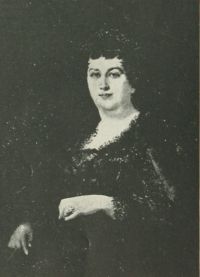
Portrait of Richard Dehan Richard Dehan,  Off Sandy Hook, and other stories

“ And because blushes—I speak on the most reliable authority—are more difficult to simulate than tears. Also because, looking down the pink silk-lined tunnel of the poke-bonnet of 1855–66, it was impossible for you, as an ordinary male creature, to decide whether the rosy glow invading the features of the woman you adored—we adored women, dear fellows, at that period—was genuine or the reverse. There you have in a nutshell the reason why the poke-bonnet was not welcomed at the dawn of the twentieth century. Modesty and blushes, dear fellers, are out of date. ”
Source: Gutenberg

1911 Encyclopædia Britannica, Volume 21… (1911)

“ Eng. as poket, and is taken from a Norman diminutive of O. Fr. poke, pouque, mod. poche, cf. “pouch.” The form “poke” is now only used dialectically, or in such proverbial sayings as a “pig in a poke,” and possibly in the “poke-bonnet,” the coal-scuttle bonnet fashionable during the first part of the 19th century, and now worn by the female members of the Salvation Army; more probably the name of the bonnet is connected with “poke,” to thrust forward, dig. The origin of this is obscure. Dutch has poken, pook, a dagger ”
Source: Wikisource

A. F. R. Wollaston,  Pygmies & Papuans: The Stone Age To-day in Dutch New Guinea

“ The best dressed, or in any case the most dressed, members of the community are the widows, who wear, in addition to the other articles of female attire, what can only be described as a poke bonnet. In some cases the bonnet projects so far in front of the face as to obscure the features, in some it is of a conical design, and in others it resembles in shape nothing so much as the morion of a mediaeval man-at-arms. ”
Source: Gutenberg

Get perspective with Kwize: daily news enlightened by great literature