“ The main line of railway runs, like an iron vertebra, a kind of backbone, from north to south; the directors of the southern line of railway, realising the necessity of extension, and desirous of giving easy access to all parts of the country, have laid down branch lines in all directions, running out like the arms of an octopus, grasping at distant towns and villages, and halting at the most beautiful secluded spots in the inmost quarters of the land. ”
Railway line
Definition and stakes
The theme of “railway line” has been addressed by authors such as Edwin A. Pratt, Sir Cusack P. Roney, Samuel Smiles, George Findlay and Charles Shattuck Hill. It is often associated with terms like train, locomotive, transportation, station and traffic.
Quotes about “railway line”
 Elinor Mordaunt,
On the Wallaby Through Victoria
“ But gradually, as people began to return to their farms and sheep-runs, and the agricultural possibilities of the State again seemed worth considering, the numbers of railway-lines began to increase, and during the twenty years which followed 1874 no fewer than 2,498 miles of railway were constructed and opened for traffic, since which only 348 miles of line have been added, chiefly in the wheat-growing districts of the North-West. ”
 Guy Boothby,
Pharos, The Egyptian: A Romance
“ The question for us to consider was whether it would be wiser to continue our walk along the high road, on the chance of its bringing us to a station, or whether we should clamber up the embankment to the railway line itself, and follow that along in the hope of achieving the same result. On the one side there was the likelihood of our having to go a long way round, and on the other the suspicion that might possibly be aroused in the minds of the railway officials should we make an appearance at the station in such an unorthodox fashion. Eventually, however, we decided for the railway line. ”
James Richard Joy, Ten Englishmen of the Nineteenth Century
“ The new railroad, the first public line, was opened in September, 1825. As its construction progressed, its engineer had become increasingly sanguine of success. He said to his son Robert at this time: "I venture to tell you that I think you will live to see the day when railways will supersede almost all other methods of conveyance in this country—when mail coaches will go by railway, and railroads will become the great highway for the King and all his subjects. The time is coming when it will be cheaper for a workingman to travel upon a railway than to walk on foot. ”
Great Britain. Board of Trade. Railway Department, Report of the Railway Department of the Board of Trade on the London…
“ Even the export trade alone in coals and iron could not be conducted with convenience upon the same line of rails as the passenger traffic, and would require a separate line of rails in order to allow the waggons passing and repassing from the different works within the district to reach without interruption some principal station at its extremity, where trains of the proper size could be formed and dispatched to distant points. ”
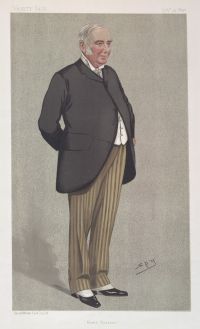 George Findlay,
The Working and Management of an English Railway
(1889)
“ Such lines are, therefore, in proportion to the traffic carried over them, more expensive to work and maintain, but as the weight of the train, the class of locomotive used, and all the other arrangements for conducting the business are specially adapted to the circumstances, such a line as this probably involves less trouble and anxiety in working than a railway which is generally level, but which has one or more long and steep gradients in its course. ”
Samuel Smiles, Lives of the Engineers
“ The railway is watched by foremen, with “gangs” of men under them, in lengths varying from twelve to five miles, according to circumstances. Their continuous duty is to see that the rails and chairs are sound, their fastenings complete, and the line clear of all obstructions.Then, at all the junctions, sidings, and crossings, pointsmen are stationed, with definite instructions as to the duties to be performed by them. At these places, signals are provided, worked from the station platforms, or from special signal boxes, for the purpose of protecting the stopping or passing trains. ”
George Findlay,
The Working and Management of an English Railway
(1889)
“ In working the goods traffic on a line such as the London and North-Western, the trains are so arranged as to run with full loads between the most important points, as from London to Birmingham, Liverpool, Manchester, Scotland, and so on; but the traffic at the intermediate stations is collected by a service of local stopping trains, and conveyed to the large junctions, such as Rugby, Crewe, and Stafford, where the waggons are properly classified and marshalled for transit by the through trains. ”
William Hemingway Mills, Railway Construction
“ This arrangement of the four lines has afforded great relief to the traffic of all kinds, and has enabled the service to be worked with much greater facility and punctuality. The goods trains being restricted to their own separate lines, can proceed regularly in their order, at their uniform working speed, without having to resort to the spasmodic fast running too often expected from them when passing over some parts of an ordinary double line. ”
Little Visits with Great Americans…
“ The length of the proposed line and the nature of the country through which it was to pass, made this the most stupendous railway undertaking the world had seen. It was necessary to procure a man fitted for a Herculean task. ”
William Hemingway Mills, Railway Construction
“ CHAPTER I. Location of a line of railway—Government regulations—Questions for consideration in connection with gauge, gradients, and curves.Location.—The locating of a line of railway, or the determination of its exact route, is influenced by many circumstances. In a rich country, with thickly populated districts and large industrial enterprises, there are towns to be served, manufacturing centres to be accommodated, and harbours to be brought into connection; while, at the same time, there may be important estates which must be avoided and private properties which must not be entered. ”
William Hemingway Mills, Railway Construction
“ At the large terminal stations platform after platform has been added to accommodate the increased number of trains which arrive in the busy parts of the morning or depart in the evening. Every facility has to be provided to permit of the expeditious ingress and egress of the large crowds forming the respective trains—ample platforms, over-line foot-bridges, subways, convenient booking-offices, waiting-rooms, and left-luggage rooms. ”
Sir Cusack P. Roney, Rambles on Railways
“ Penny-a-lining, so called, because it is paid for by the newspapers at the rate of three-half-pence a line! [75] There is only one part or portion of railway practice which, with all our railway experience, we are unable to account for. Yet the practice is universal. We (always in the singular number, we are plural, editorially, only) have travelled in a great many parts of the world, but wherever we have gone we have never found but one undeviating and unalterable rule among the door-opening and the door-closing portion of the railway community. ”
Sir Cusack P. Roney, Rambles on Railways
“ The sleepers are transverse, three feet apart, to which the outer or ordinary rails are fixed by bolts or nails. The line is fenced off from the portion of the roadway to be used for ordinary horse traffic, (the greater portion of which will disappear on the opening of the railway) by means of substantial posts and rails. The railway, in passing from one side of the roadway to the other, crosses it thirty-three times, one more than half the number of these crossings (seventeen) are on the roadway, where it is practically on the level. ”
Mary Huston Gregory, Checking the Waste: A Study in Conservation
“ The Inland Waterways Commission finds as a reason for the decrease, the relations existing between the railways and the waterways. A railway, they consider, has two classes of advantages. First, those that come from natural conditions. A railroad line can be built in any direction to any part of the country except the extremely mountainous parts, while a river runs only in a single direction. ”
Charles Shattuck Hill, The New International Encyclopædia (1905)
“ The number of employees engaged in track work by American railways averages about 150 per 100 miles of line. Buildings. Railway operations require the use of buildings in vast numbers. Of these passenger stations and freight depots are among the most important because of their number and cost. Passenger stations vary in size and character from small combination depots used at local stations of minor importance to large terminal stations of masonry and steel, and often of almost monumental magnificence. ”
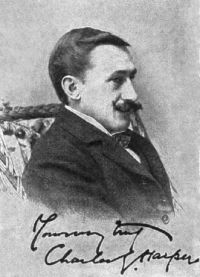 Charles G. Harper,
The Great North Road, the Old Mail Road to Scotland…
“ Nor are railways always hideous objects. It is true that in and around the great centres of population where railway lines converge and run in filthy tunnels and along smoke-begrimed viaducts they sound the last note of squalor, but in the country it is a different matter. ”
 Edwin A. Pratt,
A History of Inland Transport and Communication in England…
(1912)
“ Whatever the difficulties which have attended the development of British railways, the lines themselves have been spread throughout the three kingdoms to such an extent that there are now very few districts not within easy reach of a railway ”
Edward Hungerford, The Modern Railroad
“ Culverts have been laid for each small run or kill or creek; the bridge-builders along the new line finish their work and cart off their kits; the day comes when there is an unbroken railroad from one end of the new line to the other. It links new rails and new towns; its localities produce for new markets, commerce from strange quarters pours down upon the land that has known it not. Passenger trains begin regular operation, the fresh-painted depots are brilliant in their newness, the shriek of the locomotive sounds where it has never before sounded. ”
Samuel Smiles, Lives of the Engineers
“ But besides the above number of passengers, over one hundred and sixty-two million tons of minerals and merchandise were carried by railway in the United Kingdom in 1873, besides mails, cattle, parcels, and other traffic. The distance run by passenger and goods trains in the year was 162,561,304 miles; to accomplish which it is estimated that four miles of railway must have been covered by running trains during every second all the year round. ”
Edwin A. Pratt,
A History of Inland Transport and Communication in England…
(1912)
“ In the country what is most wanted is an increase in transport facilities between existing railways and outlying districts, the traffic from which would not be sufficient to justify the construction of branch lines of ordinary railway. ”
George A. Kyle, The Morning Glory Club
“ Her own quick wits, aided by those of a gallant fellow passenger, give the two officers an unlooked-for and exciting "run for their money." One hardly realizes till now the dramatic possibilities of a railway train, and what an opportunity for excitement may be afforded by a joint railway station for two or more roads. ”
C. E. Pascoe, Popular Science Monthly (1874)
“ Ireland, 2,000 miles; and 290 companies shared these miles of railroad between them. The total number of depots, or stations, as they are termed in England, including junctions and sidings, is about 10,000 for the whole kingdom; of these 6,000 are passenger-stations, giving approximately one station to about every two miles of railway, but not in reality, because there are no less than 150 stations in London and the suburbs alone. As a matter of course the great centre of the railway system of the United Kingdom is London. ”
J. Hamilton Fyfe, Triumphs of Invention and Discovery in Art and Science
“ The extension of the railway system is one of the wonders of our time. The few score miles of railroad planted in 1825 have put forth offshoots and branches, till now a mighty net-work of some ten thousand miles in all, is spread over the three kingdoms, with many fresh shoots in bud. ”
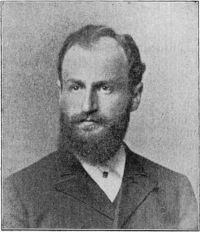 Ignaz Jastrow,
Popular Science Monthly
(1884)
“ The construction of the railways in insular countries is governed wholly by mercantile considerations, while, in countries whose boundaries are exposed, military and political objects claim prominence. Thus, an English railway-map affords a most accurate picture of the relations of the country to production and trade, and of the office of the railroads as the medium of communication between the great coal and iron fields on one side and the world's mart on the Thames on the other side. ”
“ Is this train for Queen's Road, Bayswater?Haughty Official. Yes, Queen's Road. Look sharp! She'll be off in a minute. [Country Cousin scrambles through the crowd to a carriage; drops his umbrella; stoops to pick it up and on rising finds train three parts through the tunnel. Exit Country Cousin in a rage, to get a cab, having lost twenty minutes, the price of his unused ticket, his self-respect, and that of everybody he has come in contact with in the Metropolitan District Railway Station. [Pg 41] WHEN IN DOUBT—DON'T!Scene—Country StationGent. ”
Parodies of the works of English & American authors… (1889)
“ Into the very heart and depth of this, and politely bending with the bends of it, your railway introduces its close-clinging attention. The rocks are not big enough to be tunnelled, they are cheerily blasted away; the brook is not wide enough to be bridged, it is comfortably covered in, and is thence-forward no physical obstacle to an enterprising Railway Company. ”
Howard Elliott, The Truth About The Railroads (1913)
“ The railways of the country, in their present form, have been built since the close of the Civil War, or in less than fifty years, and are the wonder and admiration of students of the transportation problem who come here from other countries. There are 234,182 miles of railway, and more than 340,000 miles of track in this country, as compared with a trifle less than 300,000 miles of railway in all the other countries of the world combined. There are nearly 58,000 locomotives; more than 45,000 passenger-train cars; nearly 2,200,000 freight- and service-cars. ”
William Hemingway Mills, Railway Construction
“ Where there are only two lines of rails to serve for the UP and DOWN service of a heavy passenger and goods traffic, it is imperative to restrict those lines as much as possible to the actual transit of trains, and not to block them by unnecessary occupation for shunting purposes. A goods train running a long distance collects waggons from many roadside stations, and at some of them several waggons will be taken on, to be forwarded to various and widely distant destinations. ”
Edwin A. Pratt,
A History of Inland Transport and Communication in England…
(1912)
“ To see waggons with flat wheels drawn over cast-iron rails one yard long by a horse, cannot fail to interest those who watch the workings of railways, and it most clearly shows the great improvements made and the perseverance which has been required to develop the present gigantic railway system out of such small beginnings. ”
Edwin A. Pratt,
A History of Inland Transport and Communication in England…
(1912)
“ There is little prospect of any extensive opening out of new competitive routes in this country, and, but for a few comparatively short lines here and there, the railway system may be considered complete. ”
Frederick C. Bakewell, Great Facts
“ In a national and in a social point of view, also, railways have produced important improvements. They tend to equalize the value of land throughout the kingdom, by bringing distant sources of supply nearer the points of consumption; they have given extraordinary stimulus to manufacturing industry; and by connecting all parts of the country more closely together, railway communication has concentrated the energies of the people, and has thus added materially to their wealth, their comforts, and to social intercourse. ”
William Hemingway Mills, Railway Construction
“ The fact that our own home lines, the principal Continental lines, and nearly all that vast network of railways in the United States of America, have been laid to the 4 feet 81⁄2 inch gauge, testifies to the general opinion of its utility and efficiency; and we know that included in that list are the railways which carry the largest, heaviest, and fastest train service in the world. ”
Samuel Smiles, The Life of George Stephenson and of his Son Robert Stephenson
“ The remarkable safety with which railway traffic is on the whole conducted, is due to constant watchfulness and highly-applied skill. The men who work the railways are for the most part the picked men of the country, and every railway station may be regarded as a practical school of industry, attention, and punctuality. ”
Nicholas Wilcox Cundy, Inland Transit — Inland Transit (1834)
“ But the peculiar nature of a railway, the magnitude and weight of the loads which may be transported on it, and the prodigious speed which may be attained, render the transport of cattle, meat or fish of every species, to almost any distance, both easy and cheap. In process of time, when the railway system becomes extended, the metropolis and populous towns will therefore become markets, not, as at present, to districts within limited distances of them, but to the whole country within 200 miles of the metropolis. ”
Related terms
Authors who wrote about “railway line”
Edwin A. PrattSir Cusack P. RoneySamuel SmilesGeorge FindlayCharles Shattuck HillIgnaz JastrowWilliam Hemingway MillsHoward ElliottArthur H. Beavan John HawkshawJohn R. RaynesJames P. BoydWhately C. ArnoldNicholas Wilcox CundyCharles G. Harper
 Charles DeLano Hine
 Sir Francis Bond HeadFrederick C. Bakewell
 Thomas Wallace KnoxIsambard Brunel
