Sandalwood

Definition and stakes

Portrait of Padraic Colum Padraic Colum,  At the gateways of the day (1924)

“ We go away from our homes and our villages, leaving our crops unplanted and untended. We are up in the mountains by the first light of the morning, working, working with our axes to cut the sandalwood. And we go back at the fall of night carrying the loads of sandalwood upon our shoulders the whole way down the mountain-side. Ah, if there were any amongst us who knew the Me-ne-hu-ne or who knew how to come to them! In one night the Me-ne-hu-ne would cut all the sandalwood for us! ”
Source: Gutenberg

R. V. Russell,  The Tribes and Castes of the Central Provinces of India…

“ A crescent moon or a triangle may also be made.3 The marks are often made in sandalwood, and the Gosains say that the original sandalwood grows on a tree in the Himalayas, which is guarded by a great snake so that nobody can approach it; but its scent is so strong that all the surrounding trees of the grove are scented with it and sandalwood is obtained from them. Those who worship Bhairon make a round mark with vermilion between the eyes, taking it from beneath the god’s foot. A mendicant usually has a begging-bowl and a pair of tongs, which are useful for kindling a fire. ”
Source: Gutenberg

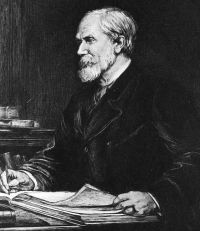
Portrait of Henry Yule Henry Yule,  Hobson-Jobson — S (1903)

“ From Low Latin santalum, in Greek σάνταλον, and in later Greek σάνδανον; coming from the Arab. ṣandal, and that from Skt. chandana. The name properly belongs to the fragrant wood of the Santalum album, L. Three woods bearing the name santalum, white, yellow, and red, were in officinal use in the Middle Ages. But the name Red Sandalwood, or Red Sanders, has been long applied, both in English and in the Indian vernaculars, to the wood of Pterocarpus santalina, L., a tree of S. India, the wood of which is inodorous, but which is valued for various purposes in India (pillars, turning, &c.) ”
Source: Wikisource

Get perspective with Kwize: daily news enlightened by great literature