Sensible heat

Definition and stakes

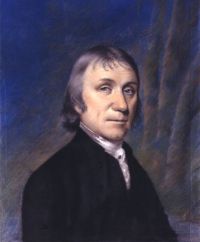
Portrait of Benjamin Franklin Benjamin Franklin,  The Complete Works in Philosophy…

“ Heat may be separated from the smoke as well as from the light, by means of a plate of iron, which will suffer heat to pass through it without the others.
3. Fire sends out its rays of heat as well as rays of [228] light, equally every way; but the greatest sensible heat is over the fire, where there is, besides the rays of heat shot upwards, a continual rising stream of hot air, heated by the rays shot round on every side.
”
Source: Gutenberg

Fred H. Colvin,  The Working of Steel

“ That portion of the heat which results in an increase in temperature of the body is called "sensible heat," inasmuch as such a gain in heat is apparent to the physical senses of the observer. If heat were supplied to the body at a uniform rate, the temperature would rise continuously, and if the temperature were plotted against time, a smooth rising curve would result. Or, if sensible heat were abstracted from the body at a uniform rate, a time-temperature curve would again be a smooth falling curve. Such a curve is called a "cooling curve." ”
Source: Gutenberg

Portrait of Elisha Gray Elisha Gray,  Familiar Talks on Science: World-Building and Life…

“ If we push the process still further, with a sufficient application of energy we can separate the vapor molecules into their original elements, oxygen and hydrogen.
Let us go back now to the freezing point of water and see what is becoming of the heat that is consumed in melting the cake of ice, and still does not produce any effect upon the mercury in the thermometer. Sensible heat, [Pg 183] as before stated, is a movement of the atoms of matter, and temperature, as it affects the thermometer, is a measure of the intensity of motion exhibited by these atoms.
”
Source: Gutenberg

Get perspective with Kwize: daily news enlightened by great literature