Somatic cell

Definition and stakes

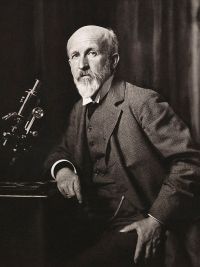
Portrait of August Weismann August Weismann,  Essays Upon Heredity and Kindred Biological Problems

“ There is no nucleoplasm like that of the germ-cell in any of the somatic cells, and no one of these latter can be said to be undifferentiated. All somatic cells possess a certain degree of differentiation, which may be rigidly limited to one single direction, or may take place in one of many directions. All these cells are widely different from the egg-cell from which they originated: they are all separated from it by many generations of cells, and this fact implies that their idioplasms possess a widely different structure from the idioplasm, or germ-plasm, of the egg-cell. ”
Source: Gutenberg

Portrait of August Weismann August Weismann,  Essays Upon Heredity and Kindred Biological Problems

“ But the somatic cells have lost this power to a gradually increasing extent, so that at length they became restricted to a fixed, though perhaps very large number of cell-generations. This restriction, which implies the continual influx of new individuals, has been explained above as a result of the impossibility of entirely protecting the individual from accidents, and from the deterioration which follows them. ”
Source: Gutenberg

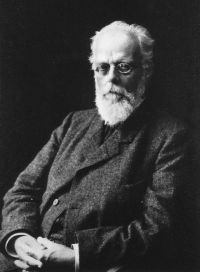
Portrait of August Weismann August Weismann,  The Evolution Theory, Vol. 2 of 2

“ Thus the first cell-colonies with two kinds of cells arose, as we have seen in the case of Volvox—the reproductive cells with a complete equipment for regeneration in their nucleus, and the somatic cells with a limited equipment for regeneration in their nuclei. The somatic cell could no longer give rise anew to the whole organism, but could only reproduce itself or its like. ”
Source: Gutenberg

Get perspective with Kwize: daily news enlightened by great literature