Visible spectrum

Definition and stakes

Shelford Bidwell,  Curiosities of Light and Sight

“ The visible spectrum is limited solely by the physiological constitution of our organs of vision, and the fact that it begins and ends where it does is, from a physical point of view, a mere accident. The spectrum actually projected upon the screen is in truth much longer than that portion of it which any one can see: it extends for a considerable distance beyond the violet at the one end and beyond the red at the other, these invisible portions being known as the ultra-violet and infra-red regions. People’s eyes differ in regard to range of sensibility just as their ears do. ”
Source: Gutenberg

Shelford Bidwell,  Curiosities of Light and Sight

“ The two ends of the spectrum gradually fade away into darkness, and the point that I wish to insist upon and make perfectly clear is this:—The position of the boundaries terminating the visible spectrum does not depend upon anything whatever in the nature of light regarded as a physical phenomenon. Ether waves which are much longer and much shorter than those which illuminate the spectrum certainly exist, and evidence [Pg 14] of their existence is easily obtainable. But we cannot see them; they fall upon our eyes without exciting the faintest sensation of light. ”
Source: Gutenberg

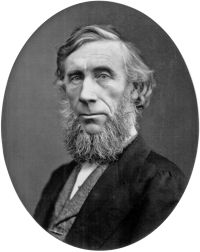
Portrait of John Tyndall John Tyndall,  Popular Science Monthly (1883)

“ Pushing the movable screen toward the visible spectrum, at a distance of three or four feet beyond the violet, where only darkness existed before, light begins to appear. On pushing in the screen, the whole ultra-violet spectrum falls upon it, and is rendered visible from beginning to end. The spectrum is not continuous, but composed for the most part of luminous bands derived from the white-hot crucible in which the metals are to be converted into vapor. ”
Source: Wikisource

Get perspective with Kwize: daily news enlightened by great literature