“ Alone, I was forced to pass through the fiend haunted woodlands of Villefère. In those frightful forests I was beset by an inhuman, a ghastly thing—a werewolf. Beneath a midnight moon we fought, and slew it. Now this is the truth: that if a werewolf is slain in the half-form of a man, its ghost will haunt its slayer through eternity. But if it is slain as a wolf, hell gapes to receive it. The true werewolf is not (as many think) a man who may take the form of a wolf, but a wolf who takes the form of a man! ”
Werewolf
Definition and stakes
The werewolf, as depicted in J.R.R. Tolkien’s legendarium, is a fearsome creature serving Morgoth, embodying primal terror in Middle-earth’s lore. Unlike the human-transformed lycanthropes of folklore, Tolkien’s werewolves constitute a distinct, bestial race, exemplified by Draugluin and Carcharoth, whose monstrous actions shaped pivotal events in the First Age.
Yet beyond Tolkien, authors like Dorothy Scarborough and John Fiske examined the werewolf as a metaphor for atavistic desires or mythic change, while Robert E. Howard and Ambrose Bierce portrayed it as a cursed duality between man and beast. These varied portrayals—from Tolkien’s mythic terrors to literary reflections on psychology and folklore—reveal the werewolf as a multifaceted symbol of humanity’s darker, untamed instincts.
Quotes about “werewolf”
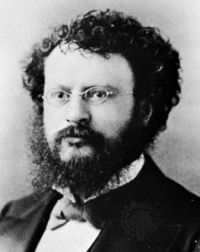 John Fiske,
Myths and Myth-Makers
John Fiske,
Myths and Myth-Makers
“ The original werewolf is the night-wind, regarded now as a manlike deity and now as a howling lupine fiend; and the original swan-maiden is the light fleecy cloud, regarded either as a woman-like goddess or as a bird swimming in the sky sea. The one conception has been productive of little else but horrors; the other has given rise to a great variety of fanciful creations, from the treacherous mermaid and the fiendish nightmare to the gentle Undine, the charming Nausikaa, and the stately Muse of classic antiquity. ”
Dorothy Scarborough, The Supernatural in Modern English Fiction
“ The werewolf is a human being cursed with the power or the obligation to be transformed into an animal who goes forth to slay and devour. Like a vampire, he might become such as a curse from God, or he might be an innocent victim, or might suffer from an atavistic tendency, a cannibalistic craving for blood. Distinction is to be made between the real werewolf and the lycanthrope,—the latter a human being who, on account of some peculiar twist of insanity, fancies himself a wolf and acts accordingly. ”