“ And she sees herself dead. All her friends are about her crowning her with flowers, beautiful garlands of white roses. They dress her in a long white robe, white as the snowiest cloud in heaven, and it lies in long, straight plaits about her limbs, like the robes of those who lie in marble in cathedral aisles. It falls over her feet, her hands are crossed over her breast, and all praise in low but ardent words the excessive whiteness of the garment. For none but she sees that there is a black spot upon the robe which they believe to be immaculate. ”
White robe
Definition and stakes
The theme of “white robe” has been addressed by authors such as Catherine Beatrice Phillips, Eliza Davis Aria, William Clark, G. Woolliscroft Rhead and James Thomson. It is often associated with terms like dress, clothing, gown, silk and linen.
Quotes about “white robe”
“ The flickering candles in tin sconces against the walls, or depending in rude chandeliers of barrel-hoops from the ceiling, lit up the most astounding diversity of female costume the master had ever seen. Gowns of bygone fashions, creased and stained with packing and disuse, toilets of forgotten festivity revised with modern additions; garments in and out of season—a fur-trimmed jacket and a tulle skirt, a velvet robe under a pique sacque; fresh young faces beneath faded head-dresses, and mature and buxom charms in virgin' white. ”
 G. A. Henty,
To Herat and Cabul: A Story of the First Afghan War
G. A. Henty,
To Herat and Cabul: A Story of the First Afghan War
“ All you will want will be a long white robe coming over the head and down to the eyebrows, and falling to the feet; and a white cloth coming across the face below the eyes, and falling down over the throat. There is no occasion to buy other garments. ”
G. Woolliscroft Rhead, Chats on Costume
“ The robe is made of plain sattin, chiefly white, worn without a hoop, round, and a long train. It is drawn up in the front, on one side, and fastened with tassels of silver, gold, or silk, according to the taste of the wearer; and this discloses a puckered petticoat of gauze or sarsenet, of a different colour. The sleeves are wide and short, drawn up near the shoulder with small tassels, or knots of diamonds; under sleeves of the finest cambrick, full plaited, and trimmed at the elbow with Brussels or point, give infinite charms to the whole. ”
James H. Head, Home Pastimes; or Tableaux Vivants
“ The costume consists of a long white dress, worn without many skirts, over which is draped a robe of white muslin; a long, white gauze veil should be loosely tied around the head; the hair is allowed to hang loosely over the shoulders. The face, and arms, and neck must be made as white as possible by the use of pearl-powder. The features should express sternness.The bridegroom should be dressed in a velvet coat trimmed with gold lace, velvet breeches, white vest, white hose, low shoes, knee and shoe buckles, ruffled bosom, white lace collar. ”
Trumbull White, The War in the East: Japan, China…
“ The wardrobe of the upper classes consists of the ceremonial and the house dress. The former as a rule is of fine silk, and the latter of coarser silk or cotton. They are of pink, blue, and other rich colors. The official robe is a long garment like a wrapper, with loose baggy sleeves. There are few tailors’ shops, the women of each household making the family outfit. The underdress of both sexes is a short jacket with tight sleeves, which for men reaches to the thighs, and for women only to the waist, and a pair of drawers reaching from waist to ankle. ”
William Clark, The Journals of Lewis and Clark…
“ The dress of the women consists of a robe, tissue, and sometimes when the weather is uncommonly cold, a vest. their robe is much smaller than that of the men, never reaching lower than the waist nor extending in front sufficiently far to cover the body. it is like that of the men confined across the breast with a string and hangs loosly over the sholders and back. the most esteemed and valuable of these robes are made of strips of the skins of the Sea Otter net together with the bark of the white cedar or silk-grass. ”
 Sir Aurel Stein,
The Thousand Buddhas
(1921)
Sir Aurel Stein,
The Thousand Buddhas
(1921)
“ An under-robe of dull red appears only above the feet. The upper half of the body is nude except for a band of purplish-pink drapery, elaborate jewellery, and a filmy blue stole which shown in delicate transparent colour descends over shoulders and arms to the ground.The abundant jewellery is of a type with which we have already become familiar in paintings of Avalokiteśvara and elsewhere. The head-dress consists of a narrow fillet of white drapery, ending with a narrow white band which hangs in a long loop to the knees. ”
Trumbull White, The War in the East: Japan, China…
“ The usual dress of a coolie in summer is a loose fitting pair of cotton trousers and an equally loose jacket; but the same man in winter will be seen wearing quilted cotton clothes, or if he should be an inhabitant of the northern provinces a sheepskin robe, superadded to an abundance of warm clothing intermediate between it and his shirt. By the wealthier classes silk, satin, and gauze are much worn in the summer, and woolen or handsome fur clothes in the winter. ”
 John Claude White,
Sikhim and Bhutan — Chapter XIV …
(1909)
John Claude White,
Sikhim and Bhutan — Chapter XIV …
(1909)
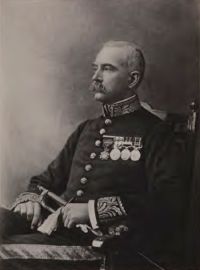
“ Paul, and the Subadar, and in front of each chair was a small table with fruit and refreshments. Close behind us stood my orderlies with presents. On the opposite side of the nave, facing me, was a low daïs with a magnificent cushion of the richest salmon-coloured brocade, on which Sir Ugyen Wang-chuk sat, dressed in a handsome robe of dark blue Chinese silk, embroidered in gold with the Chinese character “Fu,” the sign emblematical of good luck. Below him were ranged the chairs of all the officials present, the Thimbu Jongpen, the Poonakha Jongpen, the Zung Donyer, and the Deb Zimpon. ”
Walter White, A July Holiday in Saxony, Bohemia…
“ Their gown is long in the sleeves and short in the skirt—short as a Highlander's kilt, which it very much resembles, and is in most instances of a carpet-like texture. Plum-colour, blue, pink, and green, dotted with bright flowers or crossed by stripes, are the prevailing patterns; their gay tints relieving the sombre blue and black of the men. The skirt is made to fit pretty closely, much more so, indeed, than the men's breeches, and as it descends no lower than the knee, you can see that if Nature is niggard to the men she is generous to the women. ”
 Nathaniel Parker Willis,
Famous Persons and Places
Nathaniel Parker Willis,
Famous Persons and Places
“ His dress was a mixture of oriental and English fashions—a pair of baggy blue pantaloons, bound around the waist with a rich shawl, a splendid scarlet waistcoat buttoned close over his spacious chest, and a robe of a very fine snuff-colored cloth something like a loose dressing gown without a collar. A cap of silver cloth, and a brilliant blue-satin cravat completed his costume, unless in his covering should be reckoned an enormous turquoise ring, which almost entirely concealed one of his fingers. ”
Various, The Scrap Book, Volume 1, No. 1
“ A débutante should always wear white, made as becomingly and elaborately as possible. For her assistants, white or very light-colored gowns.For Men.—When calling, at afternoon teas, receptions, etc., during the fall and winter, the correct dress is a double or single breasted frock coat of black or very dark gray, soft cheviot or vicuna, with double or single breasted vest, either to match the coat or of fancy cloth. Trousers of gray; white linen; a broad, folded tie of light-colored silk; top hat, gray gloves, and patent-leather shoes. ”
Eleonora Hunt, My Trip Around the World: August…
“ The Englishman, dressed in black trousers, broad sash-belts of black or red silk, which seems to make more pronounced the smooth shirt bosom, with a spotless white pea-jacket, forms a refreshing costume. Ladies almost invariably are in low-neck black dresses, with a broad piece of white lace which droops gracefully as a bertha, with bright flowers in their hair, while a band of stringed instruments makes the scene enlivening. ”
Harry Collingwood, The Adventures of Dick Maitland…
“ All these people wore garments of exceedingly fine material, mostly white, richly trimmed with elaborate embroidery in colours or gold, the women’s dress being a long, sleeveless garment reaching from the throat to the feet and confined at the waist by an ornamental belt, handsome sandals, much jewellery, and the head bare, the heavy masses of dark hair being wound upon the head very becomingly, and intertwined with ribbon or strings of coloured beads. ”
 Sarah Knowles Bolton,
Famous European Artists
Sarah Knowles Bolton,
Famous European Artists
“ The white dress, though muslin-fine and gathered into minute folds, is beyond measure graceful in fall, and contrasts in texture as well as harmonizes in color with the stiffer and more cornered stuff of the rose-tinged cloth which shows such fine damask reflexes on the left arm. ”
Florence Mary Gardiner, The Evolution of Fashion
“ At no period in the history of costume were the styles so offensive to those with a true conception of colour and form than in the first half of the nineteenth century. We have only to turn to the sketches of Leech and contemporary artists to find bare necks and arms, conspicuous underwear, very short skirts distended by a stiffened petticoat or crinoline, white cotton stockings, low shoes fastened by a strap and single button, mushroom hats, aprons and pinafores devoid of elegance and grace, and the hair cut close to the head or arranged in rows of stiff ringlets. ”
 Eliza Davis Aria,
Costume: Fanciful, Historical, and Theatrical
(1906)
Eliza Davis Aria,
Costume: Fanciful, Historical, and Theatrical
(1906)
“ The fête costume of the women embraces a voluminous skirt of fine cloth, extending below the knees and trimmed about the bottom with wide and narrow bands of black ribbon velvet, and an apron, likewise of cloth, but in a contrasting colour, bordered with gold lace or passementerie. The closely-fitting jacket reaches to the hips; the seams are outlined in gold lace, and the sleeves slashed open from the elbow to the wrist to reveal white undersleeves belonging to the chemisette, a second glimpse of which is caught at the neck in front. ”
Ardern Holt, Fancy dresses described (1887)
“ DINORAH. Hair in two long plaits; light blue skirt, with bands of black velvet; lace-edged apron; white chemisette, with long sleeves to wrist; blue square corselet bodice, laced and trimmed with silver and black velvet. DIRECTOIRE, 1795, COSTUME OF. This is a favourite style of dress at fancy balls, and admits of many good combinations of colour. After the great Revolution towards the close of the last century, women launched into all kinds of eccentricities. Wonderful head-dresses were originated. ”
Norvell Page, Wings of the Black Death — A Shot in the Dark (1933)
“ She was a lovely girl, and in evening dress she was surprisingly beautiful. The low-cut gown of simple white left bare the exquisite slope of her shoulders. The gleam of her rich brown hair made a jewel-like setting for the perfect oval of her face. ”
Various, The Girl's Own Paper, Vol. XX. No…
“ The group of figures which I have called “Two harmonies in black and white,” are two pretty gowns in the two hues which are the most fashionable of all. The figure on the left holding a bird wears a gown of white lace over black satin, which is trimmed with crescent-shaped pieces of silk, shading from black to grey and white. These are laid on in regular sequence of size on the skirt as well as on the bodice. The other dress is of plainer character, and is of black, with a white design. It is, in fact, one of the new satin-faced foulards, the pattern being of small leaves and dots. ”
 Mrs. Aria,
Costume: Fanciful, Historical and Theatrical
Mrs. Aria,
Costume: Fanciful, Historical and Theatrical
“ The outdoor dress of ladies in those days was a lengthy mantle of dark material, which boasted long sleeves and a deep sailor collar of red, blue, or green satin; essential accessories being the two white veils and top boots of yellow morocco. Heavy and sumptuous, the gown worn at home consisted of baggy trousers of thin texture drawn in tightly at the ankles, supplemented by a long sleeved chemisette of white muslin trimmed with a peculiar kind of lace. ”
Ardern Holt, Fancy dresses described (1887)
“ Or, dark blue net covered with red velvet tridents; forks of lightning wired round neck and sleeves; scarf drapery of black satin with firefly wings; silver pitchfork, and horns in hair; short sleeves, long streamers of red satin from the side, falling on skirt and draped at back, with gold fringe, coins, and sequins; black velvet cap with two high horn-like feathers and scarlet lace; gold ornaments. Bracelets as well as armlets worn. For a child an ordinary white and red dress, with black gloves and sash and stockings, and gold horned headdress; forked wand; high-heeled boots. ”
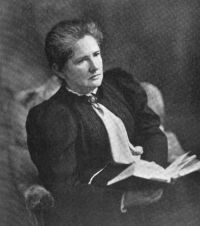 Laura Elizabeth Howe Richards,
Abigail Adams and Her Times
Laura Elizabeth Howe Richards,
Abigail Adams and Her Times
“ The light from the lustres is more favorable to beauty than daylight, and the color acquired by dancing, more becoming than rouge, as fancy dresses are more favorable to youth than the formality of a uniform. There was as great a variety of pretty dresses, borrowed wholly from France, as I have ever seen; and amongst the rest, some with sapphire-blue satin waists, spangled with silver, and laced down the back and seams with silver stripes; white satin petticoats trimmed with black and blue velvet ribbon ”
Mrs. Bearne, Pictures of the old French court
“ The fashions in her reign were exceedingly graceful and artistic. Fine linen, velvet or satin shoes, long trailing dresses open in front, made of cloth of gold and crimson silk or velvet, with a golden girdle and chaplet of pearls, chains and jewels round the neck, headdress of white silk embroidered with gold and pearls, hoods of cloth, satin, or velvet, scarlet for bourgeoises, black for nobles. ”
Imbert de Saint-Amand, The Court of the Empress Josephine
“ Their full dress differs from livery only by the lace of their coat which imitates embroidery, by the knot on their left shoulder, and by the lace frill above their waistcoat, Besides, in full dress they wear, like footmen, a green coat with all the seams laced with gold, gold shoe-buckles, a hat with a white feather, but they have no sword. ”
A. Hugh Fisher, Through India and Burmah with pen and brush (1911)
“ The sun has now just set and a light that seems to cast no shadows spreads and grows, suffusing all the scene in soft effulgence. Most of the women are dressed in long trousers, close fitting from the ankles to the knees and then bagging out loosely. They all have long veils which they wear like a hood; some are white but others scarlet, crimson, or orange, and some of green silk tissue strewn with silver stars and bordered with a ribbon of bright gold. It is the hour when even humble clothes take on luxurious tints, and richer stuffs show all their utmost beauty in enhanced perfection. ”
Ardern Holt, Fancy dresses described (1887)
“ ARMENIAN WOMAN. In the country they wear shoes with toes turning upwards, full silk trousers, white under-dress, open at neck, made of thin muslin; a silk scarf round waist; full white sleeves; velvet embroidered sleeveless coat, opening wide in front; round cap of velvet; hair in plaits, and a yachmush out of doors. For a fancy ball, handsome silver clasps are added to the belt; a silk brocaded jacket and tunic often replace the over-dress. Long gauze veil and plenty of ornaments admissible. ”
Ardern Holt, Fancy dresses described (1887)
“ FINLANDER. Blue cloth petticoat, the edge embroidered with crimson; full white bodice to the throat; sleeves to wrist, rosettes of red down the front; red sash, knotted at the side; velvet sleeveless bodice bordered with gold. Red handkerchief tied round head. A long embroidered over-dress is also worn by the peasantry. FIRE. Black tulle evening dress over red silk, tunic or train fringed with red and gold tinsel, bodice and skirt dotted with stars of the same, as also the veil; coronet of tinsel to resemble flames; ornaments, garnets. ”

“ I never dreamed of such clothes even in my dreams of heaven. But the French are an extravagant race. There was hardly a gown worn last season which was not of the most delicate texture, garnished with chiffon and illusion and tulle—the most crushable, airy, inflammable, unserviceable material one can think of. Now, I am a utilitarian. When I see a white gown I always wonder if it will wash. ”
R. Walsh, Constantinople and the Scenery of the Seven Churches of Asia Minor
“ The young women are particularly distinguished by their dress. They wear in some parts a blue, and in other a white cloth gown, wide and open at the sleeve and bosom, displaying a snow-white chemise of cotton or linen, tastefully embroidered. ”
Eliza Davis Aria,
Costume: Fanciful, Historical, and Theatrical
(1906)
“ An audacious selection is the costume of the Wallflower in gold and brown, which looks its best when made in chiffon and velvet. As a rule, it must be admitted that the finest fancy dress looks the best, and however charming may be the effects arrived at with muslin, cotton, crepe, and calico, she who stands out in the vast crowd will be she who has the most magnificent clothes. ”
Related terms
Authors who wrote about “white robe”
Catherine Beatrice PhillipsEliza Davis AriaWilliam ClarkG. Woolliscroft RheadJames ThomsonVariousTrumbull White Bret Harte
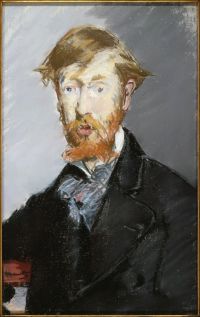 George MooreG. A. Hentyactive 19th century Lady of distinctionSir Aurel SteinJohn Claude WhiteEdwin W. FullerEdwin JamesJames H. HeadNathaniel Parker Willis
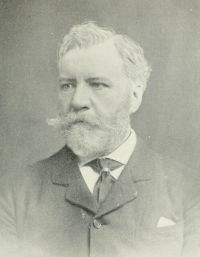 Richard Whiteing
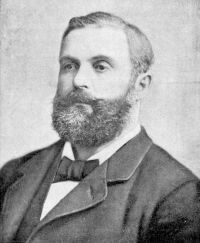 Thomas Wallace Knox
 Evariste Régis Huc
Eliza Davis AriaWilliam ClarkG. Woolliscroft RheadJames ThomsonVariousTrumbull WhiteBret HarteGeorge MooreG. A. Hentyactive 19th century Lady of distinctionSir Aurel SteinJohn Claude WhiteEdwin W. FullerEdwin JamesJames H. HeadNathaniel Parker WillisRichard WhiteingThomas Wallace KnoxEvariste Régis Huc