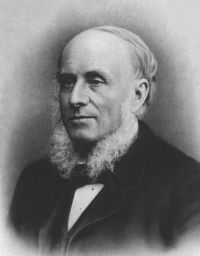
Henry Sidgwick

Biographical details

Portrait of Henry Sidgwick Henry Sidgwick The Methods of Ethics

It is scarcely doubtful that a modest, diffident, and retiring nature, distrustful of its own abilities, and shrinking with humility from conflict, produces on the whole less benefit to the world than the self-assertion of an audacious and arrogant nature, which is impelled to every struggle, and develops every capacity. Gratitude has no doubt done much to soften and sweeten the intercourse of life, but the corresponding feeling of revenge was for centuries the one bulwark against social anarchy, and is even now one of the chief restraints to crime.
Source: Gutenberg

Portrait of Henry Sidgwick Henry Sidgwick Criteria of Truth and Error (1900)

Let us turn to consider Kant’s sweeping negation in relation to a different criterion, laid down by Empiricists.
I take the principle of Empiricism, as an epistemological doctrine, to be that the ultimately valid premises of all scientific reasonings are cognitions of particular facts; all the generalisations of science being held to be obtained from these particular cognitions by induction, and to depend upon these for their validity.
Source: Wikisource

Portrait of Henry Sidgwick Henry Sidgwick The Methods of Ethics

I recognise that each concession to vicious desire makes the difficulty of resisting it greater when the desire recurs: but the difficulty always seems to remain separated from impossibility by an impassable gulf. I do not deny that the experience of mankind includes cases in which certain impulses—such as aversion to death or extreme pain, or morbid appetite for alcohol or opium—have reached a point of intensity at which they have been felt as irresistibly overmastering voluntary choice.
Source: Gutenberg

Get perspective with Kwize: daily news enlightened by great literature