“ But the rooster is troubled by no dreams of a divine orgy, no carnival-loves like Beethoven's Fourth Symphony, no heroic and shining lust gathering and swinging into a merry embrace like the third act of Siegfried. It is desire in this sense that goes farthest from the animal. Consciously, no one can achieve the act of love on earth as a completed thing of grace, with whatever delirium of delight, with whatever ingenious preciosity, we go through its process. Only as an image of beauty mated in some strange hermaphroditic ecstasy is that possible. ”
Summary
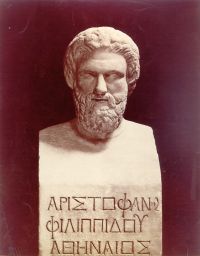
“Lysistrata”, is a work by Aristophanes. It explores elements such as duality, rooster and Lysistrata.
Quotes from Lysistrata (Aristophanes)
“ They retire. MEN There is no beast, no rush of fire, like woman so untamed. She calmly goes her way where even panthers would be shamed. WOMEN And yet you are fool enough, it seems, to dare to war with me, When for your faithful ally you might win me easily. MEN Never could the hate I feel for womankind grow less. WOMEN Then have your will. But I'll take pity on your nakedness. For I can see just how ridiculous you look, and so Will help you with your tunic if close up I now may go. MEN Well, that, by Zeus, is no scoundrel-deed, I frankly will admit. ”
“ I amuse myself at times with the fancy that Homer, Sappho, and Aristophanes are the inviolable Trinity of poetry, even to the extent of being reducible to One. For the fiery and lucid directness of Sappho, if her note of personal lyricism is abstracted, is seen to be an element of Homer, as is the profoundly balanced humour of Aristophanes, at once tenderly human and cruelly hard, as of a god to whom all sympathies and tolerances are known, but who is invulnerable somewhere, who sees from a point in space where the pressure of earth's fear and pain, and so its pity, is lifted. ”
“ LYSISTRATA Girdled now sit humbly at home, Munching beans, while you card wool and comb. For war from now on is the Women's affair. WOMEN. Come then, down pitchers, all, And on, courageous of heart, In our comradely venture Each taking her due part. I could dance, dance, dance, and be fresher after, I could dance away numberless suns, To no weariness let my knees bend. Earth I could brave with laughter, Having such wonderful girls here to friend. O the daring, the gracious, the beautiful ones! Their courage unswerving and witty Will rescue our city. ”
“ And shut us out. Come, Philurgus, bustle thither; lay our faggots on the ground, In neat stacks beleaguering the insurgents all around; And the vile conspiratresses, plotters of such mischief dire, Pile and burn them all together in one vast and righteous pyre: Fling with our own hands Lycon's wife to fry in the thickest fire. By Demeter, they'll get no brag while I've a vein to beat! Cleomenes himself was hurtled out in sore defeat. His stiff-backed Spartan pride was bent. ”
“ How could the humanistic emotions, such as pity, justice, sympathy, exist save as pacifistic quietings of the desire to slay, to hurt, to torment. Where the desire to hurt is gone pity ceases to be a significant, a central emotion. It must of course continue to exist, but it is displaced in the spiritual hierarchy; and all that moves courageously, desirously, and vitally into the action of life takes on a deeper and subtler intention. Lust, then, which on the lower plane was something to be very frightened of, becomes a symbol of the highest spirituality. ”
“ But on earth we cannot complete the cycle in consciousness that would give us the freedom of an image in which two identities mysteriously realize their separate unities by the absorption of a third thing, the constructive rhythm of a work of art. It is thus that Tristan and Isolde become wholly distinct individuals, yet wholly submerged in the unity that is Wagner; and so reconcile life's duality by balancing its opposing laughters in a definite form--thereby sending out into life a profounder duality than existed before. ”
“ It is much more difficult to realize the complex and delicately passionate edge of the former play's rhythm, its tides of hugely wandering emotion, the restless, proud, gay, and agonized reaction from life, of the blood, of the mind, of the heart, which is its unity, than to follow the relatively straightforward definition of Hamlet's nerves. ”
“ LYSISTRATA An easy task if the love's raging home-sickness Doesn't start trying out how well each other Will serve instead of us. But I'll know at once If they do. O where's that girl, Reconciliation? Bring first before me the Spartan delegates, And see you lift no rude or violent hands-- None of the churlish ways our husbands used. But lead them courteously, as women should. And if they grudge fingers, guide them by other methods, And introduce them with ready tact. The Athenians Draw by whatever offers you a grip. ”
“ It is right for Paul to be terrified of sex and so to hate it, because he has so freshly escaped a bestial condition of life that it threatens to plunge him back if he listens to one whisper But it is also right for a Shakespeare to suck every drop of desire from life, for he is building into a higher condition, one self-willed, self- responsible, the discipline of which comes from joy, not fear. ”
“ Surely the only enduring moral virtue which can be claimed is for that which moves to more power, beauty and delight in the future? The plea that the question of changing customs arises is not valid, for customs ratified by Aristophanes, by Rabelais, by Shakespeare, have no right to change. If they have changed, let us try immediately to return from our disgraceful refinements to the nobler and more rarefied heights of lyric laughter, tragic intensity, and wit, for we cannot have the first two without the last. ”
“ Not that anything derogatory to Hamlet or the Birds is intended; but the value of such works is not enhanced by forcing them into contrast with other works which cover deeper and wider nexus of aesthetic and spiritual material. It is the very subtlety of the vitality of such works as Antony and Cleopatra and Lysistrata that makes it so easy to undervalue them, to see only a phallic play and political pamphlet in one, only a chronicle play in a grandiose method in the other. ”
“ What the academic cannot understand is that in such works, while attacking certain conditions, the creative power of the vigorous spirits is so great that it overflows and saturates the intellectual conception with their own passionate sense of life. It is for this reason that these works have an eternal significance. If Rabelais were merely a social reformer, then the value of his work would not have outlived his generation. ”
“ Ah cursed drab, what have you brought this water for? WOMEN What is your fire for then, you smelly corpse? Yourself to burn? ”
“ Calonice, it's more than I can bear, I am hot all over with blushes for our sex. Men say we're slippery rogues-- CALONICE And aren't they right? ”
“ LYSISTRATA Why are you blaming us for laying you out? Assure yourself we'll not forget to make The third day offering early for your sake. MAGISTRATE retires, LYSISTRATA returns within. OLD MEN. All men who call your loins your own, awake at last, arise And strip to stand in readiness. For as it seems to me Some more perilous offensive in their heads they now devise. ”
“ LYSISTRATA Well, first as we wash dirty wool so's to cleanse it, so with a pitiless zeal we will scrub Through the whole city for all greasy fellows; burrs too, the parasites, off we will rub. That verminous plague of insensate place-seekers soon between thumb and forefinger we'll crack. All who inside Athens' walls have their dwelling into one great common basket we'll pack. Disenfranchised or citizens, allies or aliens, pell-mell the lot of them in we will squeeze. Till they discover humanity's meaning.... ”
“ LYSISTRATA Silence then, you chatterboxes. Here-- Whenas the swallows flocking in one place from the hoopoes Deny themselves love's gambols any more, All woes shall then have ending and great Zeus the Thunderer Shall put above what was below before. WOMEN Will the men then always be kept under us? ”
“ LYSISTRATA On, gallant allies of our high design, Vendors of grain-eggs-pulse-and-vegetables, Ye garlic-tavern-keepers of bakeries, Strike, batter, knock, hit, slap, and scratch our foes, Be finely imprudent, say what you think of them.... Enough! retire and do not rob the dead. ”
“ But also in the bewildering and humorous and tragic duality of all life's energies, it is the bridge to every eternity which is not merely a spectral condition of earth disembowelled of its lusts. For sex holds the substance of the image. But we must remember with Heine that Aristophanes is the God of this ironic earth, and that all argument is apparently vitiated from the start by the simple fact that Wagner and a rooster are given an analogous method of making love. And therefore it seems impeccable logic to say that all that is most unlike the rooster is the most spiritual part of love. ”
“ LYSISTRATA Then while we should be companioned still merrily, happy as brides may, the livelong night, Kissing youth by, we are forced to lie single.... But leave for a moment our pitiful plight, It hurts even more to behold the poor maidens helpless wrinkling in staler virginity. MAGISTRATE Does not a man age? LYSISTRATA Not in the same way. Not as a woman grows withered, grows he. ”
“ All will agree on that, schisms only arise when one tries to decide what does go farthest from the bird's automatic mechanism. Certainly not a Dante-Beatrice affair which is only the negation of the rooster in terms of the swooning bombast of adolescence, the first onslaught of a force which the sufferer cannot control or inhabit with all the potentialities of his body and soul. ”
“ To shift that basis is to find the marshes of primitive night and fear alone beneath the feet: Christianity. And here we return to the question of the immorality of Lysistrata. First we may inquire: is it possible for a man whose work has so tremendous a significance in the spiritual development of mankind--and I do not think anyone nowadays doubts that a work of art is the sole stabilizing force that exists for life--is it possible for a man who stands so grandly at head of an immense stream of liberating effort to write an immoral work? ”
“ But there are certain works in which a man finds himself at an angle of vision where there is an especially felicitous union of the aesthetic and emotional elements which constitute the basic qualities of his uniqueness. We recognize these works as being welded into a strange unity, as having a homogeneous texture of ecstasy over them that surpasses any aesthetic surface of harmonic colour, though that harmony also is understood by the deeper welling of imagery from the core of creative exaltation. And I think that this occurs in Lysistrata. ”
“ It is here that the Shakespearean and Homeric worlds impinge and merge, not to be separated by any academic classifications. They meet in this sensitivity equally involved and aloof, sympathetic and arrogant, suffering and joyous; and in this relation we see Aristophanes as the forerunner of Shakespeare, his only one. We see also that the whole present aesthetic of earth is based in Homer. We live and grow in the world of consciousness bequeathed to us by him ”
“ Aristophanes wrote to express his vision on life, his delight in life itself seen behind the warping screen of contemporary event; and for his purposes anything from Euripides to Cleon served as ground work. Not that he would think in those terms, naturally: but the rationalizing process that goes on in consciousness during the creation of a work of art, for all its appearance of directing matters, is the merest weathercock in the wind of the subconscious intention. ”
“ Shakespeare wrote sculduddery because he liked it, and for no other reason; his sensuality is the measure of his vitality. These liars pretend similarly that because Rabelais had a humanistic reason for much of his work--the destructior Mediaevalism, and the Church, which purpose they construe of course as an effort to purify, etc.--therefore he only put the lewdery to make the rest palatable, when it should be obvious even to an academic how he glories in his wild humour. ”
“ But Panurge is as fantastic and fascinating a character now as he was 300 years ago, Lysistrata and her girls as freshly bodied as any girl kissed to-day. Therefore the serious part of the play is that which deals with them, the frivolous part that in which Rogers detects gravity and earnestness. Aristophanes is the lord of all who take life as a gay adventure, who defy all efforts to turn life into a social, economic, or moral abstraction. ”
“ Indeed it is precisely for these reasons that it is not considered Aristophanes' greatest play. To take a case which is sufficiently near to the point in question, to make clear what I mean: the supremacy of Antony and Cleopatra in the Shakespearean aesthetic is yet jealously disputed, and it seems silly to the academic to put it up against a work like Hamlet. But it is the comparatively more obvious achievement of Hamlet, its surface intellectuality, which made it the favourite of actors and critics. ”
“ For we have to be in a highly sensitized condition before we can get to that subtle point where life and the image mix, and so really perceive the work at all; whereas we can command the response to a lesser work which does not call so finely on the full breadth and depth of our spiritual resources. ”
“ It is in the best academic tradition, and everyone respects a man for writing so mendaciously. The effort of these castrators is always to show that the parts considered offensive are not the natural expression of the poet, that they are dictated externally. They argue that Shakespeare's coarseness is the result of the age and not personal predilection, completely ignoring the work of men like Sir Philip Sidney and Spenser, indeed practically all the pre-Shakespearean writers, in whom none of this so-called grossness exists. ”
“ O women, if we would compel the men To bow to Peace, we must refrain-- MYRRHINE From what? O tell us! LYSISTRATA Will you truly do it then? MYRRHINE We will, we will, if we must die for it. LYSISTRATA We must refrain from every depth of love.... Why do you turn your backs? Where are you going? Why do you bite your lips and shake your heads? Why are your faces blanched? ”
“ Is it therefore just that the critics who, by some dark instinct, unerringly pick out the exact opposite of any creator's real virtues as his chief characteristics, should praise him as an idealistic reformer? An "ideal" state of society was the last thing Aristophanes desired. ”
Common terms
Similar works
Aristophanes: The Eleven Comedies…../../../ (Melville Davisson Post…Discoveries: A Volume of Essays…The Dance of Death (William Herman…The Dance of Dinwiddie (Marshall Moreton…The Comedies of Aristophanes (Aristophanes…Some Textual Difficulties in Shakespeare…Visions and Revisions: A Book of Literary Devotions…A House-Boat on the Styx (John Kendrick Bangs…Madame Margot: A grotesque legend of old Charleston…
