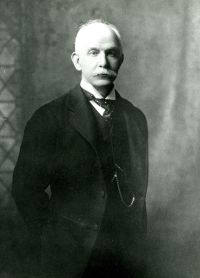
Brooks Adams

Brooks Adams

Summary

Portrait of Brooks Adams Brooks Adams The Law of Civilization and Decay… (1896 | notes)

Having lost its independence, the priesthood lapsed into an adjunct of the civil power; it then became reorganized upon an economic basis, and gradually turned into a salaried class, paid to inculcate obedience to the representative of an oligarchy which controlled the national revenue. Perhaps, in all modern history, there is no more striking example of the rapid and complete manner in which, under favourable circumstances, one type can supersede another, than the thoroughness with which the economic displaced the emotional temperament, in the Anglican Church, during the Tudor dynasty.
Source: Wikisource

Portrait of Brooks Adams Brooks Adams The Law of Civilization and Decay… (1896 | notes)

Men like Drake, Blake, and Cromwell were among the most terrible warriors of the world, and they were distrusted and feared by an oligarchy which felt instinctively its inferiority in arms. Therefore, in Elizabeth's reign, politicians like the Cecils took care that the great seamen should have no voice in public affairs. And though these men defeated the Armada, and though England owed more to them than to all the rest of her population put together, not one reached the peerage, or was treated with confidence and esteem.
Source: Wikisource

Portrait of Brooks Adams Brooks Adams The Law of Civilization and Decay… (1896 | notes)

Docility to lay dictation has always been the test by which the Anglican clergy have been sifted from Catholics and Puritans. To the imaginative mind a faith must spring from a revelation, and a revelation must be infallible and unchangeable. Truth must be single. Catholics believed their revelation to be continuous, delivered through the mouth of an illuminated priesthood, speaking in its corporate capacity.
Source: Wikisource

Get perspective with Kwize: daily news enlightened by great literature