Summary

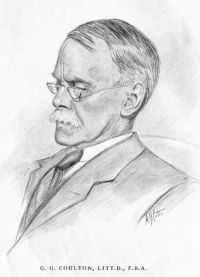
Portrait of G. G. Coulton G. G. Coulton Chaucer and His England

To the contemporary authors of Piers Plowman, and in a less degree to John Gower, the world of that time was Vanity Fair in Bunyan’s sense; a place of constant struggle and danger, in which every honest pilgrim marches with his back to the flames of the City of Destruction, marks their lurid glare on the faces of the crowd, and sees the slightest gesture magnified into shadows that reach to the very stars. To Chaucer the poet it was rather Thackeray’s Vanity Fair: a place where the greatest problems of life may be brought up for a moment, but can only be dismissed as insoluble
Source: Gutenberg

Portrait of G. G. Coulton G. G. Coulton Chaucer and His England

It is a healthy instinct which prompts us to dwell on the beauties of an ancient timber-built house, or on the gorgeous pageantry of the Middle Ages, without a too curious scrutiny of what may lie under the surface; and at this distance the 14th century stands out to the modern eye with a clearness and brilliancy which few men can see in their own age, or even in that immediate past which must always be partially dimmed with the dust of present-day conflicts.
Source: Gutenberg

Portrait of G. G. Coulton G. G. Coulton Chaucer and His England

Boccaccio wrote for a society that was in many ways over-refined already; it is fortunate for us that Chaucer’s public was not yet at that point of literary development at which art is too often tempted into artifice. He took the living men day by day, each in his simplest and most striking characteristics; and from all these motley figures, under the artist’s hand, grew a mosaic in which each stands out with all the glow of his own native colour, and with all the added glory of the jewelled hues around him. The sharp contrasts of medieval society gave the poet here a splendid opportunity.
Source: Gutenberg

Get perspective with Kwize: daily news enlightened by great literature