Summary

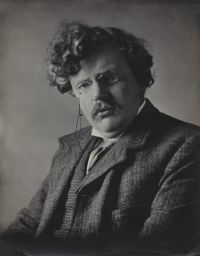
Portrait of Gilbert Keith Chesterton Gilbert Keith Chesterton The New Jerusalem — Chapter IV: The Philosophy of Sight-seeing (1920)

Yet for us who are familiar with it all that gaudy advertisement fades into a background, just as the gaudy oriental patterns fade into a background for those oriental priests and pilgrims. Just as the innocent Kensington gentleman is wholly unaware that his black top hat is relieved against a background, or encircled as by a halo, of a yellow hoarding about mustard, so is the poor guide sometimes unaware that his small doings are dark against the fainter and more fading gold in which are traced only the humbler haloes of the Twelve Apostles.
Source: Wikisource

Portrait of Gilbert Keith Chesterton Gilbert Keith Chesterton The New Jerusalem — Chapter IV: The Philosophy of Sight-seeing (1920)

I can understand a man who had only seen in the distance Jerusalem sitting on the hill going no further and keeping that vision for ever. It would, of course, be said that it was absurd to come at all, and to see so little. To which I answer that in that sense it is absurd to come at all. It is no more fantastic to turn back for such a fancy than it was to come for a similar fancy. A man cannot eat the Pyramids; he cannot buy or sell the Holy City; there can be no practical aspect either of his coming or going. If he has not come for a poetic mood he has come for nothing
Source: Wikisource

Portrait of Gilbert Keith Chesterton Gilbert Keith Chesterton The New Jerusalem — Chapter IV: The Philosophy of Sight-seeing (1920)

Various cultivated critics told me that I should find Jerusalem disappointing; and I fear it will disappoint them that I am not disappointed. Of the city as a city I shall try to say something elsewhere; but the things which these critics have especially in mind are at once more general and more internal. They concern something tawdry, squalid or superstitious about the shrines and those who use them. Now the mistake of critics is not that they criticise the world; it is that they never criticise themselves.
Source: Wikisource

Get perspective with Kwize: daily news enlightened by great literature