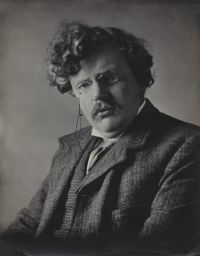
Gilbert Keith Chesterton

Gilbert Keith Chesterton

Summary

Portrait of Gilbert Keith Chesterton Gilbert Keith Chesterton The Victorian Age in Literature (1913)

People put the matter wrong when they say that the novel is a study of human nature. Human nature is a thing that even men can understand. Human nature is born of the pain of a woman; human nature plays at peep-bo when it is two and at cricket when it is twelve; human nature earns its living and desires the other sex and dies. What the novel deals with is what women have to deal with; the differentiations, the twists and turns of this eternal river. The key of this new form of art, which we call fiction, is sympathy.
Source: Wikisource

Portrait of Gilbert Keith Chesterton Gilbert Keith Chesterton The Victorian Age in Literature (1913)

Dickens did not merely believe in the brotherhood of men in the weak modern way; he was the brotherhood of men, and knew it was a brotherhood in sin as well as in aspiration. And he was not only larger than the old factions he satirised; he was larger than any of our great social schools that have gone forward since he died.
The seemingly quaint custom of comparing Dickens and Thackeray existed in their own time, and no one will dismiss it with entire disdain who remembers that the Victorian tradition was domestic and genuine, even when it was hoodwinked and unworldly.
Source: Wikisource

Portrait of Gilbert Keith Chesterton Gilbert Keith Chesterton The Victorian Age in Literature (1913)

England became much more of an island than she had ever been before. There fell from her about this time, not only the understanding of France or Germany, but to her own long and yet lingering disaster, the understanding of Ireland. She had not joined in the attempt to create European democracy; nor did she, save in the first glow of Waterloo, join in the counter-attempt to destroy it. The life in her literature was still, to a large extent, the romantic liberalism of Rousseau, the free and humane truisms that had refreshed the other nations, the return to Nature and to natural rights.
Source: Wikisource

Get perspective with Kwize: daily news enlightened by great literature