Summary

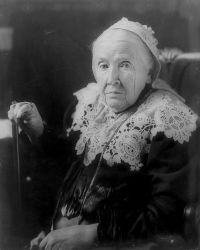
Portrait of Julia Ward Howe Julia Ward Howe From the Oak to the Olive: A Plain record of a Pleasant Journey

Before the shadows grew quite dark, a barouche or two, with ladies and livery, would drive across the Piazza, giving a whiff of fashion like the gleam of red costume that heightens a landscape. And the people sat, ate and drank, came and went, in sober gladness, not laughing open-mouthed—rather smiling with their eyes. From our narrow hotel balcony we used to look down and wonder whether we should ever be cool again. For though the evenings were not sultry, their length did not suffice to reduce the fever of the day. And the night within the mosquito-nettings was an agony of perspiration.
Source: Gutenberg

Portrait of Julia Ward Howe Julia Ward Howe From the Oak to the Olive: A Plain record of a Pleasant Journey

The Venetian school is, however, to the Florentine much as Rossini's Barbière to Dante's Divina Commedia. Here all is color, vitality, energy. The superabundance of life and of temperament does not allow the severer deliberations of thoughtful art. The finest picture of this school, the Assumption of Titian, is the intense embodiment of the present, an ideal moment that presupposes no antecedent and no successor. It is as startling as a sudden vision. But it is a vision of life, not of paradise. The Madonna is a grand, simple, human woman, whose attitude is more rapt than her expression.
Source: Gutenberg

Portrait of Julia Ward Howe Julia Ward Howe From the Oak to the Olive: A Plain record of a Pleasant Journey

The Italian school was to art what the Greek school was to literature—an original creation and beginning. But life has surpassed Plato and Aristotle. We are forced to piece their short experiences, and to say to both, "You are matchless, but insufficient." And so, though Raphael's art remains immortal and unsurpassed, we are forced to say of his thought, "It is too small." No one can settle, govern, or moralize a country by it. It will not even suffice to reform Italy. The golden transfigurations hang quiet on the walls, and let pope and cardinal do their worst.
Source: Gutenberg

Get perspective with Kwize: daily news enlightened by great literature