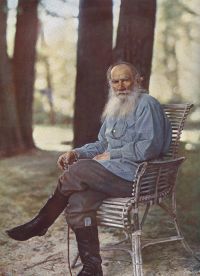
Leo Tolstoy

Leo Tolstoy

Summary

Portrait of Leo Tolstoy Leo Tolstoy Tolstoy on Shakespeare (1906)

The drama in our time is a great man fallen, who has reached the last degree of his degradation, and at the same time continues to pride himself on his past of which nothing now remains. The public of our time is like those who mercilessly amuse themselves over this man once so great and now in the lowest stage of his fall.
Such is one of the mischievous effects of the epidemic suggestion about the greatness of Shakespeare. Another deplorable result of this worship is the presentation to men of a false model for imitation.
Source: Wikisource

Portrait of Leo Tolstoy Leo Tolstoy Tolstoy on Shakespeare (1906)

One sees at once that he does not believe in what he says, that it is of no necessity to him, that he invents the events he describes, and is indifferent to his characters—that he has conceived them only for the stage and therefore makes them do and say only what may strike his public; and therefore we do not believe either in the events, or in the actions, or in the sufferings of the characters. Nothing demonstrates so clearly the complete absence of esthetic feeling in Shakespeare as comparison between him and Homer.
Source: Wikisource

Portrait of Leo Tolstoy Leo Tolstoy Tolstoy on Shakespeare (1906)

The obvious exaggeration of this estimate proves more conclusively than anything that it is the consequence, not of common sense, but of suggestion. The more trivial, the lower, the emptier a phenomenon is, if only it has become the subject of suggestion, the more supernatural and exaggerated is the significance attributed to it. The Pope is not merely saintly, but most saintly, and so forth. So Shakespeare is not merely a good writer, but the greatest genius, the eternal teacher of man kind.
Source: Wikisource

Get perspective with Kwize: daily news enlightened by great literature