Summary

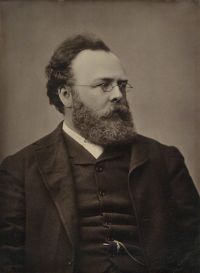
Portrait of Robert Williams Buchanan Robert Williams Buchanan The Fleshly School of Poetry and Other Phenomena of the Day (1872)

In justice we should observe that a madman is speaking; but this madman has Mr. Rossetti's gift, for here is the sort of conceit with which he delights the priest:—
"She had a mouth
Made to bring death to life,—the underlip
Suck'd in, as if it strove to kiss itself."
With the Della Cruscan, the attempt to seem subtle and striking becomes a positive mania. What would be said of a poet who wrote thus?—
Her nose inclined to heaven,
As if it tried to turn up at itself!
Yet the one metaphor is every whit as sensible and brilliant as the other.
Source: Wikisource

Portrait of Robert Williams Buchanan Robert Williams Buchanan The Fleshly School of Poetry and Other Phenomena of the Day (1872)

The form of Verse was at one period held to be the noblest possible kind of human utterance; but that form, remaining as it does in the swaddling-clothes of infant speech, will possibly be more or less abandoned as time rolls on by the thinkers and dreamers of the world. The word poetry may one day be identical with absurdity; and no one will jingle the cap and bells of rhyme but a fool. Is there no hope? Yes, a gleam. All the blundering and all the time-wasting in our literature have been caused by eternal posturing before the mirror.
Source: Wikisource

Portrait of Robert Williams Buchanan Robert Williams Buchanan The Fleshly School of Poetry and Other Phenomena of the Day (1872)

Whether he is writing of the holy Damozel, or of the Virgin herself, or of Lilith, or of Helen, or of Dante, or of Jenny the street-walker, he is fleshly all over, from the roots of his hair to the tip of his toes; never a true lover merging his identity into that of the beloved one; never spiritual, never tender; always self-conscious and æsthetic. "Nothing in human life," says a modern writer, "is so utterly remorseless—not love, not hate, not ambition, not vanity—as the artistic or æsthetic instinct morbidly developed to the suppression of conscience and feeling;"
Source: Wikisource

Get perspective with Kwize: daily news enlightened by great literature