Ab

Definition and stakes

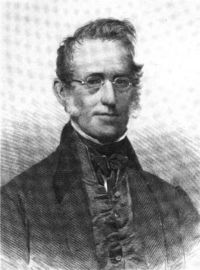
Portrait of Henry Rowe Schoolcraft Henry Rowe Schoolcraft,  The Indian in his Wigwam; Or, Characteristics of the Red Race of America

“ Ab, often pronounced with the sound of we, before it,—a particle which, in geographical names, in the family of the Algonquin dialects, denotes light, or the east. It is also the radix of the verb wab, to see, as well as of the derivatives, a-ab, an eye-ball, and wabishka, a white substance, &c.,—ideas which either in their origin or application, are closely allied. ”

Source: Gutenberg

Rowland Jones,  Hieroglyfic: or, a Grammatical Introduction to an Universal Hieroglyfic Language

“ There are no adjectives terminating in b except ib, which signifies life to beings, as in glib liquid, and bib to drink; for ab, eb, ob, ub, signifying from or out of life, would be improper to express life to things, as descending upon, and penetrating them, so as to give them motion, growth, generation, and sensation. ”
Source: Gutenberg

Charlton T. Lewis,  A Latin Dictionary (1879)

“ Ab ab ăb, ā, abs, preposition with the ablative case. This Indo-European particle (Sanscrit apa or ava; Etruscan av; Greek 'απó; Gothic af; Old German aba; New German ab; English of, off) has in Latin the following forms: ap, af, ab (av) , au-, â, ă; aps, abs, as-. The existence of the oldest form, ap, is proved by the oldest and best manuscripts analogous to the preposition apud, the Sanscrit api, and the Greek 'επí, and by the weakened form, af, which, by the rule of historical grammar and the nature of the Latin letter f, can be derived only from ap, not from ab. ”
Source: Wikisource

Get perspective with Kwize: daily news enlightened by great literature