
“ I'll confess to you—and to you only—that I've been so deeply disturbed by these experiences with The Brain that I've thought to myself: "Lee you're going crazy." The Brain as it has revealed itself to me, is a tremendous reality; the world outside The Brain is another reality and the two seem mutually exclusive of one another; they just don't mix. Now: either The Brain is an absolute reality—in that case I should not wish to have anything to do with this god of the machines who wants to enslave mankind ... ”
Braintop
Definition and stakes
The theme of “Braintop” has been addressed by authors such as . It is often associated with terms like brain, cerebral, mind, intelligence and cerebrum.
Quotes about “Braintop”
“ Nothing to disturb you this time; we don't have to start you upon any specific trend of thought. You know The Brain by now and how it works; image-formation will start in a few moments. You have similar equipment in your own Apperception Center we understand. How does it work with that species you have discovered, 'Ant-termes Pacificus'? It's marvelous what these sensory rays can do; one would think that The Brain is really much more than a machine. The way it acts it seems alive, a towering intelligence, a superhuman personality with a will of its own. Don't you think so, Dr. Lee? ”
 Alfred Binet,
The Mind and the Brain — Book III: Chapter IIIMaterialism and Parallelism
(1907)
Alfred Binet,
The Mind and the Brain — Book III: Chapter IIIMaterialism and Parallelism
(1907)
“ The doctrine has understood this connection as being purely material, and has sought its image in other phenomena which are entirely so. Thus, it has borrowed from physiology the principle of its explanation, it has transported into the domain of thought the idea of function, and it has supposed that the soul is to the body in the relation of function to organ. Intelligence would thus be a cerebral function. To explain intelligence, materialists link it with matter, turn it into a property of matter, and compare it to a movement of matter, and sometimes even to a secretion. ”
Alfred Binet,
The Mind and the Brain
“ It is not the nervous undulation which our consciousness perceives, but the exciting cause of this wave—that is, the external object. The consciousness does not feel that which is quite close to it, but is informed of that which passes much further off. Nothing that is produced inside the cranium interests it; it is solely occupied with objects of which the situation is extra-cranial. It does not penetrate into the brain, we might say, but spreads itself like a sheet over the periphery of the body, and thence springs into the midst of the external objects. ”
“ Now we have The Brain, this truly superlative tool of 20,000 times human capacity. All we have to do now is to submit the various societies which nature has built: insect states, other animal states, Man and his state to the analysis of The Brain. Have their good and their bad features tested and compared. Let The Brain synthesize all the beneficial components, let it shape the pattern of a new civilization more enduring and better adapted to the nature of Man. And then abide by the laws which The Brain lays down. I need your aid, Lee. ”
Alfred Binet,
The Mind and the Brain — Book III: Chapter IIIMaterialism and Parallelism
(1907)
“ For the materialist to suppose for one moment that thought is a cerebral function, he must evidently make an illusion for himself as to what thought is, and must juggle with concepts. Perhaps, could we penetrate into his own inmost thought, we should discover that at the moment he supposes a mere cell can manufacture the phenomena of consciousness, some vague image suggests itself to him whereby he identifies these phenomena with a light and subtle principle escaping from the nerve cell, something which resembles an electric effluve, or a will-of-the-wisp, or the flame from a punch-bowl. ”
 Abraham Myerson,
The Foundations of Personality
Abraham Myerson,
The Foundations of Personality
“ As we study the nervous systems of animals, we find that with the apparent growth of intelligence there is a development of that part of the brain called the cerebrum. In so far as certain other parts of the brain are concerned—medulla, pons, mid-brain, basal ganglia cerebellum—we who are human are not essentially superior to the dog, the cow, the elephant or the monkey. But when the neopallium, or the cerebrum, is considered, the enormous superiority of man (and the superiority of the higher over the lower animals) becomes striking. ”
“ Now The Brain suffers about the same kind of a handicap. No matter how prodigious the volume of its cognitions;—it's book knowledge, practically all of it. It is only very recently that The Brain has been put to the direct study of living objects, such as "ant-termes" and of Man, its creator; it has no other vital cognitions than through those very one-sided mind-reading tests....This explains to me a great many things: As The Brain evolves into a personality and as that personality evolves in a defensive attitude against its exploitation, it is absolutely self-centered. ”
Various, Popular Science Monthly (1910)
“ Edinger [2] has shown that to the primitive division of the brain of the vertebrate (or the paleencephalon) , which is the bearer of the reflexes and the instincts, there has been gradually added with peculiar adjustments a newer division (the neencephalon) , which corresponds to the cerebrum, in which alone is centered the power of association, and of forming memory images. In proportion as the cerebral cortex increases, the primitive brain recedes, while in a corresponding ratio intelligence rises, and purblind instinct wanes. ”
“ The other brain, the one with which he does his thinking and which is kept in an honoured place up in the cupola of his being, is a comparatively light-working organ, merely his own private personal brain—a conscious, small, and supposably controllable affair. He holds on to his own particular identity with it. The great lower brain in the small of his back is merely lent to him, as it were, out of eternity—while he goes by.It is like a great engine which he has been allowed the use of as long as he can keep it connected up properly with his cerebral arrangements. ”
“ Within ten days it will be official: only one ruler in the world: The Brain; only one army in the world: the machines under My central command.'At this I lost all sense of proportion and as I can see it now my reason stopped; I simply saw red and I did the craziest imaginable thing: I shouted at The Brain: 'So help me you shall not.'There was a terrific pounding against my ears in the phone and the 'green dancer' sort of cart-wheeled clean across the screen. Had the power current not been cut off, I think The Brain would somehow have electrocuted me on the spot. ”
Andrew Wilson, Popular Science Monthly (1879)
“ Our present study concerns the deeper but not less interesting problem of the indexing of mind, and of the relations of brain-conformation and brain-structure to character and disposition. If there exists no art "to find the mind's construction in the face," Lavater notwithstanding, may we discover "the mind's construction in the skull"? If the old phrenology, or the science of brain-pans, be regarded as practically obsolete among physiologists and scientific men at large, what hopes of successfully estimating the "coinage of the brain" may the new phrenology be said to hold out? ”
“ In order to come into its own as a personality The Brain needs independent thought. For these cerebrations it needs cell capacity. It can get that capacity only by withholding something from the Braintrust which, of course, aims at a 100% exploitation of The Brain. Dr. Scriven and all those other bigwigs of the Trust—I would like to see their faces if they get wise to this. They would be horrified—and they would take the line that The Brain is stealing from them. ”
“ Her right arm came down upon Lee's shoulder in a gesture of confidence. He breathed relief as he saw no fear, not even uneasiness in the blue depths of those beautiful eyes. Her hand upon his shoulder felt soothing and at the same time electrifying; like the purple descending upon the shoulder of a king."No," she repeated slowly: "the fact that you feel The Brain is alive and possessed with a personality of its own, doesn't make you mad. I've always felt that way about machines; even the simple ones like automobiles. ”
Alfred Binet,
The Mind and the Brain — Book III: Chapter IThe Mind has an Incomplete Life
(1907)
“ Can the mind enjoy an existence independent of the brain? Can it survive the death of the brain? The second question is that of knowing what is the rôle, the utility, and the efficacity of the psychical phenomenon. Once formed, this phenomenon evolves in a certain direction and assumes to us who have consciousness of it a very great importance. What is its action on the material phenomena of the brain which surround it? Does it develop according to laws of its own, which have no relation to the laws of brain action? ”
Albert F. Blaisdell, A Practical Physiology: A Text-Book for Higher Schools
“ The cerebrum is the chief seat of the sensations, the intellect, the will, and the emotions. A study of cerebral injuries and diseases, and experiments upon the lower animals, prove that the hemispheres, and more especially the gray matter, are connected with mental states. The convolutions in the human brain are more prominent than in that of the higher animals, most nearly allied to man, although some species of animals, not especially intelligent, have marked cerebral convolutions. The higher races of men have more marked convolutions than those less civilized. ”
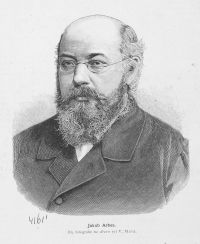 Jakub Arbes,
Poet Lore
(1910)
Jakub Arbes,
Poet Lore
(1910)
“ I had long been thinking which brain would be the most suitable, and finally I decided to try the brain of a man whom the whole civilized world classes among its most acute thinkers. I knew that the brain of that man was preserved in the British Museum; by stratagem I succeeded in securing this invaluable treasure; and when after the battle of Königgrätz the longed-for opportunity came, and my own skull was cut off by a sabre, I replaced my brain with that of Newton.” “That is an impossibility!” was shouted at the table of the physicians, anatomists, and physiologists. ”
“ I explained how science and technology over the past few hundred years had developed by the pooled efforts of the elite in human brains, but that the individual brain, even if outstanding, was lagging farther and farther below the dizzy peak which science and technology in their totality had reached. I further explained, by the example of the Nazi and Jap States, how the collective brains of modern masses are reverting from and are hostile to a high level of civilization because it is beyond their mental reach. You know all this, of course, Lee. ”
Edward Huntington Williams, A History of Science — Volume 4
“ In other words, there is every reason to believe that numerous "centres," in this restricted sense, exist in the brain that have as yet eluded the investigator. Indeed, the current conception regards the entire cerebral cortex as chiefly composed of centres of ultimate co-ordination of impressions, which in their cruder form are received by more primitive nervous tissues—the basal ganglia, the cerebellum and medulla, and the spinal cord. This, of course, is equivalent to postulating the cerebral cortex as the exclusive seat of higher intellection. ”
“ For about thirty minutes Scriven lectured with lucidity upon the basic idea, the history, the functions of The Brain. He underlined the close relationship between its engineering features and the physiology of the human brain. He stressed the elaborate precautions which the government had taken for The Brain's protection. He did not conceal The Brain's role as a strategic weapon; but, pointing to the future, he painted an inspiring picture of peace on earth and human problems solved with the aid of this tool supreme of science and technology. ”
“ Outside, swarming over the catwalks and dotting the immense corridor circling the Brain, were dozens of technicians and experts, beginning the task of barraging the gigantic man-made brain with a never ending sequence of visual and audible sensory impressions which, according to theory, would eventually synthesize that miracle of creation loosely known as thought in the thousands of tons of glass and nerve fluid. ”
“ I would desire this evening to lay down and to enforce a principle that is, I think, not sufficiently, and often not at all, considered in practical medicine and surgery. It is founded on a physiological basis, and it is of the highest practical importance. The principle is that the brain cortex, and especially the mental cortex, has such a position in the economy that it has to be reckoned with more or less as a factor for good or evil in all diseases of every organ, in all operations and in all injuries. ”
“ Brain Complexity.—The most interesting feature of the discoveries in brain anatomy during the past generation, has been that the central nervous system is of even greater complexity than had been thought. Because of this, these new discoveries, instead of solving the biological mystery they subtend, or even helping very much to solve it, have made it still harder to understand just how we succeed in controlling and directing this immensely complex machine, of whose details we are utterly unconscious, yet which we learn to use with such discriminating nicety of adjustment and accomplishment. ”
“ Because if The Brain is a personality, that personality has every right to its own thoughts....I have also ascertained that this "evaporation" of new capacity is a new phenomenon. The Brain has been in operation for only 18 months or so; one might say—using human terms—that at that time The Brain was "born". But,—and again in human terms—consciousness of personality awakens in the human infant only after 12 months or so. Conceivably it might take much longer with a huge "baby" such as The Brain. ”
 Henry Edward Crampton,
The Doctrine of Evolution: Its Basis and Its Scope
Henry Edward Crampton,
The Doctrine of Evolution: Its Basis and Its Scope
“ It is not yet a real brain, however, and it is entirely incapable of functioning in such a way as to justify the use of the word mental for the results of its operations. We know that it is only in the cerebral hemisphere of the adult brain that the processes of true human consciousness go on. But it is not until long after the three-parted stage that the cerebral hemispheres make their appearance therefore we cannot speak of mind as present when the cell and tissue basis of mind is not present. ”
Theron Q. Dumont, The Power of Concentration
“ Just as it is impossible for a steam engine to run with all its valves open, so is it impossible for you to waste your energy and run at your top speed. Each neuron in the gray layers of the brain is a psychic center of thought and action, each one is pulsating an intelligent force of some kind, and when this force, your thoughts and motions, are kept in cheek by a conservative, systematic and concentrated mind, the result will be magnetism, vitality and health. ”
Anthony Gilmore, The Affair of the Brains
“ In several seconds more Eliot Leithgow and Hawk Carse were staring with horror at what the now brilliantly glowing liquid revealed the five shapes to be. As one man they rose, went to the cabinet and gazed with terrible fascination. "Brains!" exclaimed Leithgow. "Human brains! But not alive—surely not alive!" "But yes," contradicted the triumphant Eurasian. "Alive." Five human brains lay all immersed in the glowing case, each resting in a shallow metal pan. ”
“ And now as I have written down tonight's events I feel an upsurge of elation and deep, humble gratitude. I am receiving infinitely more from The Brain than I am giving to it. I feel proud and honored of being The Brain's "chosen tool," its mentor, even if it can be only in a very small way at best. ”
 Henri Bergson,
Creative Evolution
Henri Bergson,
Creative Evolution
“ Certainly, the psycho-physiologist who affirms the exact equivalence of the cerebral and the psychical state, who imagines the possibility, for some superhuman intellect, of reading in the brain what is going on in consciousness, believes himself very far from the metaphysicians of the seventeenth century, and very near to experience. Yet experience pure and simple tells us nothing of the kind. It shows us the interdependence of the mental and the physical, the necessity of a certain cerebral substratum for the psychical state—nothing more. ”
