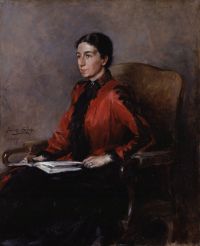
“ The semi-transparent folds of the black brought out the brilliance of the white neck and shoulders, the pale carnations of the face, the beautiful hair, following closely the contours of the white brow. Even through all his pain and preoccupation, Buntingford admired; was instantly conscious of the sheer pleasure of her beauty. But it was the pleasure of an artist, an elder brother—a father even. Her mother was in his mind, and the strong affection he had begun to feel for his ward was shot through and through by the older tenderness. ”
Buntingford
Definition and stakes
Quotes about “Buntingford”
E. F. Benson,
Buntingford Jugs
(1926)
“ As he sat at his solitary dinner that night, the idea matured. He believed that he had guessed what her new collection was, and the name of it was Buntingford ware. He guessed, too, that Buntingford ware was already dear to her, the collection she was making had got a place in her heart, and it would wring her heart when the day came for selling it, as had been the case with her Chelsea figures. But it would be even more heart-breaking, he thought, if she could not get on with her collection. ”
E. F. Benson,
Buntingford Jugs
(1926)
“ She must be in a condition to realise that it was no use fighting him either in the field of matrimony or in that of Buntingford jugs. She must learn that he was stronger than she. He had turned into a side-street where there were many curiosity shops, and his progress was slow. Then he gave a gasp of amazed wonder, and his eyes started from his head. There in an inconspicuous shop facing him was a tea-set—tea-pot, sucrier, milk jug, bread-and-butter plate, and six cups and saucers—all of Buntingford ware. And the foolish experts knew of no such thing ”
E. F. Benson,
Buntingford Jugs
(1926)
“ I've never cared for anything so much in my life. The only consolation is that the price has gone up immensely, and I have no doubt I shall sell the pieces I've got at a great profit." "Perhaps, then, you might tell me what it is," he said. "Why, I forgot you didn't know," said she. "Naturally there's no secret about it now. I sent my pieces down to the shop this morning. Buntingford jugs. I suppose you've never heard of Buntingford ware?" ”
Anthony Trollope,
Mr. Scarborough's Family
“ He had been ordered to admit no visitor into the house at all, unless it were some one from the firm of Grey & Barry. From the moment in which he had got rid of Miss Thoroughbung he had been subject to some dread lest she should return. Or if not she herself, she might, he thought, send Soames & Simpson, or some denizen from the brewery. And he was conscious that not only all Buston, but all Buntingford was aware of what he had attempted to do. Every one whom he chanced to meet would, as he thought, be talking of him, and therefore he feared to be seen by the eye of man, woman, or child. ”
E. F. Benson,
Buntingford Jugs
(1926)
“ All round the billiard table, nicely spaced, was a row of Buntingford jugs, and in the middle the tea-set. He inspected it just before she came, and locked the door. Mrs. Aylwin was in excellent spirits again, all her dejection had passed, and she was her cheerful self. "I've been making myself miserable, Tony," she said as they lunched, "and I'm tired of it. I've been beaten. I don't like being beaten, but when you are beaten, the best thing to do is to acknowledge it, and begin on something else." "Oh, your last collection," said he. ”
Hulbert Footner, The Obsession (1911)
“ Bunting said to me. "We won't take any servants. I shall do the cooking, Thomas will steer, and we're taking a young man from Mr. Bunting's office who knows all about machinery. He's a gentleman and will be quite one of us," she thought it necessary to add. Mrs. Bunting, I should tell you, is a dear little old fashioned rolypoly, with her front hair waved and laid down smooth on each side of her forehead. She always has a surprised and scandalized look. Her husband has been poking fun at her for twenty-five years, and she still takes him seriously. ”
Marie Belloc Lowndes,
The Lodger
“ Bunting went into the sitting-room, silently followed by his wife, and then, sitting down in his nice arm-chair, he poked the little banked-up fire. It was the first time Bunting had poked the fire for many a long day, and this exertion of marital authority made him feel better. A man has to assert himself sometimes, and he, Bunting, had not asserted himself enough lately. ”
Marie Belloc Lowndes,
The Lodger
“ But Londoners of Bunting’s class have an uneasy fear of the law. To his mind it would be ruin for him and for his Ellen to be mixed up publicly in such a terrible affair. No one concerned in the business would give them and their future a thought, but it would track them to their dying day, and, above all, it would make it quite impossible for them ever to get again into a good joint situation. It was that for which Bunting, in his secret soul, now longed with all his heart. ”
Marie Adelaide Belloc Lowndes,
The Lodger
(1913)
“ Like most men and women of his class, Bunting took a great interest in other people’s ailments, the more interest that he was himself so remarkably healthy. He would feel quite injured if Ellen didn’t tell him everything that had happened; everything, that is, that the doctor had told her. As she walked swiftly along, at every corner, or so it seemed to her, and outside every public-house, stood eager boys selling the latest edition of the afternoon papers to equally eager buyers. "Avenger Inquest?" they shouted exultantly. "All the latest evidence!" ”
Edward Verrall Lucas,
Highways and Byways in Sussex
(1904)
“ Walking west from Wiston we come to the tiny hamlet of Buncton, one of the oldest settlements in Sussex, a happy hunting ground for excavators in search of Roman remains, and possessing in Buncton chapel a quaint little Norman edifice. The word Buncton is a sign of modern carelessness for beautiful words: the original Saxon form was "Biohchandoune," which is charming. Buncton belongs to Ashington, two miles to the north-west on the Worthing road, a quiet village with a fifteenth-century church (a mere child compared with Buncton Chapel) and a famous loss. ”
Marie Belloc Lowndes,
The Lodger
“ Bunting’s relief—yes, to her inexpressible relief—Sir John Burney and his friends swept on. They passed Mr. Sleuth and the girl by his side, unaware, or so it seemed to her, that there was anyone else in the room but themselves. “Hurry up, Mrs. Bunting,” said the turnstile-keeper; “you and your friends will have the place all to yourselves for a bit.” From an official he had become a man, and it was the man in Mr. Hopkins that gallantly addressed pretty Daisy Bunting: “It seems strange that a young lady like you should want to go in and see all those ’orrible frights,” he said jestingly. ”
Laura Lee Hope, Six little Bunkers at Uncle Fred's
“ Bunker, sitting up in bed. She looked at her husband. "Where is Mun Bun?" she asked."I don't know," he answered. "He was sleeping with me, but, all of a sudden, I woke up and Mun Bun was not with me.""He must have awakened and got up to get a drink, or something," said Mrs. Bunker. "Then when he went to go back again, he couldn't find the place where you were, and he's either crawled in with Russ [62] and Laddie, or with Rose and Violet. We must look for him.""I'll look," said Mr. Bunker. "You stay with Margy. If she wakes up and finds you gone, she'll cry and disturb the whole car. ”
Marie Adelaide Belloc Lowndes,
The Lodger
(1913)
“ It would be a good thing for Bunting to get even an occasional job—for the matter of that he could now take up a fairly regular thing in the way of waiting. Mrs. Bunting knew that it isn’t easy to get a man out of idle ways once he has acquired those ways. ”
Marie Belloc Lowndes,
The Lodger
“ She opened the door of their sitting-room and looked in. Yes, there was her husband, sitting back comfortably in his easy chair, reading a paper. And as she saw his broad, rather rounded back, Mrs. Bunting felt a sudden thrill of sharp irritation. There he was, doing nothing—in fact, doing worse than nothing—wasting his time reading all about those horrid crimes. She sighed—a long, unconscious sigh. Bunting was getting into idle ways, bad ways for a man of his years. But how could she prevent it? He had been such an active, conscientious sort of man when they had first made acquaintance. ”
Joseph Conrad,
Tales Of Hearsay
“ That very evening I went to see Bunter on board, and sympathized with him on his prospects for the voyage. He was subdued. I suppose a man with a secret locked up in his breast loses his buoyancy. And there was another reason why I could not expect Bunter to show a great elasticity of spirits. For one thing he had been very seedy lately, and besides—but of that later. Captain Johns had been on board that afternoon and had loitered and dodged about his chief mate in a manner which had annoyed Bunter exceedingly. ”
Frank L. Packard,
On the Iron at Big Cloud
(1911)
“ Munford would. So he kept his seat when the construction train pulled out just as the dawn was breaking, and twenty miles up the road at Twin Bear Creek they tumbled him off and introduced him to Alan Burton, foreman of Bridge Gang No. 3. At the sight of his battered and jaded crew, who in no wise appeared fit for the day's work before them, Burton swore savagely and with great bitterness of tongue bade them get to their work. Then he turned in his ill-humor to Munford, who was still standing beside him. "Who the devil are you? What you doin' here? Where d'ye come from?" ”
Joseph Conrad,
Tales Of Hearsay
“ Dear Mrs. Bunter used to worry a good deal after the Sapphire left for Calcutta. She would say to me: “It must be so awful for poor Winston”—Winston is Bunter's name—and I tried to comfort her the best I could. Afterwards, she got some small children to teach in a family, and was half the day with them, and the occupation was good for her. In the very first letter she had from Calcutta, Bunter told her he had had a fall down the poop-ladder, and cut his head, but no bones broken, thank God. That was all. ”
Joseph Conrad,
Tales Of Hearsay
“ Bunter was afraid of not keeping properly awake when on duty at night, that was another matter. “But I think you borrowed a novel to read from the second mate the other day—a trashy pack of lies,” Captain Johns sighed. “I am afraid you are not a spiritually minded man, Mr. Bunter. That's what's the matter.” Sometimes he would appear on deck in the middle of the night, looking very grotesque and bandy-legged in his sleeping suit. At that sight the persecuted Bunter would wring his hands stealthily, and break out into moisture all over his forehead. ”
Frank L. Packard,
On the Iron at Big Cloud
(1911)
“ Would he, he demanded of himself with a snort, have fired a man that had talked to him as he had talked to Burton, had he been in Burton's place? He would! And the gang, bridge, job and everything else could go to blazes! Munford sat up to emphasize his feelings on this point with a crash of his fist on the side of the bunk. He thrilled with the fierce joy of enacting just such a role as his imagination depicted, despising Burton accordingly for lacking in what were, to him, the essentials of a man. He decided, as he fell asleep, to make the foreman's life a burden to him—and he did. ”
Francis Lynde, The Honorable Senator Sage-Brush
“ Hiring a buckboard at the one livery stable in the place, he drove out to the "Little Mary," and found Blatchford, the friendly manager, smoking a black clay cutty pipe in his shack office. It did not take Blount over a minute to renew the pleasant acquaintance, and to state his dilemma."I'm hung up here with my special train, the wires are down and I can't get out," was his statement of the crude fact. "Didn't you tell me that you owned a motor-car?" ”
Frances Hodgson Burnett,
Through One Administration
“ Blundel was beguiled into a somewhat uneasy laugh."Well," he remarked, "you're frank enough."Richard fixed upon him an open, appreciative glance."And why not?" he answered. "There is our strong point,—that we can afford to be frank. We have nothing to conceal. We have something to gain, of course—who has not?—but it is to be gained legitimately—so there is no necessity for our concealing that. The case is simplicity itself. ”
Charles Whitehead, Lives and exploits of the most noted highwaymen… (1847)
“ Though his funds often afforded him the means of reformation, he naturally hated virtue and honesty; he, therefore, with redoubled keenness, pursued his depredations. Once, upon foot, he met with a butcher between Paddington and London, who, being a strong, lusty fellow, was not disposed to give his contribution to Bunce without an exchange of blows. The cudgelling commenced, and, though the butcher acted his part well, yet Bunce was victorious. The conqueror, on searching for his spoil, found the immense sum of fourpence in his pockets. ”
various contributors, Punch, Volume 147 — October 21st… (19th and 20th century)
“ Mrs. Bannockburn laughed. "I must say!" she exclaimed. "You to complain of things being done quickly! I've done all you told me," she continued. "Everything. I sent a notice to the Post Office about the telephone directory, telling them to alter the name. I sent to Kelly's about the London Directory. I told all the tradespeople. I got the cards. I even went further and ordered a few silver labels for your walking-sticks and umbrellas. I thought you would like that." Mr. Bannockburn puffed at his cigar and said nothing. ”
Marie Adelaide Belloc Lowndes,
The Lodger
(1913)
“ Mrs. Bunting drew herself up. The question as to Bunting’s occupation was no one’s business but theirs. Still, it wouldn’t do for her to show offence. "He goes out waiting," she said stiffly. "He was a gentleman’s servant, sir. He could, of course, valet you should you require him to do so." And then she turned and led the way up the steep, narrow staircase. At the top of the first flight of stairs was what Mrs. Bunting, to herself, called the drawing-room floor. It consisted of a sitting-room in front, and a bedroom behind. ”
“ Bunting. There were just the three, Adeline Glendower being the third; and Fred and the three other girls, I understand, hung about in a [61] general sort of way up and down the staircase (to the great annoyance of the servants who were thus kept out of it altogether) confirming one another’s views of the tail, arguing on the theory of mermaids, revisiting the garden and beach and trying to invent an excuse for seeing the invalid again. They were forbidden to intrude and pledged to secrecy by Mrs. Bunting, and they must have been as altogether unsettled and miserable as young people can be. ”
Joseph Conrad,
Notes on My Books
“ As a matter of fact, on that evening of Carnival, those two, Mills and Blunt, had been actually looking everywhere for our man. They had decided that he should be drawn into the affair if it could be done. Blunt naturally wanted to see him first. He must have estimated him a promising person, but, from another point of view, not dangerous. Thus lightly was the notorious (and at the same time mysterious) Monsieur George brought into the world; out of the contact of two minds which did not give a single thought to his flesh and blood. ”
William MacLeod Raine,
A Meeting of His Creditors
(1899)
“ Another man might have objected. Blount merely shrugged his shoulders. He had been weary for an adventure. Here was one ready made to his hand. He produced a kerchief, and the outlaw bound it over his eyes. As they passed through the woods, Blount could tell from the rustling in the bushes that they were being watched. It did not alarm him in the least. He had but to disclose his name and they would let him go. There were no outlaws in England who would interfere with Eustace Blount. Their trades were too near alike. ”
Augustus J. C. Hare,
The Story of My Life, volumes 1-3
“ The elder, Mary, was very delicate in health, but a very pretty, gentle old lady, who always wore an immense bonnet, ending in a long shade of the kind called "an ugly," so that people used to call her "the old lady down the telescope." Buntingsdale is one of the finest houses in Shropshire, a large red brick mansion, with very handsome stone mouldings and pillars, and a most splendid flower-garden, bordered by a high terrace overlooking the little shining river Terne and its pretty watermeadows. ”