“ Similarly they relate of Diogenes of Sinope,262 when he began to be a philosopher, that the Athenians were celebrating a festival, and there were public banquets and shows and mutual festivities, and drinking and revelling all night, and he, coiled up in a corner of the market-place intending to sleep, fell into a train of thought likely seriously to turn him from his purpose and shake his resolution, for he reflected that he had adopted without any necessity a toilsome and unusual kind of life, and by his own fault sat there debarred of all the good things. At that moment, however, they say a mouse stole up and began to munch some of the crumbs of his barley-cake, and he plucked up his courage and said to himself, in a railing and chiding fashion, "What say you, Diogenes? ”
Diogenes of Sinope
Definition and stakes
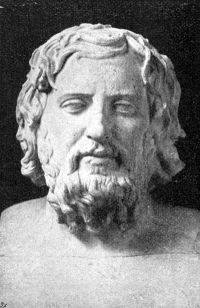
Diogenes of Sinope (c. 413–324/321 BCE), a 4th-century BC Greek Cynic philosopher, is renowned for his ascetic way of life, radical critiques of societal norms, and promotion of a return to nature. Born into a wealthy family in Sinope, his exile following a currency scandal prompted his rejection of materialism and adoption of a life of poverty.
Authors like Plutarch emphasize his philosophical determination, while Xenophon mentions his connection to Sinope. Diogenes Laërtius relates stories of his defiance, such as confronting Alexander the Great, and Cicero recognizes his influence. His legacy lies in his unwavering challenge to artificial values, shaping Cynicism’s principles of self-reliance and cosmopolitanism.
Quotes about “Diogenes of Sinope”
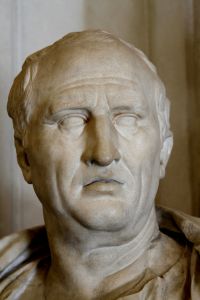 Marcus Tullius Cicero,
The Academic Questions, Treatise De Finibus…
(1891)
Marcus Tullius Cicero,
The Academic Questions, Treatise De Finibus…
(1891)
“ In a treatise in which he discussed the nature of the Gods he contended for the unity of the Deity, and asserted that man is unable to know him by any sensible representation, since he is unlike any being on earth; and demonstrated the sufficiency of virtue for happiness, by the doctrine that outward events are regulated by God so as to benefit the wise and good. Diogenes, a native of Sinope in Pontus, who was born b.c. 412, was one of his few disciples; he came at an early age to Athens, and became notorious for the most frantic excesses of moroseness and self-denial. ”
Samuel G. Goodrich, Famous Men of Ancient Times
“ DIOGENES.This eccentric individual was a native of Sinope, a city of Pontus, and born 419 B. C. Having been banished from his native place, with his father, upon the accusation of coining false money, he went to Athens, and requested Antisthenes, the Cynic, [11] to admit him among his disciples. That philosopher in vain attempted to drive away the unfortunate supplicant. He even threatened to strike him; but Diogenes told him he could not find a stoic hard enough to repel him, so long as he uttered things worthy of being remembered. ”