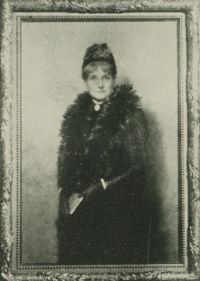
“ Bernard's face, his white robe contrasts well with two saints behind him, which carry out Fra Bartolommeo's favourite triangular grouping, and with a rich harmony of colour balance his white robe. The Virgin is drawn with great nobility and grace, her drapery admirably majestic, yet airy, and a sweet, infantile playfulness renders the Child charming. The angels beneath the Virgin's feet are lovely, but the group of seraphs behind are the least pleasing of all. They are of the earth, earthy, and seem reminiscences of the Florentine maidens the artist met in the streets. ”
Fra Bartolommeo
Definition and stakes
Quotes about “Fra Bartolommeo”
“ In the Pitti Palace, a charming Pietà of Fra Bartolommeo's occupies a place near the Pietà of Andrea del Sarto, the two pictures forming a most interesting contrast of style. The kneeling Virgin and S. John support the head of the prostrate Saviour, S. Catherine and Mary Magdalen weep at his feet, the latter in an agony of grief crouches prone on the ground hiding her face. The colouring is extremely rich, broad masses of full-tone melting softly into deep shadows. The handling in the flesh-tones of the dead Saviour, as well as the modelling of form, are most masterly. ”
“ On Fra Bartolommeo the spirituality of Fra Angelico still lingered, while the perfection of Raphael illumined him. Andrea del Sarto, on the other side, had gathered into his hands the gleams of genius from all the great artists who were his elder contemporaries, and so blending them as to form seemingly a style of his own, distinct from any, has left on our walls and in our galleries hundreds of masterpieces of colour, as gay and varied as the tints the orientals weave into their wondrous fabrics. ”
“ As a building San Marco has been a shrine of art; since the time that Michelozzi, with the assistance of the Medici, built the convent for Sant' Antonino, and Fra Angelico left the impress of his soul on the walls, a long line of artist monks has lived within its cloisters. With San Marco our story has now to deal, for it is impossible to write Fra Bartolommeo's life without touching on the well-known history of Savonarola. ”
John Addington Symonds,
Renaissance in Italy, Volume 3…
“ Had that but found expression in their cloistral pictures, one of the most peculiar and characteristic flowers of art the world has ever known, would then have bloomed in Florence. The mantle of Savonarola, however, if it fell upon any painter, fell on Michael Angelo, and we must seek an echo of the friar's thunders in the Sistine Chapel. Fra Bartolommeo was too tender and too timid. The sublimities of tragic passion lay beyond his scope. Though I have ventured to call him the painter of adoration, he did not feel even this movement of the soul with the intensity of Fra Angelico. ”
John Addington Symonds,
Renaissance in Italy, Volume 3…
“ To what extent it influenced the style of Raphael, will be afterwards discussed. As a colourist, Fra Bartolommeo was equal to the best of his contemporaries, and superior to any of his rivals in the school of Florence. Few painters of any age have combined harmony of tone so perfectly with brilliance and richness. It is a real joy to contemplate the pure and splendid folds of the white drapery he loved to place in the foreground of his altar-pieces. Solidity and sincerity distinguish his work in every detail, while his feeling is remarkable for elevation and sobriety. ”
“ Look at the little round-backed nestling child in Fra Angelico's Madonna della Stella, imperfect as it is in form, the whole spirit of love is in it. He does not give only the mother-love for the child, but the child-love for the mother, which is more divine, and the same feeling is seen in the Madonna of Fra Bartolommeo. ”
“ The Christ is a fine nude figure standing in a niche, and in it Fra Bartolommeo has solved the problem of obtaining complete relief almost in monochrome, so little do the lights of the flesh tints, and the warm yellowish tinge of the background differ from each other. All the positive colour is in the drapery of the saints, one in red and green, and another in red and blue. The two angels are exquisitely drawn, and contrast well in their natural innocence with the sentimental pair in Raphael's Madonna of the Baldacchino on the same wall of the Pitti Palace. ”
Sarah Tytler, The Old Masters and Their Pictures…
“ We come to a second gentle monk, not unlike Fra Angelico in his nature, but far less happy than Fra Angelico, in having been born in stormy times. Fra Bartolommeo, called also Baccio della Porta, or Bartholomew of the gate, from the situation of his lodgings when a young man, but scarcely known in Italy by any other name than that of Il Frate, or the Friar, was born near Florence, and trained from his boyhood to be a painter. ”
Frank Jewett Mather, A history of Italian painting (1923)
“ Stolid men like Fra Bartolommeo immediately accepted his principles of composition and so did miraculously alert intelligences like Raphael’s. His mere passing contact and tradition inspired that admirable language of light and dark that became poetry in Giorgione and Correggio. The good and the harm he did is active today in thousands of academies and art schools. His is assuredly the finest intelligence that ever applied itself to the painter’s art, and if he failed in will and in fecundity, he has impressed himself upon posterity as no other Italian painter save Titian. ”
Deristhe L. Hoyt, Barbara's Heritage
“ They had been much interested in the many examples of Fra Bartolommeo's painting that are in San Marco—where he, as well as Fra Angelico, had been a monk;—in the Academy, and in the Uffizi and Pitti galleries; and had learned to recognize the peculiarities of his grouping of figures, and their abstract, devotional faces, his treatment of draperies, and the dear little angels, with their musical instruments, that are so often sitting at the feet of his madonnas. ”
“ Padre Marchese, himself a Dominican, speaks thus of his convent:—"San Marco has within its walls the Renaissance, a compendium in two artists. Fra Angelico, the painter of the ideal, Fra Bartolommeo, of form. The first closes the antique Tuscan school. He who has seen Fra Angelico, has seen also Giotto, Cimabue, &c. The second represents the modern school. In him are almost comprised Masaccio, Lorenzo di Credi, Leonardo, Buonarroti, and Andrea del Sarto." ”
“ The preparing of the panels fell to the work of one of the monk scholars, Fra Andrea. [Footnote: The books of the convent have a note of payment to Fra Bartolommeo for 20th March, 1512, "per parte di lavoro di Fra Andrea converse per mettere d'oro, et ingessare alle tavole nella bottega in diversi lavori" (Padre Marchese, Memorie, lib. ii. chap. in. p. 70) .] Then the master made his sketch in white, or "sgraffito" (i.e. graven on the plaster) , as in the architectural lines of the pictures of patron saints in the Uffizi, and the Marriage of S. Catherine in the Pitti Palace ”
“ The work, if it had been painted in the larger form, would have been a perfect masterpiece of composition, "a very Beethoven symphony in colour," if we may judge from the sketch at Panshanger, where a living crowd groups round the bier of the archbishop, and life, earnestness, harmony, and richness, are all intense. So ill was Fra Bartolommeo in 1517 that he was ordered to take the baths at San Filippo, thence he went for the last time to Pian di Mugnone, where he painted a Vision of the Saviour to Mary Magdalen, above the door of the chapel. ”
“ In design and attitude it corresponds to the one described by Vasari, the saint being in a niche, surrounded by a double cornice. The left arm is bound; the right, with its cord hanging, is upraised in attitude of the faith, so fully expressed in the beautiful face. Three arrows are fixed in the body, which is nude except a slight veil across the loins; an angel, also nude, holds the palm to him. Connoisseurs do not think this painting equal in merit to the other works of Fra Bartolommeo. ”
“ The background is an intricate piece of architecture with vaulted roof, showing that he too had profited by Raphael's instructions in perspective to Fra Bartolommeo. The Virgin is a tender sweet figure; indeed no artist has given more gracious dignity to womanhood than Albertinelli, although his detractors say his life showed no great respect for it. Above, the Almighty is seen in a yellow light with a circle of angels and seraphs around. It is strange how the realistic painters stopped at nothing, not even the representation of the eternal in a human form. ”
Giorgio Vasari, Lives of the Most Excellent Painters… (1850)
“ In the church of San Romano also there is a picture by Fra Bartolommeo, the Madonna della Misericordia namely, the painting is on canvas, and is placed on a projection of stone, angels support her mantle, and around her is a concourse of people scattered over a flight of steps, some seated, others standing, but all with their looks turned earnestly towards a figure of Christ appearing in the heavens, and showering down lightnings and thunder-bolts upon the people. ”
A Popular Handbook to the National Gallery…
“ In some of his works, however, the attempt to adopt the chiaroscuro of Leonardo led to an over-darkening of the shadows. Vasari noticed even in his day that the use of printer's-black and ivory-black had caused some of Fra Bartolommeo's shadows to become unduly heavy. In his landscape backgrounds, Fra Bartolommeo showed a considerable advance on his predecessors. "Everything is true and harmonious, up to its intention, which is to be simple, calm, consistent, and real,—real, and yet breathing an idyllic beauty." ”
Harriet Beecher Stowe,
Agnes of Sorrento
“ Oh, my master! my dear master!""It is indeed a most heavy day to us all," said Baccio della Porta, the amiable and pure-minded artist better known to our times by his conventual name of Fra Bartolommeo. "Never have we had among us such a man, and if there be any light of grace in my soul, his preaching first awakened it, brother. I only wait to see him enter Paradise, and then I take farewell of the world for ever. I am going to Prato to take the Dominican habit and follow him as near as I may.""It is well, Baccio, it is well," said Father Antonio ”
“ The nuns of S. Giuliano employed him to paint two pictures, both of which are now in the Belle Arti. One is an altarpiece; the Madonna enthroned, with the Divine Child in her arms. Era Bartolommeo's idea of an angel-sustained canopy is here, but the angels hold it up from the outside instead of the inside. Before her are S. John the Baptist, S. Julian, S. Nicholas, and S. Dominic. The S. Julian has a great similarity to the S. Michael of Perugino, and the S. John, by its good modelling, shows the result of his studies from the antique in the Medici garden. ”
“ About this time Fra Bartolommeo recommenced work, and while he was painting the triptych for Donatello's Madonna (the miniature Nativity and Circumcision in the Uffizi) , Albertinelli was at work in the convent of the Certosa, at a Crucifixion in fresco. The painting is extant in the chapterhouse, and is a very fair and unrestored specimen of his best style. The Virgin and Magdalen are very purely conceived figures; the idea of the angels gathering the blood falling from the wounded hands of the crucified Saviour is very tender ”
“ One or two of the female saints are pleasing, but the nude figure of Christ is hard, exaggerated, and faulty in drawing. The artists got thirty-five lire for the work, though the record in the archives allows that it was worth more. There is an Assumption in the Belle Arti of Florence, of which the design is Fra Bartolommeo's, but the colouring Fra Paolo's. It was painted for the Dominican monks at Santa Maria del Sasso, near Bibbiena. The colouring is hard and weak, the shadows heavy, and not fused well in the half tints. ”
“ But with the decadence we have happily nothing to do; the artists of whom we speak first, Fra Bartolommeo and Albertinelli, belong to the culmination of art on its rising side, while Andrea del Sarto stands as near to the greatest artists on the other side, and is the last of the group before the decline. ”
Frank Jewett Mather, A history of Italian painting (1923)
“ His readiness to assimilate any sort of excellence was his strength, and at times his weakness, for he was not always self-critical enough to reject merits alien to his own personality. His admitted primacy rests on perfection of composition, and that perfection represented a beautiful synthesis of the methods of Perugino, Fra Bartolommeo, and Leonardo da Vinci. In dramatic power, force of draughtsmanship, and charm of color many of his contemporaries surpassed him. ”
Giorgio Vasari, Lives of the Most Excellent Painters… (1850)
“ Fra Bartolommeo painted a figure in oil over the door which leads into the sacristy of the Convent, the subject being San Vincenzio, who was a Monk of his own order, preaching on the rigours of the Divine Justice. In the attitude of this figure, but still more in the head, there is all that sternness and imposing severity, usually manifest in the countenance of the preacher who is labouring to induce men, obstinate in their sins, to amendment of life, by setting before them the terrors of the justice of God ”
“ The evidence of style goes to show that the works of Albertinelli and Fra Bartolommeo influenced him more than those of Piero. Yet though his sphere was devotional, it was "impelled more by a material sense of beauty than by the deep religious feeling which inspired the Frate." As time went on the youth in strange old Piero's studio became more famous than his master, and felt that he could do greater things away from the stiff method which cramped him, and the whimsicalities which annoyed him. ”
“ Both Fra Bartolommeo and Albertinelli are little known in this country. Practically nothing has been written about them and very few of their works are in either public galleries or private collections. It is in Italy, of course, that one must study their originals, although the great collections usually include one or two. Most interesting from the viewpoint of the study of art is the evolution of the work of the artist-monk as he came under the influence of the more dramatic modern and frankly sensational work of Raphael, of the Venetians and of Michelangelo. ”
E. V. Lucas,
A Wanderer in Florence
“ Perugino is here and Botticelli, Fra Bartolommeo and Leonardo, Luca Signorelli, Fra Lippo Lippi and Filippino Lippi. And here is a Masaccio. The great Perugino Assumption has all his mellow sunset calm, and never was a landscape more tenderly sympathetic. The same painter's Deposition hangs next, and the custodian brings a magnifying glass that the tears on the Magdalen's cheek may be more closely observed ”
“ Two monks on the left are tolerably life-like, probably they were drawn from living models; the S. Catherine on the right is very inferior. The Belle Arti also possesses a Deposition from the Cross, which Fra Bartolommeo had sketched out and left uncoloured at Pian di Mugnone. In 1519 Fra Paolo finished it, and it presents the usual disparity between the composition and colouring, the former being good, the latter weak and crude. His best known works are a Nativity in the Palazzo Borghese, a Madonna and Child with S. John Baptist in the Sciarra Colonna, also in Rome ”
“ Even the unworldly Fra Bartolommeo was the centre of such quarrels, and although his vow of poverty forbade him to receive money for his work, the order to which he belonged stood out firmly for the scudi which the Frate's pictures brought them. In justice to Andrea it must be added that this was not the only motive for his activities; it was not without cause that the men of his time called him "senza errori," the faultless painter; and the production of a vast quantity of his work rather than good prices for individual pictures made his art pay to the extent it did. ”