“ These gorgeous beings with their kingliness of mien, these children of the sun who spoke with the accent of the gods meant much more to the primitive soul of Henry Harper than as yet it could understand. In the intoxication of the hour, with the sun and the birds, the trees, the green earth, the bright flowers paying their homage to the grace and beauty of his countrywomen, he felt like an angel who has fallen out of heaven, who after aeons of time in a bottomless hell is permitted to see again a fair heritage that once was his. ”
Henry Harper
Definition and stakes
The theme of “Henry Harper” has been addressed by authors such as Mary Shelley, Joseph Barry, J. C. Snaith, Charles G. Harper and Harper's Weekly. It is often associated with terms like Young, people, John, ferry and magazine.
Quotes about “Henry Harper”
“ Henry Harper lay down with a feeling of relief and burrowed among the sacks as far as he could get. A mass of aches in body and soul, anything was better than the darkness and damp fog and icy substances cutting into his bare feet. ”
“ Henry Harper's one instinct was to take a tight hold of Mother's apron. And this he did in spite of the fact that Johnnie and Alfie and Percy were sitting round the table, drinking tea and eating bread and jam. Mother told Henry Harper very gently he must be a man, whereupon he did his best to meet Mr. Thompson boldly. ”
“ It is impossible, it is said, to touch pitch and not be defiled. The worth of that aphorism was about to be tried by the clairvoyant soul of Henry Harper. At this time, while he was drawing very painfully and yet rapturously upon his inner life, he was like an expanding flower. ”
“ Henry Harper had been present at several of the very agreeable bachelor dinner parties in Bury Street, and on each occasion his host had noted an honorable and increasing effort on the part of the neophyte to rise to the measure of his opportunity. There could be no doubt he was coming on amazingly. The rough edges were being smoothed down and he was always so simple and unaffected that it was hardly possible for liberal-minded men whom fortune had given a place in the stalls at the human comedy to refrain from liking him. ”
“ The respect of others for the accidental prowess he wore so unassumingly, good food, regular habits, a sense of security, did much for Henry Harper in this critical phase of his fortunes. First he learned to take a pride in his body. That was a very simple ethic of the great religion to be revealed to him. He was quick to see that he was one of a company of highly trained athletes whom nature had endowed nobly. Together with his fellow players, he was exercised with as much care as if he had been a racehorse. ”
“ Henry Harper stated his modest need with extreme simplicity. He just wanted to be taught in as few lessons as possible to speak like a real college gentleman that went regular—regularly (remembering his grammar in time) —into Society. Madame Sadleir's smile was maternal. "Why, certainly," she said in the voice of a dove. "Nothing easier." The young man felt reassured. He had not thought, even in his moments of optimism, that there would be anything easy in the process of making a Mr. Edward Ambrose or a Mr. Esme Horrobin. ”
“ One does not like to raise false hopes or to promise more than one can perform. Now, Mr. Harper, kindly let me hear you read this leading article in the Times on 'What is Wrong with the Nation?' paying particular attention to the vowel sounds." With grave deliberation, Mr. Henry Harper did as he was asked. Having painfully completed his task, Madame Sadleir, in a remarkably benign way, which somehow brought Mr. Herbert Gracious vividly to his mind, proceeded to deal with him with the utmost fidelity. ”
“ There was no denying that for a chap of nineteen not to have the elements of the three r's was a disgrace; it was bound to prejudice him in the eyes of a lady of education. Still, Miss Foldal was not Mrs. Sparks. Being a higher sort of lady perhaps she would be able to make allowances. Yet Henry Harper didn't want her or anyone else to make allowances. However, he could not afford to be proud. ”
 William Lyon Mackenzie King,
The Secret of Heroism: A Memoir of Henry Albert Harper
William Lyon Mackenzie King,
The Secret of Heroism: A Memoir of Henry Albert Harper
“ Few men of his years have thought as deeply as Harper did, or had clearer perceptions, concerning conditions and forces which make for happiness and progress in social life, and the development of national greatness. Had he been spared he would have been an earnest and practical reformer; silent as his voice is now, the words he once uttered are not without their value to our day and generation. ”
William Lyon Mackenzie King,
The Secret of Heroism: A Memoir of Henry Albert Harper
“ In its ambitions, its man [89] dates, Harper saw but little which made for the development of true manhood or womanhood, while he saw much which aimed directly at the destruction of both. There was never any one who enjoyed more the pleasure of good company, whose temperament, frank, hearty and mirthful, and whose manner, courteous and sincere, made him a more welcome guest wherever he went. It was no affectation, therefore, which caused Harper to feel as he did; it was his belief in the true purpose of life. What to some, and to himself, was a pastime, he saw, to others, was becoming an end ”
Henry William Harper, Letters from New Zealand, 1857-1911… (1914)
“ Here's a tin; every fellow who lets out a bad word shall pay half-a-crown into it, and we'll give it to the first hard-up chap we meet. That's agreed, is it, so long as this gentleman is with us?" "Aye, aye!" "Well, then, I'll take charge of the tin, and I'm d——d if I don't make you pay up." Shouts of laughter as he had to drop his half-crown into the tin. I don't fancy they recognized the Bishop even as a parson, for he was bespattered with mud from head to foot, as his horse "Dick" had rolled over with him in a swamp, his hat crushed out of shape, reduced to the colour of clay. ”
William Lyon Mackenzie King,
The Secret of Heroism: A Memoir of Henry Albert Harper
“ Day by day he had been seeking for years to gain that freedom which is the reward of obedience to the highest laws of life, and little by little he had been fashioning a character unfettered and untrammelled by human weaknesses and prejudices, and strong in the noblest qualities of heart and mind. Galahad cried, “If I lose myself, I save myself!” In the same spirit, and with the same insight into truth, Harper sought to keep unbroken the vision of immortality which was his, to be faithful to an ideal of duty, which, by a seeming loss, he has made incarnate for all time. ”
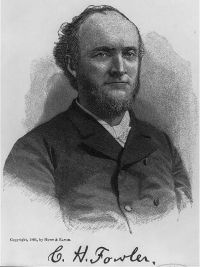 Charles Henry Fowler,
Historical Romance of the American Negro
Charles Henry Fowler,
Historical Romance of the American Negro
“ Harper applied herself most vigorously to study as she was growing up in her teens, and by the time she had come to woman's estate she was well educated. (Thus we see that nobody need despair of becoming well educated, for we can all learn if we only have pluck and ambition, and patience and perseverance with them to forge to the front, like the lady in question) . This eminent woman soon became widely known for her brilliant talents, and all her sweet, lady-like graces, and admonished all Abolitionists and anti-slavery people what our race could do if they were once freed from their shackles! ”
Various, Harper's Round Table, August 4…
“ Frank joined in, and at once the sixteen red men sprang to their feet, apparently none the worse for Henry's double charge of bird-shot at short range. They held their weapons above their heads, and continuing to utter their friendly "How," rapidly advanced toward the boys."They aren't playing us a trick, are they, Frank?" asked Henry, in an anxious tone."No," replied the older boy, after snatching a glance to the rear. "The Lieutenant and soldiers are saddling. The Indians dare not harm us on an open plain in sight of a mounted force." ”
Little Visits with Great Americans…
“ Harper’s Magazine is one of the classics in the vast library of monthly publications. Magazines, like people, have their periods of elevation and depression. But Harper’s has maintained a steady level of high-class individuality, this being due in no small degree to the work of Henry Mills Alden, who, since 1869, has been its editor-in-chief. Mr. Alden was born at Mount Tabor, near Danby, Vermont, November 11, 1836. He attended public school at Hoosick Falls, New York, graduated from Williams college in 1857, and from the Andover theological seminary in 1860, but he never took orders. ”
 Henry Watterson,
Marse Henry: An Autobiography, Complete
Henry Watterson,
Marse Henry: An Autobiography, Complete
“ Nast drew a grotesque cartoon of me, distorting my suggestion for the assembling of 100,000 citizens, which was both offensive and libellous. Being on friendly terms with the Harpers, I made my displeasure so resonant in Franklin Square—Nast himself having no personal ill will toward me —that a curious and pleasing opportunity which came to pass was taken to make amends. A son having been born to me, Harper’s Weekly contained an atoning cartoon representing the child in its father’s arms, and, above, the legend “10,000 sons from Kentucky alone.” ”
William Lyon Mackenzie King,
The Secret of Heroism: A Memoir of Henry Albert Harper
“ Measured by the standard of growth already hinted at, Harper may be said to have left the university with a consciousness that he was fitted by talent and inclination for work in some branch of the so-called higher professions, that it was in connection with the general, rather than the more exclusive, interests of society that his energies would find their freest play, and that not by theories, but by men, he could hope to be permanently attracted. ”
Henry William Harper, Letters from New Zealand, 1857-1911… (1914)
“ Stripping off everything, we bundled our clothes together and carried them on our necks, and making long bundles of flaxsticks, which float well, by way of life-buoys, and tucking them under our arms, in case of deep water, we entered the Lagoon in single file, the Inspector leading, myself last. Every now and then he turned his head and uttered some encouraging joke. "Pity there's no artist handy! three fellows stark naked, one of them a Bishop, up to their waists in water, clothes on their heads, plodding through mud and water!" ”
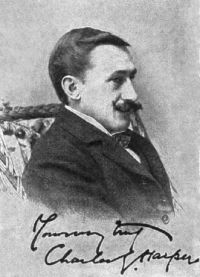 Charles G. Harper,
The Kentish Coast
Charles G. Harper,
The Kentish Coast
“ There was the avaricious, greedy Henry, own son of the mean Henry the Seventh; the vain and luxurious and spendthrift Henry; the proud and cruel Henry, a true Welsh Tudor; and the statesman and patriot, whose existence few acknowledge. Whatever were his faults and errors, Englishmen to this day owe more to Henry the Eighth than to many a later monarch. He it was who established the Royal Navy, who had the courage to break with Rome and to free England from the deadly embrace of that Church ”
Charles G. Harper,
The Manchester and Glasgow Road…
“ Apart from the chief group of crumbling walls there stands a poor old battered one-legged and headless statue, said to represent Henry the Eighth, but unrecognisable, scored amazingly with the penknives and the initials of generations of Toms, Dicks, and Harrys. The scene of past pomps and vanities is scarcely mournful, as some might find it; the sight of it makes history live again as human experience, not as we read it in the dulled pages of historical exercise. ”
Joseph Barry, The Strange Story of Harper's Ferry…
“ Henry Hoffman, of Cumberland, who, even then, was regarded as an ultra-Republican, was a passenger and, when the train stopped at Harper's Ferry, the fact of his presence was made known to the crowds of soldiers on the platform of the depot by a fellow passenger who evidently entertained some private malice against Mr. ”
Harper's Weekly, Harper's Weekly Editorials on Carl Schurz…
“ There is no more familiar and interesting figure in our political history than Henry Clay, and no party leader who was more idolized, or followed with more enthusiasm. His political life began with the century and continued until his death in 1852, and his biography therefore includes the political history of that half-century. ”
Harper's Weekly, Harper's Weekly Editorials on Carl Schurz…
“ The contrast between the two leaders, Jackson and Clay, the final emergence of the antislavery question as the absorbing political issue, and the distinctive character and service of the moral abolition agitation, which are curiously misapprehended in the memoir of Benton, lately published in the “Statesmen Series,” are all described with accuracy and force.But, as becomes a biography, Henry Clay is always the central figure of the story. Mr. Schurz shows, however, much more clearly than has been shown heretofore, Clay's natural and instinctive antislavery tendency. ”
Henry William Harper, Letters from New Zealand, 1857-1911… (1914)
“ Imagine a tower of marble, its sides encircled with decorated arcading, perfectly straight, like an ornamental jam pot, rising to a height of one hundred and eighty feet, and leaning fourteen feet out of the perpendicular, with a top story a little less in diameter than the rest of the tower, but with neither battlements or pinnacles atop. ”
Henry William Harper, Letters from New Zealand, 1857-1911… (1914)
“ The wind continued in full force till midnight; lightning vivid and incessant, playing all round us, and often falling like fireballs right on the vessel. Not much sleep that night, until about five in the morning, in one instant, it seemed, the wind fell. Coming on deck at daylight, somehow, the ship looked like a forest after a tornado, masts and spars like trees stripped of foliage, the decks like land just recovering from drenching floods. ”
Henry William Harper, Letters from New Zealand, 1857-1911… (1914)
“ In most parts the water is deep, with very slight fall, winding its way through primæval forest, its banks fringed with luxuriant growth of fern and flax. Being entirely sheltered from wind, its surface is like a mirror, in which the reflection of fern and foliage is so vivid and clear-cut that, looking down, you might fancy yourself on your back, gazing up at a vista of forest into the blue sky above. ”
Henry William Harper, Letters from New Zealand, 1857-1911… (1914)
“ I do not know how to describe the scene: men and women kneeling, standing, leaning against the cabin doors, uttering words of prayer and cries of fear. "Oh, what shall we do? Is there any hope?" Some quite quiet, holding their children in their arms, crouching on the ground; some staring with vacant eyes, other pacing backwards and forwards, some in a dead faint. ”
Henry William Harper, Letters from New Zealand, 1857-1911… (1914)
“ Every night we tied up by the bank, making daily excursions to temples, villages, and places of interest. In winter months the climate is like an ideal summer's day at home, yet at night cold enough for a couple of blankets. Egypt is emphatically a land of light, brilliant, all-pervading light; there is scarcely any cloud scenery. Sunrise and sunset, such a contrast to the white light of midday, flood the atmosphere with colour that lies reflected on the river, veiling every peak and crevice of the barren dry sandstone ranges with hues of delicate beauty. ”
Harper's Weekly, Harper's Weekly Editorials on Carl Schurz…
“ The simplicity of the style is admirable, and the tone of treatment, which is in no sense merely eulogistic, but perfectly appreciative and candid, gives a sincerity to the book which at once commands the entire confidence of the reader. ”
The World's Greatest Books — Volume 02…
“ Against the walls were suspended garments fitted for all ages and conditions, and either sex. British and American uniforms hung side by side. Sitting on a stool, with his head leaning on his hand, was a man more athletic than either Harvey or her brother. He raised his face and Frances instantly recognised the composed features of Harper. She threw open the door of the hut and fell at his feet, crying, "Save him, save my brother; remember your promise!""Miss Wharton!" exclaimed Harper. "But you cannot be alone!" ”
Various, Harper's Young People, June 29…
“ I'm sure I wish there wasn't any Fourth of July.""Oh, Harp, you ninny!" cried his brother Joe. "There wasn't any Fourth at all till George Washington made it.""You better study up," said Aunt Nancy, coming to her senses, as Harper, very much confused, stopped the rattling. "You don't begin to realize what the guns and the fire-crackers and the torpedoes, and all the other dreadful things that blow up people and knock off boys' fingers and toes, are for. It would be a great deal better if boys had more history in their heads and less money in their pockets. ”
Harper's Weekly, Harper's Weekly Editorials on Carl Schurz…
“ Schurz's memoir, just published in the “American Statesmen Series,” his life has never been adequately treated. it is mainly in biography that our political history has been written, and in that branch of our literature Mr. Schurz's two volumes take their place at once in the highest rank. His work is the result not only of careful research, but of thorough mastery and due consideration of the results of research, and in his biography of Clay we have both a singularly just and sympathetic estimate of the man, and a lucid and comprehensive summary of the political movement of the half-century. ”