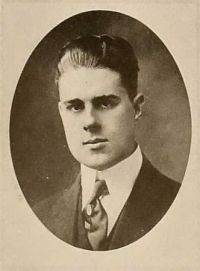
“ Von Lippe is not an American citizen as so many of the agents are. With no visible means of support, he received expenses from a total stranger—oddly enough, Count von Bülow whose home overlooked the naval base in San Diego and who was constantly in conferences with Nazi agents. It was to Count von Bülow, you recall, that Hermann Schwinn brought Schneeberger as soon as he arrived on his way to Japan, and von Bülow took him around while Schneeberger photographed areas in the military and naval zone. ”
Hermann von Bülow
Definition and stakes
Quotes about “Hermann von Bülow”
1911 Encyclopædia Britannica (1911)
“ BÜLOW, BERNHARD HEINRICH KARL MARTIN, Prince von (1849–) , German statesman, was born on the 3rd of May 1849, at Klein-Flottbeck, in Holstein. The Bülow family is one very widely extended in north Germany, and many members have attained distinction in the civil and military service of Prussia, Denmark and Mecklenburg. Prince Bülow’s great-uncle, Heinrich von Bülow, who was distinguished for his admiration of England and English institutions, was Prussian ambassador in England from 1827 to 1840, and married a daughter of Wilhelm von Humboldt (see the letters of Gabrielle von Bülow) . ”
Alexandre Dumas,
The Prussian Terror
“ The grandmother, sixty-nine years of age, might die at any moment. They waited till the strict season of mourning dictated both by their hearts and by custom had elapsed, and at the end of six months they were married.Three days after the birth of his first child, a boy, the Baron Frederic von Bülow received his commission as major. On this occasion the protection of the king was so obvious and so kindly intentioned that the baron resolved to make a second journey to Berlin, not on this occasion to ask for favours, but to return thanks for them. ”
Various, Encyclopaedia Britannica, 11th Edition…
“ From Weimar he went to Zürich, where the exile Wagner instructed him in the elements of conducting. But he soon returned to Weimar and Liszt; and in 1853 he made his first concert tour, which extended from Vienna to Berlin. Next he became principal professor of the piano at the Stern Academy, and married in his twenty-eighth year Liszt's daughter Cosima. For the following nine years von Bülow laboured incessantly in Berlin as pianist, conductor and writer of musical and political articles. ”
Alexandre Dumas,
The Prussian Terror
“ A dying man's wishes are sacred, and Frederic von Bülow's wish was that one of us—either you or I—should disappear from this world. I deliver it to you the more readily because I know you, sir, to be brave, skilful in all bodily exercises, and a first-rate swordsman and shot. I am not an officer in the Prussian army; you are in no sense my chief. I am a Frenchman, you are a Prussian; we have Jena behind us and you have Leipzig; we are therefore enemies. ”
W. J. Henderson, Richard Wagner His Life and His Dramas
“ When Von Bülow went to Basle to teach, the beginning of the end had come, and it was not long after that when the relations between Wagner and Mme. von Bülow could no longer be kept secret. "If it were only someone whom I could kill," said Von Bülow, "he would have been dead before this." The great conductor could not think of slaying the great master. ”
baron Beyens, Germany before the war
“ German political science had tried every remedy against the Socialist taint and found it wanting, from the repressive system of Bismarck to the social reform policy of Posadowsky. In reality,155 however, the microbe of Social Democracy was perfectly harmless. Prince von Bülow, in his book, comes to the conclusion that the danger would become serious if Socialism, after making havoc among the proletariate, wormed its way into the middle classes, those steadfast bulwarks against all change. ”
1911 Encyclopædia Britannica (1911)
“ At the same time he professes that his system provides working rules for the armies of his own day, which in point of fact were “armed nations,” infinitely more affected by “friction” than the small dynastic and professional armies of the preceding age. Bülow may therefore be considered as anything but a reformer in the domain of strategy. With more justice he has been styled the “father of modern tactics.” ”
1911 Encyclopædia Britannica (1911)
“ A cautious and versatile diplomatist like Bernhard von Bülow appears to be best adapted to the personal and political necessities of the present situation.” Count Bülow, indeed, though, like Bismarck, a “realist,” utilitarian and opportunist in his policy, made no effort to emulate the masterful independence of the great chancellor. He was accused, indeed, of being little more than the complacent executor of the emperor’s will, and defended himself in the Reichstag against the charge. ”
baron Beyens, Germany before the war
“ Prince von Bülow is careful to insist upon the purely defensive rôle that the Imperial fleet has marked out for itself, and, in order to reassure us as to the peaceful aims of the new statesmanship, he quotes the following passage from a speech made by him in the Reichstag on 6th November 1906: “It is the duty of our generation to uphold our position on the Continent, which is the basis of our international position ”
Edmund Dane, The Battle of the Rivers
“ There was good reason for this German panic. These troops of the army of von Bülow had been completely defeated. Of that no better evidence can be offered than a letter found on a soldier of the 74th German Regiment of infantry, part of the 10th army corps. The letter is of vivid human interest.My Dear Wife,—I have just been living through days that defy imagination. I should never have thought that men could stand it. Not a second has passed but my life has been in danger, and yet not a hair of my head has been hurt. ”
Friedrich von Bernhardi,
Germany and the Next War
“ In the face of these claims the German nation, from the standpoint of its importance to civilization, is fully entitled not only to demand a place in the sun, as Prince Bülow used modestly to express it, but to aspire to an adequate share in the sovereignty of the world far beyond the limits of its present sphere of influence. But we can only reach this goal, by so amply securing our position in Europe, that it can never again be questioned. Then only we need no longer fear that we shall be opposed by stronger opponents whenever we take part in international politics. ”
Stanley Shaw, William of Germany
“ At any rate his policy, or that of his Government, changed, and instead of following up his encouraging words with mediation or intervention, he assumed an attitude of neutrality towards the war which soon after began. Subsequently, in the Reichstag, Chancellor von Bülow described the course the German Government pursued immediately before and during the war; and there seems no reason to discredit his account. The speech was made apropos of the projected visit of President Kruger to Berlin, when on his tour of despair to the capitals of Europe while the war was still in progress. ”
Graf von Johann Heinrich Bernstorff, My Three Years in America
“ The policy of the free hand, which we pursued until the outbreak of war, aimed at the highest possible results. Prince Bülow, who was the inaugurator of this policy, might possibly have known how to steer us through the "Danger-Zone" without provoking war. And then in a few years to come, we should have become so strong and should have left the Danger-Zone so very far behind us, that, as far as human judgment could tell, we should no longer have had any need to fear war. ”
Alexandre Dumas,
The Prussian Terror
“ It will easily be understood that nobody in the town talked of any other subject. Astonishment and curiosity were even more aroused owing to the occurrence of two mysterious deaths at the same time. People wondered how it happened that Frederic von Bülow, after having been insulted by his superior officer, should before he shot himself have charged his wife with her pious errand to Berlin, seeing that he was no citizen of Frankfort, but belonged, body and soul, to the Prussian army. ”
James W. Gerard, Face to Face with Kaiserism
“ For years before the war the Bavarian Comic papers cartooned the Prussians, common and royal, but like every other movement nothing will result.There is much underground work for the resumption of reckless submarine war going on, all part of a campaign to upset the Chancellor. Von Bülow, Ex-Chancellor, is working hard. He, however, since his row with the Emperor over the "Telegraph" interview, which he passed as correct, will never be accepted by His Majesty. Nevertheless, he is becoming a focal point for opposition.The Chancellor and his party are very timid about attacks. ”
The Story of the Great War, Volume III…
“ After a skirmish the German hussars were driven off with the loss of a few killed and wounded. But the raid evidently came out of the gap as a surprise to the French. The citizens were promptly ordered to their homes. Barricades were raised in the streets, and mitrailleuses were placed in sweeping positions. An artillery engagement began at Jemappe, nine miles above Namur on the left bank of the Sambre, between Von Bülow's vanguard and the main French right. Later in the day Von Bülow's vanguard artillery had advanced to open fire on Charleroi and Thuin, seven miles beyond. ”
William Smyth Rockstro, A Dictionary of Music and Musicians (1900)
“ Scarcely less remarkable, as the representative of a newer School, is Hans von Bülow, who, notwithstanding his strong predilections in favour of Liszt and Wagner, is rivalled by few in his reading of the works of the older Masters, from Bach to Beethoven. Even Liszt himself, the Paganini of the Pianoforte, and the greatest executant of the century, still possesses powers, which, despite his seventy years, one sometimes half expects to welcome once more in all the glories of a second youth ”
The Secret Memoirs of Bertha Krupp
“ Von Bohlen looked puzzled. He had imbibed enough of the Krupp spirit to encourage him in the belief that he might rival an earthquake as a destroyer of life and property, but his ambition had never extended to interference with other people's digestion."Explain, Bülow," ordered the War Lord, considering it beneath his dignity to give information on so trifling a subject."His Majesty refers, of course, to the disturbance of England's food supplies. Unlike Germany, Great Britain cannot feed herself, being dependent for the sustenance of the inner man on imports. ”
J. N. Larned, History For Ready Reference, Volume 7 (1895)
“ On the next day, rumors of the intended resignation of Prince Bülow were checked by the publication of the following semi-official statement: "Prince von Bülow will remain as chancellor of the empire. The Reichstag will not be dissolved. The chancellor holds that his duty is to be in accord with the conviction of the Federal Council of the necessity to bring about the passage of a taxation measure, but with the exclusion therefrom of duties on stock transfers, the output of the grain mills, and the exports of coal. Financial reform must now come into operation. ”
Charles Sarolea, German Problems and Personalities
“ The nerves can no more transmit their orders to the muscles. Even so Lutheranism has not killed the thinking power of the German people. On the contrary, it has given it a morbid stimulus, as speculation is no more hampered by reality. Nor has it paralyzed their external activities, but it has prevented any connection between the two. It has prevented the thinking from influencing the acting. It justifies the recent damning statement of Prince von Bülow, who ought to be a competent judge, that the Germans have remained an essentially unpolitical people. ”
duchesse de Dorothée Dino, Memoirs of the Duchesse De Dino…
“ As for the Elector of Hesse-Cassel, he has sent word that he will come and explain to the King in person why he could enter the restricted union. General von Bülow is starting for Copenhagen to-day; he is commissioned to treat for a separate peace between Prussia and Denmark, and not to touch the questions of the Duchies, or Germany, or mediation; when I say 'treat for' peace, I mean that he should make proposals to this end, as the negotiations are to be carried on here. ”
1911 Encyclopædia Britannica (1911)
“ This inspired the greatest enthusiasm in Prussia, as being won by purely Prussian forces, and rendered Bülow’s popularity almost equal to that of Blücher. Bülow’s corps played a conspicuous part in the final overthrow of Napoleon at Leipzig, and he was then entrusted with the task of evicting the French from Holland and Belgium. In an almost uniformly successful campaign he won a signal victory at Hoogstraaten, and in the campaign of 1814 he invaded France from the north-west, joined Blücher, and took part in the brilliant victory of Laon in March. ”
Graf von Johann Heinrich Bernstorff, My Three Years in America
“ He and his alter ego are meanwhile very much afraid that our enemies might remain obdurate, since they are under the impression, or are trying to spread the impression, that the President, in opening the peace negotiations, is acting for Germany. Certainly England continually drags this idea into the discussion. At one time it is said that Prince Bülow is coming here to submit the German peace conditions to Mr. Wilson; at another, that Germany is on the brink of starvation and must therefore sue for peace. We ought as far as possible to counteract this propaganda of our enemies. ”
Edmund Dane, The Battle of the Rivers
“ The German cavalry, attacked by the French and British, was cut up with [Pg 71] heavy loss. More than 60,000 horsemen were engaged in this gigantic combat.September 7.—To assist the retreat, the centre divisions of von Kluck's army opposing the British made a stand upon the Petit Morin, and the army of von Bülow a stand from Montmirail to Le Petit Sompius. Along that line the 5th French army was all day heavily engaged against the left wing of von Kluck's army and the right of von Bülow's. ”
United States. Office of Chief of Counsel for the Prosecution of Axis Criminality, Nazi Conspiracy and Aggression…
“ Thanks to the educational work of the National Socialist Government this is the case all over Germany. I know that the things I have said here about the armament worker in particular hold true for every German worker. With these men and women who work for the cause with all their hearts, with cool heads and skilled hands we will master every fate.” (D-94; see D-64) . In a memorandum of a conference held on 9 December 1942, concerning the proposed publication of a book dealing with Krupp’s armament activities, Von Bulow, confidential secretary to Krupp, wrote ”
The Story of the Great War, Volume III…
“ But, when General von Bülow was compelled to retreat, when General Foch turned his attention to General von Hausen's Saxon Army, and when General Joffre found himself in a position to rush reenforcements and reserves to the aid of General Langle, a new color was given to the affair. The defense stiffened, and as rapidly as it stiffened, so much the more did it become patent that the Duke of Württemberg could not afford to be in an exposed position far in advance of all the other attacking armies. ”
baron Beyens, Germany before the war
“ Prince von Bülow, in his Imperial Germany, asserts that the German race, although richly endowed with great qualities, has no talent for politics. This charge is quite unfair, the real motive for it being the dread with which a Prussian statesman views the prospect of a parliamentary system. The Germans are late-comers in the field of political life. Those of the South entered it much earlier than the Prussians; Bavaria received a written constitution from its ruler in 1818, Baden in the same year, Würtemberg in 1819, and Hesse-Darmstadt in 1820. ”
Edward Mead Earle,
Turkey, the Great Powers, and the Bagdad Railway…
“ This served notice to France that Germany would not respect the French claim to exclusive protection of Catholic missionaries in the Ottoman Empire. “We do not lay claim,” said Prince von Bülow, “to a protectorate over all Christians in the East. But only the German Emperor can protect German subjects, be they Catholics or Protestants.”29 This pronouncement was received in France with undisguisedly poor grace. One writer in a prominent fortnightly magazine frankly expressed his disgust: “Germany possesses military power; she possesses economic power ”