John Napier

Definition and stakes

by John Marshall,  Royal Naval Biography — Napier… (1823)

“ Is descended from John Napier, “to whom” says Hume, the historian, “the title of Great Man is more justly due, than to any other whom his country ever produced.” He was the inventor of the Logarithms and Robdologice, commonly called “Napier’s Bones;” and likewise author of a “Treatise on the Revelation of St. John.” These works will remain lasting monuments of his sublime judgment, knowledge, and penetration. His only son by his first wife was created a Scotch peer, by the title of Baron Napier, May 4, 1627. ”
Source: Wikisource

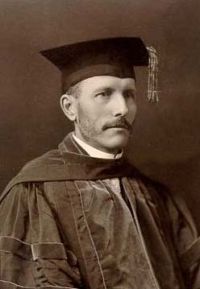
Portrait of Florian Cajori Florian Cajori,  A History of Mathematics (1893)

“ It is no exaggeration to say that the invention of logarithms "by shortening the labours doubled the life of the astronomer." Logarithms were invented by John Napier, Baron of Merchiston, in Scotland (1550–1617) . It is one of the greatest curiosities of the history of science that Napier constructed logarithms before exponents were used. To be sure, Stifel and Stevin made some attempts to denote powers by indices, but this notation was not generally known,—not even to Harriot, whose algebra appeared long after Napier's death. ”
Source: Wikisource

Portrait of Leslie Stephen Leslie Stephen,  Dictionary of National Biography… (1894)

“ He also supplied Wood with important information regarding the Napiers for his edition of Douglas's ‘Peerage.’ By his wife, Maria Margaret, eldest daughter of Lieutenant-general Sir John Clavering, he had nine children—four sons and five daughters—of whom William John [q. v.] succeeded him as eighth lord, and is separately noticed.
[Douglas's Scottish Peerage (Wood) , ii. 302, 303; Mark Napier's Memoirs of John Napier; Gent. Mag. 1823, pt. ii. p. 467.]
”
Source: Wikisource

Get perspective with Kwize: daily news enlightened by great literature