“ Julia dared not raise her voice in asking Bertram if he chose another cup of tea. Bertram felt embarrassed while eating his toast-and-butter under the eye of Mannering. Lucy, while she indulged to the uttermost her affection for her recovered brother, began to think of the quarrel betwixt him and Hazlewood. The Colonel felt the painful anxiety natural to a proud mind, when it deems its slightest action subject for a moment to the watchful construction of others. ”
Mannering
Definition and stakes
The literary concept of "Mannering" mainly surfaces in Walter Scott’s Guy Mannering, where the protagonist embodies a nuanced blend of self-regard, fragility, and social conflict. Scott depicts Mannering as a man maneuvering through the tension between personal honor and societal norms, as illustrated by his relationships with characters such as Julia and Dominie Sampson.
The theme also echoes within Scott’s broader examination of ethical complexity and human endurance, as reflected in Mannering’s musings on aging, bereavement, and the burden of heritage. Though this concept originates in Scott’s novel, it prompts discussion on how literary figures confront identity in the face of evolving social environments.
Quotes about “Mannering”
 Walter Scott,
Guy Mannering
(1815)
Walter Scott,
Guy Mannering
(1815)
“ It was long since Mannering had been in the street of a crowded metropolis, which, with its noise and clamour, its sounds of trade, of revelry, and of licence, its variety of lights, and the eternally changing bustle of its hundred groupes, offers, by night especially, a spectacle, which, though composed of the most vulgar materials when they are separately considered, has, when they are combined, a striking and powerful effect upon the imagination. ”
Walter Scott,
Guy Mannering
(1815)
“ Dinmont descended confidently, then turned into a dark alley—then up a dark stair–and then into an open door. While he was whistling shrilly for the waiter, as if he had been one of his collie-dogs, Mannering looked round him, and could hardly conceive how a gentleman of a liberal profession, and good society, should chuse such a scene for social indulgence. ”
Walter Scott,
Guy Mannering
(1815)
“ Mr Bertram, paralytick, and almost incapable of moving, occupied his easy chair attired in his night-cap, and a loose camlet coat, his feet wrapped in blankets. Behind him, with his hands crossed on the cane on which he rested, stood Dominie Sampson, whom Mannering recognised at once. Time had made no change upon him, unless that his black coat seemed more brown, and his gaunt cheeks more lank, than when Mannering last saw him. On one side of the old man was a sylph-like form—a young woman of about seventeen, whom the Colonel accounted to be his daughter. ”
Walter Scott,
Guy Mannering
(1815)
“ And now, why will you still upbraid me with my melancholy, Mervyn?–Do you think, after the lapse of twenty-five years, battles, wounds, imprisonment, misfortunes of every description, I can be still the same lively unbroken Guy Mannering, who climbed Skiddaw with you, or shot grouse upon Crossfell? That you, who have remained in the bosom of domestic happiness, experience little change; that your step is as light, and your fancy as full of sunshine, is a blessed effect of health and temperament, co-operating with content and a smooth current down the course of life. ”
“ Mannering took the packet to the window—his pride forbade a more distant retreat—he glanced at some passages of the letters with an unsteady eye and an agitated mind—his stoicism, however, came in time to his aid; that philosophy, which, rooted in pride, yet frequently bears the fruits of virtue. He returned towards his daughter with as firm an air as his feelings permitted him to assume."There is great apology for you, Julia, as far as I can judge from a glance at these letters—you have obeyed at least one parent. ”
Walter Scott,
Guy Mannering
(1815)
“ Little French Lawyer. "Will you be able to carry this honest fellow's cause for him?" said Mannering. "Why, I don't know; the battle is not to the strong, but he shall come off triumphant over Jock of Dawston if we can make it out. I owe him something. It is the pest of our profession, that we seldom see the best side of human nature. People come to us with every selfish feeling, newly pointed and grinded; they turn down the very caulkers of their animosities and prejudice, as smiths do with horses' shoes in a white frost. ”
Walter Scott,
Guy Mannering
(1815)
“ Julia laughed, coloured, and disengaged herself. "I beg a thousand pardons," said the lawyer, with a bow which was not at all professionally awkward; "age and old fashions give privileges, and I can hardly say whether I am most sorry just now at being too well entitled to claim them at all, or happy in having such an opportunity to exercise them so agreeably." "Upon my word, sir," said Miss Mannering, laughing, "if you make such flattering apologies, we will begin to doubt whether we can admit you to shelter yourself under your alleged qualifications." ”
“ On the one hand, the striking remnants of ancient grandeur, with the secret consciousness of family pride which they inspire; on the other, enough of modern elegance and comfort to satisfy every moderate wish. Here then, and with thee Sophia!—We shall not pursue a lover's day-dream any farther. Mannering stood a minute with his arms folded, and then turned to the ruined castle. ”
Walter Scott,
Guy Mannering
(1815)
“ Douse the glim!" alarmed those who were on shore, and the lights instantly disappeared. It was one hour after midnight, and the prospect around was lovely. The grey old towers of the ruin, partly entire, partly broken, here bearing the rusty weather-stains of ages, and there partially mantled with ivy, stretched along the verge of the dark rock which rose on Mannering's right hand. In his front was the quiet bay, whose little waves, crisping and sparkling to the moon-beams, rolled successively along its surface, and dashed with a soft and murmuring ripple against the silvery beach. ”
“ I protest to you, Delaserre, I often think there is a little contradiction enters into the ardour of my pursuit. I think I would rather bring this haughty insulting man to the necessity of calling his daughter Mrs. Brown, than I would wed her with his full consent, and with the king's permission to change my name for the style and arms of Mannering, though his whole fortune went with them. There is only one circumstance that chills me a little-Julia is young and romantic. ”
Walter Scott,
Guy Mannering
(1815)
“ After a deep and awful pause, the company began to talk aside—under their breaths, however, and as if in the chamber of a dying person. "Our poor friend," said one grave gentleman, scarcely opening his mouth, for fear of deranging the necessary solemnity of his features features, and sliding his whisper from between his lips, which were as little unclosed as possible,—"Our poor friend has died well to pass in the world." "Nae doubt," answered the person addressed, with half-closed eyes; "poor Mrs Margaret was aye careful of the gear." "Any news to-day, Colonel Mannering?" ”
William Mathews, Words; Their Use and Abuse
“ In every relation of life, at every moment [3] of our active being, in every thing we think or do, it is on the meaning and inflection of a word that the direction of our thoughts, and the expression of our will, turn. The soundness of our reasonings, the clearness of our belief and of our judgment, the influence we exert upon others, and the manner in which we are impressed by our fellow-men,—all depend upon a knowledge of the value of words. ”
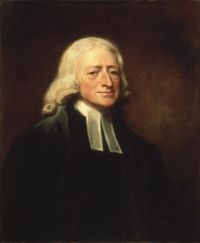 John Wesley,
The works of the Rev. John Wesley…
(1771)
John Wesley,
The works of the Rev. John Wesley…
(1771)
“ IT is the intent of this chapter to shew, that altho’ common language ascribes a variety of faculties and principles to the soul, imputing this action to the blindness of our passions, that to the inconstancy of our tempers; one thing to the heat of our imagination, another to the coolness of our reason; yet, in strictness of truth, every thing that is done by us, is the action and operation of our reason, and is to be ascribed to it, as the sole principle from whence it proceeded, and by which it is governed and effected. ”
 Bernard Mandeville,
A Letter to Dion
Bernard Mandeville,
A Letter to Dion
“ When Actions are good and laudable in themselves, and there are two different Motives from which they might proceed, the one very honourable, and the other scandalous; which is it most charitable, to ascribe these Actions to the first Motive, or the latter? Why do you hesitate, Alciphron? Would not a polite Man, speaking to another's Face, say, that he thought his Actions proceeded from that Motive which does the most Honour to him? ”
Walter Scott,
Guy Mannering
(1815)
“ Mr Dinmont had probably made a visit there either of business or pleasure. "I wish," thought Brown, "the good farmer had staid till I came up; I should not have been sorry to ask him a few questions about the road, which seems to grow wilder and wilder." In truth, nature, as if she had designed this track of country to be the barrier between two hostile nations, has stamped upon it a character of wildness and desolation. The hills are neither high nor rocky, but the land is all heath and morass; the huts poor and mean, and at a great distance from each other. ”
 Georg Wilhelm Friedrich Hegel,
Science of Logic
(1816)
Georg Wilhelm Friedrich Hegel,
Science of Logic
(1816)
“ And the unutterable,—feeling or sensation,—far from being the highest truth, is the most unimportant and untrue. If I say 'The individual,' 'This individual,' 'here,' 'now,' all these are universal terms. Everything and anything is an individual, a 'this,' and if it be sensible, is here and now. ”
Mary G. Ware, The elements of character
“ Manners are the most external manifestation by which men display their individual peculiarities of mind and heart; and unless used artificially to conceal the true Character, they form a transparent medium through which it is exhibited. ”
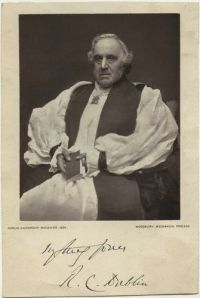 Richard Chenevix Trench,
On the Study of Words
Richard Chenevix Trench,
On the Study of Words
“ I will not urge more than one; but that one, because in it is a lesson more for ourselves than for others, and with such I would fain bring these lectures to a close. How solemn a truth we express when we name our work in this world our 'vocation,' or, which is the same in homelier Anglo-Saxon, our 'calling.' What a calming, elevating, ennobling view of the tasks appointed us in this world, this word gives us. ”
Henry Ware, Hints on extemporaneous preaching
“ To be compelled to shape the course of remark so as to suit a sentence which is by and by to come, or to introduce certain expressions which are waiting for their place, is a check to the natural current of thought. ”
 George Edward Moore,
Principia Ethica — Chapter I
(1903)
George Edward Moore,
Principia Ethica — Chapter I
(1903)
“ Every one does in fact understand the question ‘Is this good?’ When he thinks of it, his state of mind is different from what it would be, were he asked ‘Is this pleasant, or desired, or approved?’ It has a distinct meaning for him, even though he may not recognise in what respect it is distinct. ”
“ Julia, you are incorrigible;—but remember, I expect your mirth on this subject to be under such restraint, that it shall neither offend this worthy man's feelings nor those of Miss Bertram, who may be more apt to feel upon his account than he on his own. And so good-night, my dear; and recollect, that though Mr. Sampson has certainly not sacrificed to the graces, there are many things in this world more truly deserving of ridicule than either awkwardness of manners or simplicity of character. ”
 Joseph Conrad,
A Personal Record — Preface
(1912)
Joseph Conrad,
A Personal Record — Preface
(1912)
“ The manner in laughter, in tears, in irony, in indignations and enthusiasms, in judgments--and even in love. The manner in which, as in the features and character of a human face, the inner truth is foreshadowed for those who know how to look at their kind. ”
 Alexander Pope,
An Essay on Man
(1751)
Alexander Pope,
An Essay on Man
(1751)
“ At best more watchful this, but that more strong. The action of the stronger to suspend, Reason still use, to reason still attend. Attention, habit and experience gains; Each strengthens reason, and self-love restrains. ”
Walter Scott,
Guy Mannering
(1815)
“ No, Colonel, I shall never forget the misery of the house of Ellangowan that morning!—the father half-distracted—the mother dead in premature travail—the helpless infant, with scarce any one to attend it, coming wawling and crying into this miserable world at such a moment of unutterable misery. We lawyers are not of iron, sir, or of brass, any more than you soldiers are of steel. ”
Walter Scott,
Guy Mannering
(1815)
“ Brown felt that lively and awakening interest which taste and sensibility always derive from the beauties of nature, when opening suddenly to the eye, after the dulness and gloom of a night voyage. Perhaps,—for who can presume to analyse that inexplicable feeling which binds the person born in a mountainous country to his native hills?—perhaps some early associations, retaining their effect long after the cause was forgotten, mingled in the feelings of pleasure with which he regarded the scene before him. ”
 F. H. Bradley,
Ethical Studies — Essay VII.
(1876)
F. H. Bradley,
Ethical Studies — Essay VII.
(1876)
“ And where we act, as we say, with a motive, where we have in our minds a reason, an aim, an object beyond the act, which the act subserves, there these motives, these thoughts of ends or objects to be realized, are of very different kinds. ”
George Edward Mannering, With axe and rope in the New Zealand Alps… (1891)
“ It is one of those vast pictures which are indelibly impressed upon the memory—one of those overpowering examples of Nature's sublimity which seem to move a man's very soul and call him to a sense of his own littleness. ”
 Auguste Forel,
The sexual question
Auguste Forel,
The sexual question
“ Good dispositions in the domains of will, sentiment, judgment, imagination, perseverance, duty, accuracy, self-control, the faculty of thinking logically and distinguishing the true from the false, the faculty of combining æsthetic thoughts and sensations, all constitute human values which are much superior to the faculty of rapid assimilation or receptivity, and a good memory for words and phrases. ”
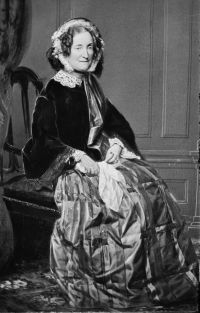 Lydia Sigourney,
Moral Pieces in Prose and Verse
(1815)
Lydia Sigourney,
Moral Pieces in Prose and Verse
(1815)
“ It is in the writings of these illustrious characters that we find originality of thought, justice of sentiment, and force of reasoning, occasionally elevating our conceptions, convincing our judgments, and softening our feelings. Many more examples might be adduced of those who prefer the exercise of composition to that of conversation, and who, in silently meditating upon some rational subject, and in recording the spontaneous flow of ideas and reflections, have felt a silent satisfaction, and an enlargement of mind, never found among the restraints, or the gaieties of society. ”
 William Walker Atkinson,
A Series of Lessons in Raja Yoga
William Walker Atkinson,
A Series of Lessons in Raja Yoga
“ You will understand, of course, that there is no magic or virtue in the words themselves—that is, in the grouping of the letters forming the words, or the sounds of the words—the virtue resting in the idea of which the words are the expression. ”
Walter Scott,
Guy Mannering
(1815)
“ If India be the land of magic, this, my dearest Matilda, is the country of romance. The scenery is such as nature brings together in her sublimest moods—sounding cataracts—hills which rear their scathed heads to the sky—lakes, that, winding up the shadowy valleys, lead at every turn to yet more romantic recesses—rocks which catch the clouds of heaven. ”
“ Ellangowan broke through the throng which had already assembled at the fatal spot, and beheld the object of their terror. It was the dead body of Kennedy. At first sight he seemed to have perished by a fall from the rocks, which rose above the spot on which he lay, in a perpendicular precipice of a hundred feet above the beach. The corpse was lying half in, half out of the water; the advancing tide, raising the arm and stirring the clothes, had given it at some distance the appearance of motion, so that those who first discovered the body thought that life remained. ”
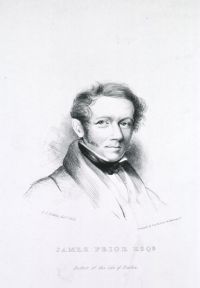 James Prior,
Life of Edmond Malone
(1860)
James Prior,
Life of Edmond Malone
(1860)
“ And how many of those slighter details, occurrences, projects, or intrigues, that link small matters with great—how many points of manner, conduct, temper, or peculiarity that make up the sum of human character, are thus lost, of which we would gladly be informed! ”
Walter Scott,
Guy Mannering
(1815)
“ No more of that, Julia; he that is too proud to vindicate the affection and confidence which he conceives should be given without solicitation, must meet much and perhaps deserved disappointment. It is enough, that one dearest and most regretted member of my family has gone to the grave without knowing me; let me not lose the confidence of a child, who ought to love me if she really loves herself. ”
William James, The Principles of Psychology, Volume 1…
“ Again, when we use a common noun, such as man, in a universal sense, as signifying all possible men, we are fully aware of this intention on our part, and distinguish it carefully from our intention when we mean a certain group of men, or a solitary individual before us. In the chapter on Conception we shall see how important this difference of intention is. It casts its influence over the whole of the sentence, both before and after the spot in which the word man is used. ”
