Case (grammar)

Definition and stakes

M. L. Nesbitt,  Grammar-land; Or, Grammar in Fun for the Children of Schoolroom-shire (1885)

“ At the words “Objective Case,” every one in the court held his breath, expecting the Judge to burst into a rage; and certainly a sudden flush did overspread his face, and rise to the very roots of his wig. For a moment he sat silent with compressed lips, then lifting his head haughtily, he said:—
“Do not apologise, Dr. Verb; I forgive you; but on one condition—that you show clearly and at once how to discover an Objective Case that is governed by a verb.”
“Certainly, my lord,” said Dr. Verb, joyfully; “it is the easiest thing in the world.
”
Source: Gutenberg

Conversation: Its Faults and Its Graces

“ Thus, if one were to say, "This is a very hard case," or "A singular case occurred [58] the other day," or "That poor man's case is a very deplorable one," we should readily comprehend that by the word "case" was meant "circumstance" or "situation;" and when we speak, in the language of the grammar, of "a noun in the nominative case," we only mean a person or thing placed in such circumstances as to become merely named, or named as the performer of some action,—as "the man," or "the man walks." In both these sentences, "man" is in the nominative case ”
Source: Gutenberg

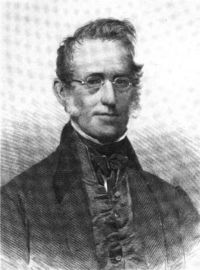
Portrait of Goold Brown Goold Brown,  The Grammar of English Grammars (1882)

“ To say again, with the same gentlemen, "Conjunctions connect the same moods and tenses of verbs, and cases of nouns and pronouns," is to put an ungrammatical, obscure, and useless assertion, in the place of an important rule. To say merely, "Prepositions govern the objective case," is to rest all the syntax of prepositions on a rule that never applies to them, but which is meant only for one of the constructions of the objective case. ”
Source: Wikisource

Get perspective with Kwize: daily news enlightened by great literature