General theory of relativity

Definition and stakes

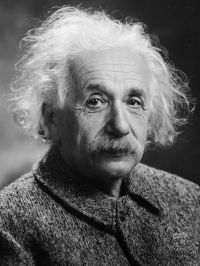
Portrait of Albert Einstein Albert Einstein,  Relativity : the Special and General Theory (1920)

“ No fairer destiny could be allotted to any physical theory, than that it should of itself point out the way to the introduction of a more comprehensive theory, in which it lives on as a limiting case.
In the example of the transmission of light just dealt with, we have seen that the general theory of relativity enables us to derive theoretically the influence of a gravitational field on the course of natural processes, the laws of which are already known when a gravitational field is absent.
”
Source: Gutenberg

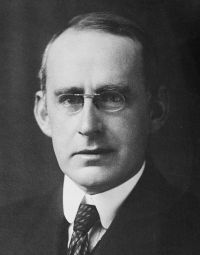
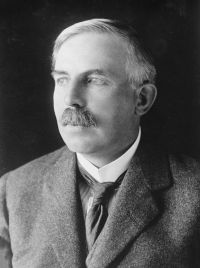
Portrait of Arthur Eddington Arthur Eddington,  Space Time and Gravitation: An outline of the general relativity theory… (1920)

“ But relativity mechanics finds that there is no evidence that the circumstances of any observer can be such as to make his views preeminent. All are on an equality. Consider an observer in a projectile falling freely to the earth, and an observer in space out of range of any gravitational attraction. Neither nor feel any field of force in their neighbourhood. Yet in Newtonian mechanics an artificial distinction is drawn between their circumstances; is in no field of force at all, but is really in a field of force, only its effects are neutralised by his acceleration. ”
Source: Wikisource

Portrait of Arthur Eddington Arthur Eddington,  Space Time and Gravitation: An outline of the general relativity theory… (1920)

“ Later on we shall reach in a more general way the identification of mass with energy and the variation of mass with speed; but, since the experimental measurement of inertia involves the study of a body in non-uniform motion, it is not possible to enter on a satisfactory discussion of mass until the more general theory of relativity for non-uniform motion has been developed. ”
Source: Wikisource

Get perspective with Kwize: daily news enlightened by great literature