Horn (vehicle)

Definition and stakes

H. Clifford Brokaw,  Putnam's Automobile Handbook: The Care and Management of the Modern Motor-Car

“ As a matter of fact the foot should instinctively go to the brake pedal each time the hand goes to the horn. But if you are seen by the other person why blow the horn at all?
If one is driving along a country road and desires to pass another car going in the same direction, it is customary to sound the horn once that the driver ahead may not turn his car in front of you, and so that, if needed, he may turn to the right to let you pass on the left. He is the judge as to when and where he will turn, since he can see ahead better and knows what obstructions are to be avoided.
”
Source: Gutenberg

George R. Chatburn,  Highways and Highway Transportation

“ How many drivers watch the sidewalks, the store fronts, or turn around to talk to the passengers on the rear seat instead of watching the street with its many passing vehicles and pedestrians.
Horns. —Every car is supposed to be equipped with a good horn and it should be used with caution when necessary but never when unnecessary or so often as to become a nuisance. Horns should be regulated by law in just the same manner as lights. The standard horn is one which honks, not one which whistles or screeches.
”
Source: Gutenberg

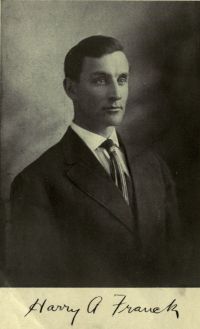
Portrait of Harry Alverson Franck Harry Alverson Franck,  A Vagabond Journey Around the World…

“ On every highway of Europe the wayfarer must be always on the alert for the sound of an automobile horn. Continental chauffeurs have small respect for foot-travelers, and the pedestrian who does not heed their imperative honk is quite apt to come into collision with a touring-car moving at its highest rate of speed. Now the first note of protest of an over-burdened ass bears a similarity to the toot of an automobile horn that can scarcely be accounted for under the head of coincidences. ”
Source: Gutenberg

Get perspective with Kwize: daily news enlightened by great literature