Optical axis

Definition and stakes

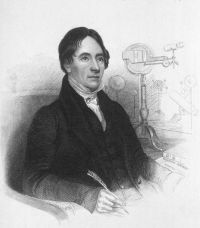
Portrait of Félix Savart Félix Savart,  Scientific Memoirs (1837)

“ Whatever be the direction of the plates, the optical axis, or its projection on their plane, always occupies a position on them which is intimately connected with the arrangement of the acoustic lines: thus, for example, in all the plates cut round one of the edges of the base of the prism, the optical axis, or its projection, invariably corresponds with one of the two straight lines which compose the nodal system formed of two lines which intersect each other rectangularly. ”

Source: Wikisource

Henry Draper,  On the Construction of a Silvered Glass Telescope

“ Through it at the height of the brightest part of the flame, as at b, two holes are bored, a quarter of an inch apart, one 1/32 of an inch in diameter, the other as small as the point of the finest needle will make—perhaps 1/200 of an inch. This apparatus is to be set at the centre of curvature of the mirror c—the optical axis of the latter being horizontal—and so adjusted that the light which diverges from the illuminated hole in use, may, after impinging on the concave surface of the glass, return to form an image close by the side of the tin screen. ”
Source: Gutenberg

David Gill,  Encyclopædia Britannica, Ninth Edition (1888)

“ The line joining the optical centre of the lens with the axis of rotation of the position circle may not be at right angles to the declination axis. (2) The declination axis may not be at right angles to the polar axis. In modern equatorials it is usual to leave these adjustments to the maker, as to leave them to the astronomer would be incompatible with the greatest stability of the instrument. In a good instrument these errors will certainly be extremely small and have no influence on its efficiency for practical purposes. ”
Source: Wikisource

Get perspective with Kwize: daily news enlightened by great literature