“ The rate of paddling must therefore be slower than that of rowing, since each stroke takes a longer time for its completion. As a rule, too, the blade is in paddling not quite so deeply covered, and cannot make the same rushing swirl under water. During the earlier stages of practice paddling is merely easier rowing; it is not so sharply distinguished from hard rowing as it becomes later on. At the outset it is necessary to make your crew both paddle and row with a full swing, in order to get length ineradicably fixed in their style. ”
Paddle (rowing)
Definition and stakes
The theme of “paddle (rowing)” has been addressed by authors such as R. C. Lehmann, John MacGregor, R. A. Fletcher, Edmond Warre and Isambard Brunel. It is often associated with terms like canoe, boat, oar, water and paddling.
Quotes about “paddle (rowing)”
“ Paddling is a difficult art to learn, and only the very best crews paddle really well with balance, rhythm, and ease. Many a time I have seen a good crew and an inferior one paddling along the course together, and almost invariably the good crew, which had mastered the trick of paddling at a slow stroke and with perfect ease, was distanced. ”
 Jacob Abbott,
Marco Paul's Voyages and Travels…
“ Therefore, if you can have but one, a paddle is better than an oar. There is another advantage in a paddle; that is, in using it, your face looks the way that you are going.""Yes," rejoined Marco, "that is a great advantage.""In rowing, you must sit with your back to the bow of the boat, and look over your shoulder to see where you are going.""Yes," said Marco, "unless you have a steersman.""True," replied Forester. "When you have several men to row, and one to steer, you get along very well with oars, but in case of only one man, there is an advantage in a paddle. ”
Adelia B. Beard, On the Trail: An Outdoor Book for Girls
“ A rowboat is a safer craft than a canoe, and rowing is not a difficult feat, but there is a difference between the rowing of a heavy flat-bottomed boat and rowing a light skiff or round-bottomed rowboat. In rowing properly one's body does most of the work and the strain comes more on the muscles of the back than on those of the arms.In paddling you face the bow of the canoe; in rowing you are turned around and face the stern of your boat. In paddling you reach forward and draw your paddle back; in rowing you lean back and pull your oars forward. ”
“ The eagerness a man will display in cutting down everything to lessen the weight of his craft, until he is sitting on the water on a weak bit of nothing, is really astounding. Three or four extra pounds often make all the difference, whether a boat is stiff and keeps on travelling, or whether she jumps, cocks her head, and waggles about generally.As to the pace of stroke, from twenty-two to twenty-six strokes a minute is a fair practice paddle, twenty-four to twenty-eight for sculling hard, and in racing, even for a minute, never attempt anything over thirty-eight. ”
 Edmond Warre,
1911 Encyclopædia Britannica
(1911)
“ In rowing, as well as in paddling, the leverage is of the second order, in which the weight lies between the power and the fulcrum The point at which the power pressed the arm of the lever against the weight in rowing would soon attract attention by the frequent breakage of the paddle so employed. ”
 John Boyle O'Reilly,
Athletics and Manly Sport
(1890)
“ To plunge the bare arms to the elbow into the river as you go, and let the cool water curl up to the biceps; to feel the soft breeze on bare head and neck; to be far from the busy crowds in the cities, with all the senses awake to new and fascinating objects—the swirl of rapid water, the brown and yellow stones on the bottom of the river, the large, free movements of clouds, the strange flowers on the bank; to grip the paddle with an agreeable sense of power in shoulder and hand; to brace the feet strongly against the foot-rest and feel the canoe spring with the elastic force of the stroke ”
William Wood, All Afloat: A Chronicle of Craft and Waterways
“ The actual paddling is not difficult to learn, that is, the paddling required from an ordinary member of the crew. But the man in the bow and, still more, the man in the stern need the highest kind of skilful daring to take them safely through. Paddling by oneself also requires a special touch, only to be learnt by long practice. Even in dead water it takes some time before a novice can send the canoe straight ahead when paddling on one side only. As the paddle goes aft the bow naturally tends to turn towards the other side. ”
 Edward B. Tylor,
Anthropology
(1881)
“ The primitive wooden paddle, imitating the form and doing the work of the flat hand or foot, is well known to savages, who mostly use the single paddle with a blade or shovel end; the double-ended paddle, such as our canoeists have borrowed from the Esquimaux, is a peculiar improved form. The paddle used free-handed to dig or sweep at the water, is best suited to the narrow bark-canoe or hollowed trunk, but for larger craft it is a rude contrivance as compared with the civilized oar, which is a lever pulled against a fulcrum so as to use more of the rower’s force, and in a steadier pull. ”
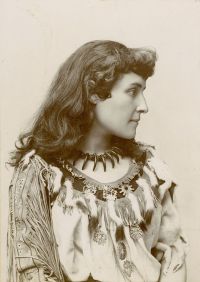 E. Pauline Johnson,
Flint and Feather — The Song my Paddle Sings
(1914)
“ They seethe, and boil, and bound, and splash. Be strong, O paddle! be brave, canoe! The reckless waves you must plunge into. Reel, reel. On your trembling keel, But never a fear my craft will feel. We've raced the rapid, we're far ahead! ”
William La Varre, Up the Mazaruni for Diamonds
“ If the water was smooth and open, with no current, our twenty paddle men would sing as softly as the whispering of a summer breeze. But if there was a current they would sing louder. And the more difficult the paddling, the louder they would sing. In boiling rapids where it took every ounce of their strength and they had to take quick, short strokes to keep going, their voices arose to an almost howling crescendo. ”
Agnes C. Laut, Vikings of the Pacific
“ Not a word is spoken, not a paddle blade allowed to click against the bone gun'els of the skiff. Double-bladed paddles are frequently used, so shift of paddle is made from side to side of the canoe without a change of hands. The skin shallops take to the water as noiselessly as the glide of a duck. Yonder, where the boulders lie mile on mile awash in the surf, kelp rafts—forests of seaweed—lift and fall with the rhythmical wash of the tide. Hither the otter hunters steer, silent as shadows. The circle widens, deploys, forms a cordon round the outermost rim of the kelp fields. ”
Various, Scribner's Magazine, Volume 26…
“ With the paddle there are not less than three variations of position on each side, which bring new muscles into play and relieve the weary ones; and a shift from one hand to the other is a complete rest. ”
Ontario. Department of Education, The Ontario Readers: Fourth Book
“ The best man shifts his place from the stern to the bow, and stands ready with his long-handled paddle to twist the frail boat out of reach of hidden rocks. The men's faces glow with excitement. Quicker and quicker flows the stream, breaking into little rapids, foaming round rocks, and [Pg 107] rising in tumbling waves over the shallows. At a word from the bowman the crew redouble their efforts, the paddle shafts crash against the gunwale, the spray flies beneath the bending blades. The canoe shakes and quivers through all its fibres, leaping bodily at every stroke. ”
Adelia B. Beard, On the Trail: An Outdoor Book for Girls
“ Girls and women generally require shorter paddles than men, as they do not have the same reach of arm, and you can take your choice of lengths. For the stern the paddle should be longer than for the bow. Paddles are made of red oak, maple, ash, spruce, and cherry. Some authorities prefer spruce for ordinary usage, but in rough water and in shooting rapids a harder wood is best. The weak part of a paddle is where the blade joins the handle, and this part should not be too slender. ”
Three Hundred Things a Bright Boy Can Do
“ The paddle is 7 feet long, flat-bladed, with a breadth of 6 inches in each palm, which is copper-banded, and made of the best spruce fir, the weight being little over 2 lbs. The spoon-shaped blade is better for speed, and a longer paddle is suitable for a racing-boat, but for a travelling canoe, where long paddling, occasional sailing, and frequent “shoving,” require the instrument to combine lightness, straight edge, handiness, and strength, it is found that a short paddle is best for the varied work of a protracted voyage. ”
Vingie E. Roe, The Maid of the Whispering Hills
“ Swiftly and silently she pushed a canoe into the water at the landing, stepped in, and with one deep dip of a paddle sent the frail craft out to midstream. She did not turn her head for a farewell glance toward the post, but set her face toward the way that led to the Pays d'en Haut and the man who journeyed thither. Deep and even her paddle took the sweet waters and the current shot her forward like a racer. The dark shores flowed by in a long black ribbon of soft shadow, their leaning grasses and foliage playing with the ripples in endless dip and lift. ”
Aletta E. Marty, The Ontario High School Reader
“ My paddle will lull you into rest. O! drowsy wind of the drowsy west, Sleep, sleep, By your mountain steep,15 Or down where the prairie grasses sweep! Now fold in slumber your laggard wings, For soft is the song my paddle sings. August is laughing across the sky, Laughing while paddle, canoe, and I,20 Drift, drift, Where the hills uplift On either side of the current swift. The river rolls in its rocky bed; My paddle is plying its way ahead25 Dip, dip, While the waters flip In foam as over their breast we slip. ”
William Bingley, Travels in North America, From Modern Writers
“ Into this hole he thrusts himself, up to the waist; after which he fastens the skin so tight round his body, that no water can enter. Thus secured, and armed with a paddle, which is broad at both ends, he ventures out to sea, even in the most stormy weather; and, if he be unfortunate enough to have his canoe overset, he can easily raise himself by means of his paddle. ”
Adelia B. Beard, On the Trail: An Outdoor Book for Girls
“ During the stroke bring your upper hand forward across your face or breast, and with the lower draw the blade through the water.It is well to begin as bow paddler, for your duty there, in smooth water, is to watch for obstructions such as hidden rocks and submerged logs or snags, while the paddler at the stern must steer the canoe and keep it in a straight course.At the beginning learn to paddle as well from one side as from the other. To be able to change sides is very restful and sometimes a quick change will prevent an accident. ”
William J. Moore, Balancing and Shoeing Trotting and Pacing Horses
“ A foot that is kept high on the inside and low on the outside will help to prevent winging in to the knees. There are lots of paddlers who do not begin to paddle until the foot has left the ground quite some distance, and to prove this I have seen the shoes worn by some paddlers and the most of the wear on the shoes of the paddling leg or legs was at the outside toe of shoe. A paddler that leaves the ground from the inside toe of shoe can be made to carry the leg straighter in a line at speed easier than one that leaves the ground from the outside toe. ”
 Hervey Allen,
Carolina Chansons
“ That lies in wait to make a silent rush, And there was something in her like a thrush, For she had paddle-wheels, each like a wing. She had a long hornet stern that seemed to hold a sting. Sometimes her paddles slowly turned, For they kept steam up, waiting for a gale. It seemed as if the slim boat chafed and yearned To go hell-tearing under steam and sail. The oily water churned And made a slap-slap to the paddles' stroke ”
 G. A. Henty,
In the Heart of the Rockies: A Story of Adventure in Colorado
“ Tom sat in the bow of his boat, Hunting Dog was next to him, then came the chief, and Harry sat in the stern. A paddle is a much easier implement to manage for a beginner than is an oar, and it was not long before they found that they could propel the boats at a fair rate. ”
Michael Scott, Tom Cringle's Log
“ About ten feet of the after part was thatched with palm leaves, over a framework of broad ash hoops; which awning, called the toldo, was open both towards the steersman that guided us with a long broad-bladed paddle in the stern, and in the direction of the men forward, who, on starting, stripped themselves stark naked, and, giving a loud yell every now and then, began to pull their oars, or long paddles, after a most extraordinary fashion. ”
Various, Scientific American magazine Vol 2…
“ It will be understood that the motion of the walking bar being circular, and that of the heads of the paddles being vertical and nearly rectilinear, the motion of the blades of the paddles must be elliptical, inclining to the horizontal; and that the position of the paddles is kept so nearly vertical that they will meet with less resistance in entering or leaving the water than those of a common paddle wheel, while the atmospheric resistance to be encountered thereby is much less. ”
Ethel C. Brill, The Island of Yellow Sands: An Adventure and Mystery Story for Boys
“ The buoyant, but frail, little craft must mount each wave at just the right angle. It must be held steady when it shot down the other side and through the trough between. The shifting squally wind made frequent, sudden twists of the paddle necessary, and to prevent the canoe from careening, the body of the paddler must be thrown in the opposite direction. The poise of his body was almost as important as the handling of the paddle. Whatever happened, Ronald and Jean must remain motionless, never for one moment shifting their weight unless the Indian so ordered. ”
 Louis Becke,
A Memory of the Southern Seas
“ If you put out a line with a hook—baited with almost anything—a bit of fish a strip of white or red rag—you will have some sport, for these great gars are a hard-fighting fish, and do the tarpon jumping-trick to perfection. But if you have not a line in readiness you can wait your chance, and as he comes close alongside, break his back with a blow from the sharp blade of your paddle, and jump overboard and secure him ere he sinks. ”
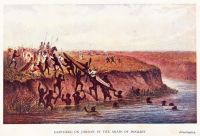 John MacGregor,
A Thousand Miles in the Rob Roy Canoe on Rivers and Lakes of Europe
“ There should be conical cups of vulcanised India rubber to catch the dribbling water, and, if possible, some plan (not yet devised) for preventing or arresting the drops from the paddle ends, which fall on the [294] deck when you paddle slowly, and when there is not enough centrifugal force to throw this water away from the boat.The painter ought to be of the best flexible rope, not tarred, well able to bear 200 lb. weight; more than 20 feet of rope is a constant encumbrance. ”
Angus B. Reach, Leonard Lindsay ; (1877)
“ We used to start before sunrise, Blue Peter in the bows of the canoe, and Jack in the stern, both paddling quickly, while I sat amidships in the bottom. No Europeans I ever saw can paddle so silently, swiftly, and surely as the Indians on the Mosquito coast. They hold the shaft of the paddle almost upright, never touching the gunwale therewith, or splashing rudely in the water. ”
 William J. Long,
Wilderness Ways
“ With two good men to paddle, it is not difficult to tire him out. Though he swims with extraordinary rapidity under water—fast enough to follow and catch a trout—a long deep dive tires him, and he must rest before another. If you are chasing him, shout and wave your hat the moment he appears, and paddle hard the way his bill points as he dives again. The next time he comes up you are nearer to him. Send him down again quick, and after him. The next time he is frightened to see the canoe so close, and dives deep, which tires him the more. ”
A. Russell Bond, The Scientific American Boy; Or…
“ Then we cut sixteen paddles of the form shown in Fig. 257. Eight of these were 12 inches long, and the rest measured 18 inches. A slot 3 inches deep was cut in each paddle of just the right width to slip over the tie boards. The shorter paddles were fastened on just back of the spokes, and the rest were secured half-way between each spoke. The paddles were braced by stretching a wire from one to another all the way around the wheel. ”
“ John’s musing exclamation was unfinished. With a swift stroke of the paddle Kingdom sent the canoe sweeping through the water with sudden liveliness and the lad who, under the name of “Little Paleface,” must answer to the charge of witchcraft, could only seize a paddle, also, to use as a rudder and likewise assist in hurrying the light bark craft onward. ”
Related terms
Authors who wrote about “paddle (rowing)”
 R. C. LehmannJohn MacGregorR. A. FletcherEdmond WarreIsambard Brunel
 Walter Bradford WoodgateWilliam Bridges AdamsWilliam La VarreF. M. HolmesE. Pauline JohnsonEthel C. BrillVariousAdelia B. BeardJacob Abbott
 Stewart Edward WhiteEdward Sylvester EllisG. A. HentyWilliam WoodOntario. Department of EducationJohn Boyle O'Reilly
