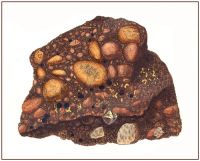
Paving stone

Definition and stakes

Various,  Blackwood's Edinburgh Magazine…

“ Your books will prove it, that the portion of granite pavement in the Poultry was taken up six or seven times during a period of three years. When the wood paving becomes a little slippery, go to your granite heaps which belong to this commission, or to your fine sifted cinder heaps, and let that be strewed over the surface; that contains no earthy particles, and will, when it becomes imbedded in the wood, form such a surface that there cannot be any possibility be any slipperiness— (hear, hear!) Do we not pursue this course in frosty weather even with our own stone paving? ”

Source: Gutenberg

Paul Lachlan MacKendrick,  The Mute Stones Speak: The Story of Archaeology in Italy

“ Along the Appia, and the other consular roads radiating from Rome, traces of the ancient stone paving are occasionally preserved. The paving blocks are usually selce (flint) , polygonal in shape and closely fitted without mortar. While most Roman roads prove on archaeological examination to consist of paving blocks laid in a trench and packed with earth and selce chips, it will be worthwhile to record the ideal method of laying a pavement—strictly speaking a mosaic pavement—as recommended by the architect Vitruvius, a contemporary of Augustus. ”
Source: Gutenberg

Get perspective with Kwize: daily news enlightened by great literature