“ The lower parts of bog-moss die and decay while its upper portions continue to flourish, and thus, in process of time, a thickness of peat is accumulated to the extent of six, twelve, twenty-four, or even forty feet. Many of the hill-tops and hill-slopes in Scotland and Ireland are covered with a few feet of peat, but it is only in valleys and hollows where the peat-bogs attain their greatest depth. ”
Peat bog
Definition and stakes
A peat bog is a natural buildup of partially decomposed plant matter, commonly found in wetland environments. This subject, as portrayed in Louise Gibson Annand’s painting, has been examined by geologists, researchers, and authors. James Geikie described its development in Scotland and Ireland, while William Boyd Dawkins connected it to ancient remnants.
Winthrop Packard imbued it with intrigue, portraying bogs as places of unsettling preservation. Scientific descriptions, such as those by Samuel W. Johnson and William Eleroy Curtis, highlight its gradual, stratified growth. Together, these viewpoints emphasize the peat bog’s dual nature as a geological feature and a storehouse of history, linking scientific analysis with imaginative storytelling.
Quotes about “peat bog”
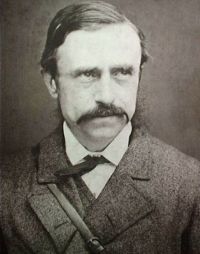 William Boyd Dawkins,
Early Man in Britain and His Place in the Tertiary Period
(1880)
“ The bog occupies the site of a tarn, and rests on the boulder clay. Above the latter is a thin layer of blue fluviatile clay, which, as it passes up towards the peat, becomes more and more mingled with black, peaty material. The animal remains rested in and on the blue clay, passing upwards through the peaty mud; in one case, which I have examined, the antler tips were within six inches of the upper friable black peat. Prof. Leith Adams believes that Irish elks have never been met with in peat bogs. ”
 William Eleroy Curtis,
One Irish Summer
“ A peat bog is not always in a hollow, but often on a hillside, and sometimes at considerable height, which contradicts the theory that bogs are due to defective drainage. Science long ago determined that Irish peat was the accumulation of a peculiar kind of moss which grows like a coral bank in the damp soil, and continues to pile up in layers year after year, century after century, until it forms a solid mass, several feet thick, seventy per cent moisture and thirty per cent fibre, which burns slowly and furnishes a high degree of heat. ”




Related terms
Authors who wrote about “peat bog”
Samuel W. JohnsonJames A. MahonyWinthrop PackardW. G. Wood-Martin Charles LyellSvend FleuronEdward A. MartinCharles ThongerVarious
 Arthur Conan Doyle
 Sabine Baring-GouldJohn Bell Bouton
 Sir Charles Lyell
 Henry S. SaltSir Thomas Dick Lauderauthor:John Gilbert BakerWilliam Eleroy Curtis
 Eugenius Warming
 James GeikieWilliam Boyd Dawkins
Charles LyellSvend FleuronEdward A. MartinCharles ThongerVariousArthur Conan DoyleSabine Baring-GouldJohn Bell BoutonSir Charles LyellHenry S. SaltSir Thomas Dick Lauderauthor:John Gilbert BakerWilliam Eleroy CurtisEugenius WarmingJames GeikieWilliam Boyd Dawkins