Placenta (botany)

Definition and stakes

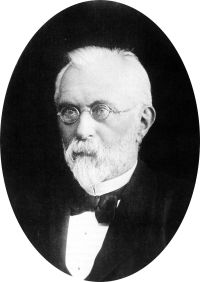
Portrait of Eugenius Warming Eugenius Warming,  A handbook of systematic botany (1895)

“ Stamens equal in number and opposite to the perianth-leaves, free, or in varying degrees united to one another. The inferior ovary is constructed as in the Santalaceæ, the ovules being situated on a low, free, centrally-placed placenta, but the placenta and ovules unite with the wall of the ovary into one connected, parenchymatous mass, in which the embryo-sacs are imbedded. Only 1 (less frequently 2–3) of the 1–6 embryo-sacs is fertile. The number of the carpels however varies. ”
Source: Gutenberg

Asa Gray,  The Elements of Botany, For Beginners and For Schools

“ Here each carpel is an open leaf, or with some introflexion, bearing ovules along its margins; and each placenta consists of the contiguous [Pg 109] margins of two pistil-leaves grown together. There is every gradation between this and the three-celled ovary with the placentæ in the axis, even in the same genus, sometimes even in different stages in the same pistil (Fig. 335, 336) .
§ 2. GYMNOSPERMOUS GYNŒCIUM.
313. The ordinary pistil has a closed ovary, and accordingly the pollen can act upon the contained ovules only indirectly, through the stigma.
”
Source: Gutenberg

Portrait of Eugenius Warming Eugenius Warming,  A handbook of systematic botany (1895)

“ A Is the youngest stage, E the oldest. ii Inner integument; ie outer integument; nc nucellus; m archespore (mother-cell of the embryo-sac) .
The Ovule in the Phanerogams arises most frequently on a projecting portion of the carpel, termed the placenta. The ovules (compare the sporangium of the Eusporangiatæ and especially the pollen-sac) take their origin from a group of cells which lies beneath the epidermis (Fig. 248 A, B) . First of all a small papilla is formed, which is later on provided with a vascular bundle and becomes the funicle
”
Source: Gutenberg

Get perspective with Kwize: daily news enlightened by great literature