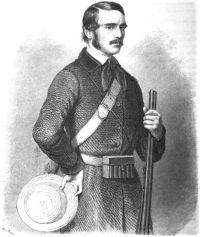
Powder horn

Definition and stakes

Portrait of René Caillié René Caillié,  Travels through Central Africa to Timbuctoo and across the Great Desert to Morocco performed in the year 1824-1828… (1830)

“ They form this powder into lumps of the size of a man’s fist, which they dry in the sun. The purchasers allow it to remain in the same state until they are going to use it, when they crush it and put it in a powder-horn. When they load their muskets with home-made powder, they use a much greater quantity than they would think necessary of the European kind, which they value far more highly. Their powder produces but a weak explosion ”
Source: Gutenberg

David I. Davis,  The modern packing house (1903)

“ The horns severed from the head preferably by sawing and cutting at a point beyond the meeting point of skull and horn, are thrown into a vat of water, held at a temperature of from 140° to 150° F. After soaking for ten or fifteen minutes they are taken out and by hammering the horn across some solid substance, or by laying it on a block and pounding it with a weight or mallet, the pith slips out. The piths are dried and used in the manufacture of glue. The horns should be stored in a room where there is ample outside air circulation and not too dry. Artificial heat will cause them to crack. ”
Source: Gutenberg

John Keast Lord,  The Naturalist in Vancouver Island and British Columbia…

“ Above this snag, the horns have a shiny surface, are rounded, and taper gradually to a sharp tip, bent into a hook. The horns vary greatly in the males. I have sometimes shot them with the prong hardly developed, sometimes springing from the horn near the tip, and in others growing close to the head, where it is always uneven and warty. The female is devoid of horns, or only has them in a rudimentary condition. ”
Source: Gutenberg

Get perspective with Kwize: daily news enlightened by great literature