Present participle

Definition and stakes

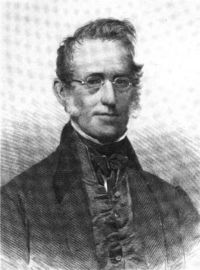
Portrait of Goold Brown Goold Brown,  The Grammar of English Grammars (1882)

“ The participle differs from these, as much as it does from a noun. But says our author, "Participles, as simple adjectives, belong to a noun; as, a loving father; an approved copy;--as parts of the verb, they have the same government as their verbs have; as, his father, recalling the pleasures of past years, joined their party."--Ib., p. 170. What confusion is this! a complete jumble of adjectives, participles, and "parts of verbs!" Again: "Present participles are often construed as substantives; as, early rising is conducive to health; I like writing; we depend on seeing you."--Ib., p. ”
Source: Wikisource

Benjamin L. D'Ooge,  Latin for Beginners

“ Ablative Absolute. The ablative of a noun or pronoun with a present or perfect participle in agreement is used to express attendant circumstance.
Note 1. The verb sum has no present participle. In consequence we often find two nouns or a noun and an adjective in the ablative absolute with no participle expressed; as, tē duce, you (being) leader, with you as leader; patre īnfirmō, my father (being) weak.
Note 2. Be very careful not to put in the ablative absolute a noun and participle that form the subject or object of a sentence.
”
Source: Gutenberg

Willem Sijbrand Logeman,  Introduction to the study of the history of language

“ Bearing in mind our definition of the participle, we may say that this recurrence has taken place as soon as the present participle is used for the lasting activity; as when we talk about a knowing man: and as soon as the perfect participle comes to be used to express the result of the activity; as, a lost chance. The more such participle is employed in a specialised meaning—as, for instance, metaphorically,—the more speedily and thoroughly will the transformation become accomplished; as in such cases as striking, charming, elevated, drunken, agèd, learnèd, crabbèd, doggèd, etc. ”
Source: Gutenberg

Get perspective with Kwize: daily news enlightened by great literature