“ There was the red star, a monstrous blotch of crimson swollen and brooding on the horizon and filling a quarter of the sky. There was the fleck of white high up near the top of the red giant, its white-dwarf companion in transit. ”
Red star
Definition and stakes
The theme of “red star” has been addressed by authors such as M. A. Orr, Florence Armstrong Grondal, George C. Comstock, William Tyler Olcott and Arthur Stanley Eddington. It is often associated with terms like Sirius, telescope, Antares, Vega and spectrum.
Quotes about “red star”
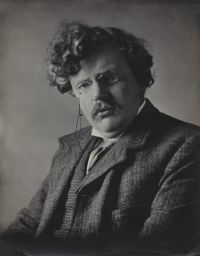 Gilbert Keith Chesterton,
Tremendous Trifles
(1909)
Gilbert Keith Chesterton,
Tremendous Trifles
(1909)
“ Once I thought like you, that one's pleasure in a flying spark was a thing that could come and go with that spark. Once I thought that the delight was as free as the fire. Once I thought that red star we see was alone in space. But now I know that the red star is only on the apex of an invisible pyramid of virtues. That red fire is only the flower on a stalk of living habits, which you cannot see. ”
 John Arthur Thomson,
The Outline of Science — Part I
John Arthur Thomson,
The Outline of Science — Part I
“ But a very interesting recent research shows that there are two kinds of red stars; some of them are amongst the oldest stars and some are amongst the youngest. The facts appear to be that when a star is first formed it is not very hot. ”
John Arthur Thomson,
The Outline of Science — Part I
“ In its main lines the spectrum of a star corresponds to its colour, and we may roughly group the stars into red, yellow, and white. This is also the order of increasing temperature, the red stars being the coolest and the white stars the hottest. We might therefore imagine that the white stars are the youngest, and that as they grow older and cooler they become yellowish, then red, and finally become invisible--just as a cooling white-hot iron would do. ”
Garrett Putman Serviss, Astronomy with an Opera-glass
“ This great, red star probably in actual size exceeds our sun, and no one can help feeling the sublime nature of those studies which give us reason to think that here we can actually behold almost the expiring throes of a giant brother of our giant sun. ”
Garrett Putman Serviss, Round the year with the stars (1910)
“ There is no doubt, whatever the exact hue may be, that this star wears a livery distinguishing it from any other in the sky. It is hardly an exaggeration to say that there is as great a variety of color tones among stars as among flowers. Although the great majority of stars approximate to white, there are, nevertheless, red stars, green stars, blue stars, lilac stars, yellow stars, orange stars, indigo stars, and violet stars, and stars of other tints and shades. ”
M. A. Orr, Stars of the southern skies (1915)
“ This immense red star is accompanied by a little green satellite, and there is also a very close companion which can never be seen, but is known to exist through the shifting of lines in the spectrum, like that of Spica.What an amazing variety among these ten stars! Though the eye can only decide that all are much brighter than the average, and that they differ somewhat in colour among themselves, science tells us that they vary enormously in many ways. Half belong to the class of blue Orion stars, others to the white Sirian, yellow solar, red Antarian classes ”
M. A. Orr, Stars of the southern skies (1915)
“ What is the meaning of these different types of stars—the blue, the yellow, and the red? and can a star change its colour and type? Yes, we believe that all the blue stars, if they follow the normal course, will in countless ages become red, and though the life of the whole human race may perhaps not be long enough to witness a single instance, we feel confident that this process is going on. One walk through a forest is enough to teach us that a tree grows from seed to sapling, from maturity to decay, because we see trees around us in all these stages. ”
 Richard A. Proctor,
Pleasant Ways in Science
Richard A. Proctor,
Pleasant Ways in Science
“ From every sun we get, as from our own sun, all the colours of the rainbow. There may be an excess of some colours and a deficiency of others in any star, so as to give the star a tint, or even a very decided colour. But even a blood-red star, or a deep-blue or violet star, does not shine with pure light, for the spectroscope shows that the star has other colours than those producing the prevailing tint, and it is only the great excess of red rays (all kinds of red, too) or of blue rays (of all kinds) , and so on, which makes the star appear red, or blue, and so on, to the eye. ”
 Oscar Wilde,
The Picture of Dorian Gray
(1890)
Oscar Wilde,
The Picture of Dorian Gray
(1890)
“ Some red star had come too close to the earth.... ”
G. E. Mitton, The Children's Book of Stars
“ The red stars have been described by various observers as resembling 'a drop of blood on a black field,' 'most magnificent copper-red,' 'most intense blood-red,' and 'glowing like a live coal out of the darkness of space.' Some people see them as a shining red, like that of a glowing cloud at sunset. Therefore there can be no doubt that the colours are genuine enough, and are telling us some message. ”
 William Tyler Olcott,
Star Lore Of All Ages — Scorpio…
(1911)
William Tyler Olcott,
Star Lore Of All Ages — Scorpio…
(1911)
“ When the air is steady and the companion can be well viewed, there is no finer sight among the double stars. The contrast in colours is beautifully distinct — fire-red and bright green. The little green star has been seen emerging from behind the moon ahead of its ruddy companion. ”
George C. Comstock, A Text-Book of Astronomy
“ If this radiant energy could come unhindered to our eyes every star would appear white, but they are all surrounded by atmospheres—analogous to the chromosphere and reversing layer of the sun—which absorb a portion of their radiant energy and, like the earth's atmosphere, take a heavier toll from the violet than from the red end of the spectrum. The greater the absorption in the star's atmosphere, therefore, the feebler and the ruddier will be its light, and corresponding to this the red stars are as a class fainter than the white ones. ”
Florence Armstrong Grondal, The music of the spheres (1926)
“ With a gradual rise and fall of temperature, stars burn, even as earthly flames, through a continuous series of colors,—generally speaking, red, yellow, blue, yellow, red,—all of which bear a special meaning to an astronomer. The yellow stars, like our sun, are middle-aged; the dwarf red stars, old, like a dying ember. After a star has expended its heat, if it does not in the meantime meet with some accident, it becomes a darkened, lifeless and cold-surfaced globe. [Pg 13] AN IRREGULAR NEBULA IN SCUTUM SOBIESKI. Photograph by Mount Wilson Observatory through 60-inch reflecting telescope. ”
 David P. Todd,
Astronomy: The Science of the Heavenly Bodies
David P. Todd,
Astronomy: The Science of the Heavenly Bodies
“ Many stars show marked differences in color, and strictly speaking the stars are now classified by their colors. The atmosphere affects star colors very considerably, low altitudes, or greater thickness of air, absorbing the bluish rays more strongly and making the stars appear redder than they really are. Aldebaran, Betelgeuse and Antares are well-known red stars, Capella and Alpha Ceti yellowish, Vega and Sirius blue, and Procyon and Polaris white. Among the telescopic stars are many of a deep blood-red tint, variable stars being numerous among them. ”
Arthur Stanley Eddington, 1911 Encyclopædia Britannica, Volume 25… (1911)
“ Colours and Spectra of Stars.—The brighter stars show a marked variety of colour in their light, and with the aid of a telescope a still greater diversity is noticeable. It is, however, only the red stars that form a clearly marked Colours. class by themselves. For purposes of precise scientific investigation the study of spectra is generally more suitable than the vague and unsatisfactory estimates of colour, which differ with different observers. Of the first magnitude red stars Antares is the most deeply coloured, Betelgeux, Aldebaran and Arcturus being successively less conspicuously red. ”
Florence Armstrong Grondal, The music of the spheres (1926)
“ Antares, Betelgeuse, Arcturus and Aldebaran are examples of stars at the beginning of their careers. The giant red stars are gaseous throughout and of enormous volume—Antares, the youngest and by far the largest of the four named above, being 400,000,000 miles in diameter. The bluish stars are the hottest stars; a red tinge indicates comparative coolness whether the star is young or old. The blue stars are in the prime of life, intensely hot and brilliant, and glow with a temperature of perhaps 10,000 degrees at their luminous surfaces. ”
M. A. Orr, Stars of the southern skies (1915)
“ Most long-period variables are red stars of the Antarian or of the carbon star classes with banded spectra, but they differ from ordinary red stars by occasionally showing bright lines, which indicate an uprush of intensely hot hydrogen gas in their atmospheres. ”
Various, The Popular Science Monthly, August…
“ It is still true that a blue star will give a much stronger photographic image than a red star of equal visual brightness. In a general way, it may be said that the catalogue includes all the stars to very nearly the tenth magnitude, and on most of the plates stars of 10.5 were included. ”
Young Folks' Library, Volume XI…
“ Double stars also frequently delight us by giving beautifully contrasted colors. I dare say you have often noticed the red and the green lights that are used on railways in the signal lamps. Imagine one of those red and one of those green lights away far up in the sky and placed close together, then you would have some idea of the appearance that a colored double star presents, though, perhaps, I should add that the hues in the heavenly bodies are not so vividly different as are those which our railway people find necessary. ”
Arabella B. Buckley, Through Magic Glasses and Other Lectures
“ It seems strange at first to speak of stars as coloured, but they do not by any means all give out the same kind of light. Our sun is yellow, and so are the Pole-star and Pollux; but Sirius, Vega, and Regulus are dazzling [Pg 167] white or bluish-white, Arcturus is a yellowish-white, Aldebaran is a bright yellow-red, Betelgeux a deep orange-red, as you may see now in the telescope, for he is full in view; while Antares, a star in the constellation of the Scorpion, which at this time of year cannot be seen till four in the morning, is an intense ruby red. ”
Florence Armstrong Grondal, The music of the spheres (1926)
“ All the brilliant red stars are young and in the giant stage of their career but the faint red stars are dwarfs and on their decline. The dwarf red stars are believed to be cooling for they possess chemical combinations only possible in a decreasing temperature relatively low for stars. ”
 Robert Stawell Ball,
In the High Heavens
(1910)
Robert Stawell Ball,
In the High Heavens
(1910)
“ It is, however, much more usual for the light from a star to be of a highly composite type, including rays not only from all parts of the visual spectrum, but also rays belonging to the ultra-violet region, as well as others beyond the extreme red end. The effect of the retreat of a star, so far as its colour is concerned, is that though the green is shifted a little towards the red, a bluish hue moves up to supply the place of the green, and as a similar effect takes place along the entire length of the spectrum, the total appearance is unaltered. ”
George C. Comstock, A Text-Book of Astronomy
“ Stellar colors.—We have already seen that one star differs from another in respect of color as well as brightness, and the diligent student of the sky will not fail to observe for himself how the luster of Sirius and Rigel is more nearly a pure white than is that of any other stars in the heavens, while at the other end of the scale α Orionis and Aldebaran are strongly ruddy, and Antares presents an even deeper tone of red. ”
Popular Science Monthly (1872)
“ So that, if a star were shining with pure red light, it might by approaching very rapidly be caused to appear yellow, or even blue or indigo, according to the rate of approach; while, if a star were shining with pure indigo light, it might by receding very rapidly be caused to appear green or yellow, or even orange or red. ”
 Voltairine De Cleyre,
And Thou Too
Voltairine De Cleyre,
And Thou Too
“ But the world moves on, and the piteous Earth Still groans in the monster pain; And the star that leads me points onward yet, Though the red drops fall like rain! ”
 Thomas Hardy,
Far from the Madding Crowd
(1874)
Thomas Hardy,
Far from the Madding Crowd
(1874)
“ The sovereign brilliancy of Sirius pierced the eye with a steely glitter, the star called Capella was yellow, Aldebaran and Betelgueux shone with a fiery red. To persons standing alone on a hill during a clear midnight such as this, the roll of the world eastward is almost a palpable movement. ”
John Cargill Brough, The fairy tales of science (1857)
“ Many of the double stars of unequal magnitude exhibit the beautiful phenomenon of complementary colours. Thus, if the larger star be of a ruddy or orange hue, the smaller one will appear blue or green; if the larger star appear yellow, the smaller will appear blue; if the light of the brighter star incline to crimson, that of the other will incline to green. ”
 William Hope Hodgson,
The House on the Borderland — Chapter XVIII: The Green Star
(1908)
William Hope Hodgson,
The House on the Borderland — Chapter XVIII: The Green Star
(1908)
“ Wherever the earth was traveling, it was, at least, going once more toward the realms of light. Light! One must spend an eternity wrapped in soundless night, to understand the full horror of being without it.Slowly, but surely, the star grew upon my vision, until, in time, it shone as brightly as had the planet Jupiter, in the old-earth days. With increased size, its color became more impressive; reminding me of a huge emerald, scintillating rays of fire across the world.Years fled away in silence, and the green star grew into a great splash of flame in the sky. ”
George C. Comstock, A Text-Book of Astronomy
“ There are no green stars, or blue stars, or violet stars, save in one exceptional class of cases—viz., where the two components of a double star are of very different brightness, it is quite the usual thing for them to have different colors, and then, almost without exception, the color of the fainter star lies nearer to the violet end of the spectrum than does the color of the bright one, and sometimes shows a distinctly blue or green hue. ”
Austin Hall, Weird Tales (1923)
“ It was small compared to the rest of the comet, but of such an intensity that against its light the rest was as shadow. Red is a terrible color; but this red had the terror of hell! “ 'It seemed to be living; like the evil eye of some magnetic devil, winking, blinking, and shooting red fire into the onrushing coma. Great wreaths of hot splendor shot out from its rim, one upon another, a whirling, blinding, dazzle of spasmodic ascending glory. ”
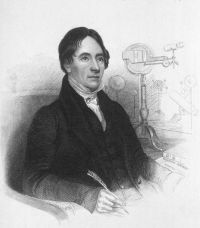 Thomas Dick,
The Practical Astronomer
Thomas Dick,
The Practical Astronomer
“ Thus the yellow spectrum of the setting sun thrown on the luminous sky, becomes blue, and changes with the colour or brightness of the clouds on which it appears. The red part of light being capable of struggling through thick and resisting mediums which intercept all other colours—is likewise the cause why the sun appears red when seen through a fog,—why distant light, though transmitted through blue or green glass, appears red—why lamps at a distance, seen through the smoke of a long street, are red, while those that are near, are white. ”
 H. G. Wells,
The Door in the Wall, and Other Stories
H. G. Wells,
The Door in the Wall, and Other Stories
“ And when next it rose over Europe everywhere were crowds of watchers on hilly slopes, on house-roofs, in open spaces, staring eastward for the rising of the great new star. It rose with a white glow in front of it, like the glare of a white fire, and those who had seen it come into existence the night before cried out at the sight of it. “It is larger,” they cried. “It is brighter!” And, indeed the moon a quarter full and sinking in the west was in its apparent size beyond comparison, but scarcely in all its breadth had it as much brightness now as the little circle of the strange new star. ”
Anonymous, The Arctic World (1876)
“ The brightness of the rays varies in an instant; they sometimes surpass the splendour of stars of the first magnitude, and often exhibit colours of admirable transparency,—blood-red at the base, emerald-green in the middle, and clear yellow towards their extremity. ”
 Ed Earl Repp,
The radium pool
(1929)
Ed Earl Repp,
The radium pool
(1929)
“ Crystals that ranged in color from deep, unfathomable red to emerald green danced before me. As though fighting for some control of a color-world the reds began to seep through into the blues and the greens.They suddenly merged into one solid color—the deep, unfathomable infra-red of the spectrum. The suddenness of the change caused my whole system to react in a terrific shudder. Remembering the scientist's words, I clenched my teeth for control over myself. Now I leaned forward tensely. Objects were slowly shaping themselves from the masses. It was the Red World! ”
Martha Evans Martin, The Ways of the Planets
“ They come sometimes with the gay company of stars that dance their way across the cold winter skies, and sometimes with those that shine during the soft summer nights. Often in the spring and autumn we see some one of them before the sun is fairly down, and, before the light of an ordinary star can yet be seen, hanging in lone brilliancy as the evening star; and often an early riser has the reward of seeing one as a morning star glowing almost in the rays of the rising sun. ”
Related terms
Authors who wrote about “red star”
M. A. OrrFlorence Armstrong GrondalGeorge C. ComstockWilliam Tyler OlcottArthur Stanley EddingtonGarrett Putman ServissRobert Stawell BallDavid P. ToddJohn Arthur ThomsonArabella B. BuckleyThomas DickRichard A. ProctorG. E. MittonMartha Evans MartinJ. Arthur ThomsonMaria Mitchell Camille Flammarion
 Gaston Tissandier
 Richard Watson GilderOscar Wilde
William Tyler OlcottArthur Stanley EddingtonGarrett Putman ServissRobert Stawell BallDavid P. ToddJohn Arthur ThomsonArabella B. BuckleyThomas DickRichard A. ProctorG. E. MittonMartha Evans MartinJ. Arthur ThomsonMaria MitchellCamille FlammarionGaston TissandierRichard Watson GilderOscar Wilde