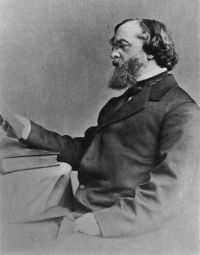
James Freeman Clarke

Biographical details

Portrait of James Freeman Clarke James Freeman Clarke,  Orthodoxy: Its Truths And Errors

“ What to the sinner, borne down by the mighty weight of transgression? What to the dying man, who knows not how to prepare to meet his God? We need the Church of Christ—the Church whose great aim it is, and always has been, to renew and regenerate the soul from its foundation, to lay the axe at the root of the tree of evil, and the very sound of whose bell, rolling its waves of music over the sleeping hills on the Sabbath morning, is worth more to the soul than a thousand lyceums and debating societies. ”
Source: Gutenberg

Portrait of James Freeman Clarke James Freeman Clarke,  Ten Great Religions: An Essay in Comparative Theology

“ Fate itself, the dark Moira, supreme power, mistress of gods and men, was met manfully and not timorously. So strong was the human element, the sense of personal dignity and freedom, that the Greek lived in the midst of a supernatural world on equal terms.
No doubt the elements of mythology are in all nations the same, consisting of the facts of nature and the facts of life. The heavens and the earth, day and night, the sun and moon, storms, fire, ocean, and rivers, love and beauty, life and progress, war, wisdom, doom, and chance,—these, among all nations, supply the material for myths.
”
Source: Gutenberg

Portrait of James Freeman Clarke James Freeman Clarke,  Nineteenth Century Questions

“ He taught us to look at realities instead of names, at substance instead of surface,—to see God in the world, in nature, in life, in providence, in man,—to see divine truth and beauty and wonder everywhere around. He taught that the only organ necessary by which to see the divine in all things was sincerity, or inward truth. And so he enabled us to escape from the form into the spirit, he helped us to rise to that plane of freedom from which we could see the divine in the human, the infinite in the finite, God in man, heaven on earth, immortality beginning here, eternity pervading time. ”
Source: Gutenberg

Get perspective with Kwize: daily news enlightened by great literature