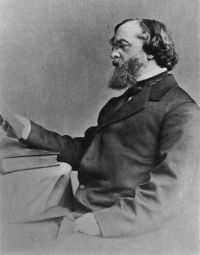
James Freeman Clarke

James Freeman Clarke

Summary

Portrait of James Freeman Clarke James Freeman Clarke,  Nineteenth Century Questions

“ He taught us to look at realities instead of names, at substance instead of surface,—to see God in the world, in nature, in life, in providence, in man,—to see divine truth and beauty and wonder everywhere around. He taught that the only organ necessary by which to see the divine in all things was sincerity, or inward truth. And so he enabled us to escape from the form into the spirit, he helped us to rise to that plane of freedom from which we could see the divine in the human, the infinite in the finite, God in man, heaven on earth, immortality beginning here, eternity pervading time. ”
Source: Gutenberg

Portrait of James Freeman Clarke James Freeman Clarke,  Nineteenth Century Questions

“ The Protestant churches may say, "With a great sum obtained we this freedom." By the lives of its confessors and the blood of its martyrs has it secured for all men to-day equal rights of thought and speech. What neither Copernicus, Kepler, nor Galileo could do was accomplished by the courage of Martin Luther, John Calvin, John Knox, and Oliver Cromwell.
And now the freedom they obtained by such sacrifices we inherit and enjoy: "We are free-born." We may be thankful that in most countries to-day no repression nor dictation prevents any man from expressing his inmost thought.
”
Source: Gutenberg

Portrait of James Freeman Clarke James Freeman Clarke,  Nineteenth Century Questions

“ Amid the stormy disputes of their time, each of these men went his own way, his eye single and his whole body full of light. The work of Darwin was the easier, for he floated with the current of the time, which sets at present so strongly toward the study of things seen and temporal. But the work of Emerson was more noble, for he stands for things unseen and eternal,—for a larger religion, a higher faith, a nobler worship. This strong and tender soul has done its work and gone on its way. But he will always fill a niche of the universal Church as a New England prophet. ”
Source: Gutenberg

Get perspective with Kwize: daily news enlightened by great literature