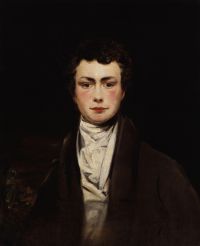
“ Hard work will not do everything: a man can only accomplish what he was born fit for. Many, in the first flush of ambition doomed to wreck, are blind to the fact that it is not in every ploughman to be a poet, nor in every prize-student to be a philosopher. Nature does half: after all perhaps the larger half. Genius has been inadequately defined as "an infinite capacity for taking trouble"; no amount of pumping can draw more water than is in the well. Himself in "the chamber of little ease," Carlyle travestied Goethe's "worship of sorrow" till it became a pride in pain. ”
John Nichol
Biographical details
John Nichol, a literary critic and essayist, is renowned for his analyses of Thomas Carlyle and Lord Byron, exploring themes of labor, individual will, and societal conflict. His works emphasize the tension between action and abstraction, critiquing complacency while celebrating the transformative power of purposeful effort.
Through Carlyle’s focus on duty and Byron’s rebellious spirit, Nichol examines the interplay of genius and struggle, framing both as essential to human progress. His writings, marked by sharp insight and rhetorical force, align with contemporaries like George Saintsbury, reflecting a shared preoccupation with the moral and intellectual forces shaping 19th-century thought.
Quotes by John Nichol
“ Carlyle has a limited love of abstract truth; of action his love is unlimited. His lyre is not that of Orpheus, but that of Amphion which built the walls of Thebes. Laborare est orare. He alone is honourable who does his day's work by sword or plough or pen. Strength is the crown of toil. Action converts the ring of necessity that girds us into a ring of duty, frees us from dreams, and makes us men. ”
“ Such comments also point to the common error of trying to make men other than they are by lecturing them. This scion of a long line of lawless bloods—a Scandinavian Berserker, if there ever was one—the literary heir of the Eddas—was specially created to wage that war—to smite the conventionality which is the tyrant of England with the hammer of Thor, and to sear with the sarcasm of Mephistopheles the hollow hypocrisy—sham taste, sham morals, sham religion—of the society by which he was surrounded and infected, and which all but succeeded in seducing him. ”
“ Carlyle might have remonstrated, "Why was I not born a book!" Her letters and journal teem to tiresomeness with the refrain, "I feel myself extremely neglected for unborn generations." Her once considerable ambitions had been submerged, and her own vivid personality overshadowed by a man she was afraid to meet at breakfast, and glad to avoid at dinner. A woman of immense talent and a spark of genius linked to a man of vast genius and imperious will, she had no choice but to adopt his judgments, intensify his dislikes, and give a sharper edge to his sneers. ”
“ Byron would have been merely a more melodious Moore and a more accomplished Brummell. But the caged lion was only half tamed, and his continual growls were his redemption. His restlessness was the sign of a yet unbroken will. He fell and rose, and fell again; but never gave up the struggle that keeps alive, if it does not save, the soul. His greatness as well as his weakness lay, in the fact that from boyhood battle was the breath of his being. To tell him not to fight, was like telling Wordsworth not to reflect, or Shelley not to sing. ”
“ To this Carlyle, with at least the general assent of Mr. Froude, Mr. Ruskin, and Sir James Stephen, substantially replies:— In freedom for itself there is nothing to raise a man above a fly; the value of a human life is that of its work done; the prime province of law is to get from its subjects the most of the best work. The first duty of a people is to find—which means to accept—their chief; their second and last to obey him. We see to what men have been brought by "Liberty, Equality, and Fraternity," by the dreams of idealogues, and the purchase of votes. ”
“ The French Revolution is a series of flame-pictures; every page is on fire; we read the whole as if listening to successive volleys of artillery: nowhere has such a motley mass been endowed with equal life. This book alone vindicates Lowell's panegyric: "the figures of most historians seem like dolls stuffed with bran, whose whole substance runs through any hole that criticism may tear in them; but Carlyle's are so real that if you prick them they bleed." ”
“ Byron has no relation to the master-minds whose works reflect a nation or an era, and who keep their own secrets. His verse and prose is alike biographical, and the inequalities of his style are those of his career. He lived in a glass case, and could not hide himself by his habit of burning blue lights. He was too great to do violence to his nature, which was not great enough to be really consistent. It was thus natural for him to pose as the spokesman of two ages—as a critic and as an author; and of two orders of society—as a peer, and as a poet of revolt. ”
“ What then is left for Carlyle's Creed? Logically little, emotionally much. If it must be defined, it was that of a Theist with a difference. A spirit of flame from the empyrean, he found no food in the cold Deism of the eighteenth century, and brought down the marble image from its pedestal, as by the music of the "Winter's Tale," to live among men and inspire them. He inherited and coûte que coûte determined to persist in the belief that there was a personal God—"a Maker, voiceless, formless, within our own soul." ”
“ His shifting attitude towards Lady Byron, his wavering purposes, his impulsive acts, are a part of the character we trace through all his life and work,—a strange mixture of magnanimity and brutality, of laughter and tears, consistent in nothing but his passion and his pride, yet redeeming all his defects by his graces, and wearing a greatness that his errors can only half obscure.Alternately the idol and the horror of his contemporaries, Byron was, during his life, feared and respected as "the grand Napoleon of the realms of rhyme." His works were the events of the literary world. ”
“ But the misery had its origin in the same sensitiveness of nature which was so tremulously alive to soft and delicate emotion. Men of genius ... are like the wind-harp which answers to the breath that touches it, now low and sweet, now rising into wild swell or angry scream, as the strings are swept by some passing gust." This applies completely to men like Burns, Byron, Heine, and Carlyle, less to the Miltons, Shakespeares, and Goethes of the world. ”
“ No one ever lived who, in the same space, more thoroughly ran the gauntlet of existence. Having exhausted all other sources of vitality and intoxication—travel, gallantry, and verse—it remained for the despairing poet to become a hero. But he was also moved by a public passion, the genuineness of which there is no reasonable ground to doubt. Like Alfieri and Rousseau, he had taken for his motto, "I am of the opposition;" and, as Dante under a republic called for a monarchy, Byron, under monarchies at home and abroad, called for a commonwealth. ”
“ Good government, according to Aristotle, is that of one, of few, or of many, for the sake of all. A Democracy where the poor rule for the poor alone, maybe a deadly engine of oppression; it may trample without appeal on the rights of minorities, and, in the name of the common good, establish and enforce an almost unconditioned tyranny. Carlyle's blindness to this superlative danger—a danger to which Mill, in many respects his unrecognised coadjutor, became alive—emphasises the limits of his political foresight. ”
“ No one else—except, perhaps, Wordsworth—who could write so well, could also write so ill. This fact in Byron's case seems due not to mere carelessness, but to incapacity. Something seems to stand behind him, like the slave in the chariot, to check the current of his highest thought. The glow of his fancy fades with the suddenness of a southern sunset. His best inspirations are spoilt by the interruption of incongruous commonplace. He had none of the guardian delicacy of taste, or the thirst after completeness, which mark the consummate artist. ”
“ It is not in man to determine what his style shall be, if it is to be his own.But though a rugged, Carlyle was the reverse of a careless or ready writer. He weighed every sentence: if in all his works, from Sartor to the Reminiscences, you pencil-mark the most suggestive passages you disfigure the whole book. His opinions will continue to be tossed to and fro; but as an artist he continually grows. He was, let us grant, though a powerful, a one-sided historian, a twisted though in some aspects a great moralist ”
“ With a slight change of phrase the same may be said of Carlyle's devotion to his work. There is no more prevailing refrain in his writing, public and private, than his denunciation of literature as a profession, nor are there wiser words than those in which the veteran warns the young men, whose questions he answers with touching solicitude, against its adoption. "It should be," he declares, "the wine not the food of life, the ardent spirits of thought and fancy without the bread of action parches up nature and makes strong souls like Byron dangerous, the weak despicable." ”
“ It is impossible to define the influence of Nature, either on nations or individuals, or to say beforehand what selection from his varied surroundings a poet will for artistic purposes elect to make. Shakespeare rests in meadows and glades, and leaves to Milton "Teneriffe and Atlas." Burns, who lived for a considerable part of his life in daily view of the hills of Arran, never alludes to them. But, in this respect like Shelley, Byron was inspired by a passion for the high-places of the earth. Their shadow is on half his verse. ”
“ There is no surge of sorrow in our literature like that which is perpetually tossed up in the second chapter of the second volume, with the never-to-be-forgotten refrain— Cherish what is dearest while you have it near you, and wait not till it is far away. Blind and deaf that we are; oh, think, if thou yet love anybody living, wait not till death sweep down the paltry little dust clouds and dissonances of the moment, and all be at last so mournfully clear and beautiful, when it is too late! ”
“ Lord Byron, electrified by this unexpected act, seemed to recover from his sickness; and the more the Suliotes raged, the more his calm courage triumphed. The scene was truly sublime." "It is impossible," says Count Gamba, "to do justice to the coolness and magnanimity which he displayed upon every trying occasion. Upon trifling occasions he was certainly irritable; but the aspect of danger calmed him in an instant, and restored him the free exercise of all the powers of his noble nature. A more undaunted man in the hour of peril never breathed." ”
“ Carlyle's paradoxes have been exaggerated, his partialities intensified, in his followers; his critical readers, not his disciples, have learnt most from him; he has helped across the Slough of Despond only those who have also helped themselves. When all is said of his dogmatism, his petulance, his "evil behaviour," he remains the master spirit of his time, its Censor, as Macaulay is its Panegyrist, and Tennyson its Mirror. He has saturated his nation with a wholesome tonic, and the practice of any one of his precepts for the conduct of life is ennobling. ”
“ His rank and fame, the glittering splendour of his verse, the romance of his travels, his picturesque melancholy and affectation of mysterious secrets, combined with the magic of his presence to bewitch and bewilder them. The dissenting malcontents, condemned as prudes and blues, had their revenge. Generally, we may say that women who had not written books adored Byron; women who had written or were writing books distrusted, disliked, and made him a moral to adorn their tales, often to point their fables with. ”
“ The Life of Friedrich could not be a succession of dramatic scenes, like the French Revolution, nor a biography like Cromwell, illustrated by the surrounding events of thirty years. Carlyle found, to his dismay, that he had involved himself in writing the History of Germany, and in a measure of Europe, during the eighteenth century, a period perhaps the most tangled and difficult to deal with of any in the world's annals. He was like a man who, with intent to dig up a pine, found himself tugging at the roots of an Igdrasil that twined themselves under a whole Hercynian forest. ”
“ He has swept into the pages of his poem the experience of thirty years of a life so crowded with vitality that our sense of the plethora of power which it exhibits makes us ready to condone its lapses. Byron, it has been said, balances himself on a ladder like other acrobats; but alone, like the Japanese master of the art, he all the while bears on his shoulders the weight of a man. Much of Don Juan is as obnoxious to criticism in detail as his earlier work; it has every mark of being written in hot haste. ”
“ Carlyle's grotesque is a mode of his golden silence, a sort of Socratic irony, in the indulgence of which he laughs at his readers and at himself. It appears now in the form of transparent satire, ridicule of his own and other ages, now in droll reference or mock heroic detail, in an odd conception, a character sketch, an event in parody, in an antithesis or simile,—sometimes it lurks in a word, and again in a sentence. In direct pathos—the other side of humour—he is equally effective. ”
“ Byron had, on occasion, more self-control than Burns, who yielded to every thirst or gust, and could never have lived the life of the soldier at Mesolonghi; but partly owing to meanness, partly to a sound instinct, his memory has been more severely dealt with. The fact of his being a nobleman helped to make him famous, but it also helped to make him hated. No doubt it half spoiled him in making him a show; and the circumstance has suggested the remark of a humourist, that it is as hard for a lord to be a perfect gentleman as for a camel to pass through the needle's eye. ”
“ Emerson, in one of his early letters to Carlyle, wrote, "Nothing seems hid from those wonderful eyes of yours; those devouring eyes; those thirsty eyes; those portrait-eating, portrait-painting eyes of thine." Men of genius, whether expressing themselves in prose or verse, on canvas or in harmony, are, save when smitten, like Beethoven, by some malignity of Nature, endowed with keener physical senses than other men. They actually, not metaphorically, see more and hear more than their fellows. Carlyle's super-sensitive ear was to him, through life, mainly a torment ”
“ The other, with a fever in his veins, calmed it in the sea and in the cloud, and, in some degree because of his very excellencies, has failed as yet to mark the world at large. The poets' poet, the cynosure of enthusiasts, he bore the banner of the forlorn hope; but Byron, with his feet of clay, led the ranks. Shelley, as pure a philanthropist as St. Francis or Howard, could forget mankind, and, like his Adonaïs, become one with nature. ”
“ Carlyle's reverence for the past makes him even more apt to be touched by its sorrows than amused by its follies. With a sense of brotherhood he holds out hands to all that were weary; he feels even for the pedlars climbing the Hohenzollern valley, and pities the solitude of soul on the frozen Schreckhorn of power, whether in a dictator of Paraguay or in a Prussian prince. He leads us to the death chamber of Louis XV., of Mirabeau, of Cromwell, of Sterling, his own lost friend ”
“ The Prophecy of Dante contains much that has since proved prophetic— What is there wanting, then, to set thee free, And show thy beauty in its fullest light? To make the Alps impassable; and we, Her sons, may do this with one deed—Unite!His letters reiterate the same idea, in language even more emphatic. "It is no great matter, supposing that Italy could be liberated, who or what is sacrificed. It is a grand object—the very poetry of politics; only think—a free Italy!" Byron acted on his assertion that a man ought to do more for society than write verses. ”
“ What in these days are terrors of conscience to diseases of the liver? Not on morality but on cookery let us build our stronghold.... Thus has the bewildered wanderer to stand, shouting question after question into the Sibyl cave, and receiving for answer an echo.From this scepticism, deeper than that of Queen Mab, fiercer than that of Candide, Carlyle was dramatically rescued by the sense that he was a servant of God, even when doubting His existence. ”
“ Byron's genius, yet in the green leaf, was not too far above the clever masses of pleasure-loving manhood by which it was surrounded. It was natural that the address on the reopening of Drury Lane theatre should be written by "the world's new joy"—the first great English poet-peer; as natural as that in his only published satire of the period he should inveigh against almost the only amusement in which he could not share. ”
“ Both find the sources of these outwardly obtrusive events in the underground current of national sentiment, the conditions of the civilisation from which they were evolved, the prosperity or misery of the masses of the people. The essence of history does not lie in laws, senate-houses, or battle-fields, but in the tide of thought and action—the world of existence that in gloom and brightness blossoms and fades apart from these.But Carlyle differs from Macaulay in his passion for the concrete. ”
“ Of late years, the struggle for existence, the temptations of a too ambitious and over active people in the race for wealth, and the benumbing effect of the constant profession of beliefs that have ceased to be sincere, have for the most part stifled the fervid fire in calculating prudence. These qualities have been adequately combined in Scott alone, the one massive and complete literary type of his race. Burns, to his ruin, had only the fire: the same is true of Byron, whose genius, in some respects less genuine, was indefinitely and inevitably wider. ”
“ Both write of Christianity as "a thing of beauty," a perennial power, a spreading tree, a fountain of youth; but Goethe was too much of a Greek—though, as has been said, "a very German Greek"—to be, in any proper sense of the word, a Christian; Carlyle too much of a Goth. His Mythology is Norse; his Ethics, despite his prejudice against the race, are largely Jewish. He proclaimed his code with the thunders of Sinai, not in the reconciling voice of the Beatitudes. He gives or forces on us world-old truths splendidly set, with a leaning to strength and endurance rather than to advancing thought. ”
“ Carlyle is a Hebraist unrelieved and unretrieved by the Hellene. A man of inconsistencies, egotisms, Alpine grandeurs and crevasses, let us take from him what the gods or protoplasms have allowed. His way of life, duly admired for its stern temperance, its rigidity of noble aim—eighty years spent in contempt of favour, plaudit, or reward,—left him austere to frailty other than his own, and wrapt him in the repellent isolation which is the wrong side of uncompromising dignity. ”
“ It is when Carlyle turns to politics and regards them as history accomplished instead of history in progress that his principle leads to the most serious error. No one has a more withering contempt for evil as meanness and imbecility; but he cannot see it in the strong hand. Of two views, equally correct, "evil is weakness," such evil as sloth, and "corruptio optimi pessima," such evil as tyranny—he only recognises the first. Despising the palpable anarchies of passion, he has no word of censure for the more settled form of anarchy which announced, "Order reigns at Warsaw." ”
“ When Carlyle was first recognised in London as a rising author, curiosity was rife as to his "opinions"; was he a Chartist at heart or an Absolutist, a Calvinist like Knox, a Deist like Hume, a Feudalist with Scott, or a Democrat with Burns—inquisitions mostly vain. He had come from the Scotch moors and his German studies, a strange element, into the midst of an almost foreign society, not so much to promulgate a new set of opinions as to infuse a new life into those already existing. ”
“ Work done after this fashion seldom brings a swift return; but if it is utilised and made vivid by literary genius it has a claim to permanence. Bating a few instances where his sense of proportion is defective, or his eccentricity is in excess, Carlyle puts his ample material to artistic use; seldom making ostentation of detail, but skilfully concentrating, so that we read easily and readily recall what he has written. Almost everything he has done has made a mark: his best work in criticism is final, it does not require to be done again. ”
“ Liberty is an end not a mere means in itself; apart from practical results the crown of life. Freedom of thought and its expression, and freedom of action, bounded only by the equal claim of our fellows, are desirable for their own sakes as constituting national vitality: and even when, as is sometimes the case, Liberty sets itself against improvements for a time, it ultimately accomplishes more than any reforms could accomplish without it. ”
“ He makes us act rather than think: he does not say, know thyself, which is impossible, but know thy work. He has no pillars of Hercules, no clear goal, but an endless Atlantic horizon. He exaggerates. Yes; but he makes the hour great, the picture bright, the reverence and admiration strong; while mere precise fact is a coil of lead." Our leading journal on the morning after Carlyle's death wrote of him in a tone of well-tempered appreciation: "We have had no such individuality since Johnson. Whether men agreed or not, he was a touchstone to which truth and falsehood were brought to be tried. ”