Summary

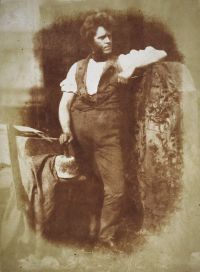
Portrait of Hugh Miller Hugh Miller The Foot-prints of the Creator (1850)

With the introduction of man into the scene of existence, creation, I repeat, seems to have ceased. What is it that now takes its place, and performs its work? During the previous dynasties, all elevation in the scale was an effect simply of creation. Nature lay dead in a waste theatre of rock, vapor, and sea, in which the insensate laws, chemical; mechanical, and electric, carried on their blind, unintelligent processes: the creative fiat went forth; and, amid waters that straightway teemed with life in its lower forms, vegetable and animal, the dynasty of the fish was introduced.
Source: Gutenberg

Portrait of Hugh Miller Hugh Miller The Foot-prints of the Creator (1850)

It is but natural that, in his anxiety to secure an ultimate retreat for his hypothesis, he should desire to see that darkness in which ghosts love to walk settling down on the extreme verge of the geological horizon, and enveloping in its folds the first beginnings of life. But even did the cloud exist, it is, if I may so express myself, on its nearer side, where there is light,—not within nor beyond it, where there is none,—that the battle must be fought. It is to Geology as it is known to be, that the Lamarckian has appealed,—not to Geology as it is not known to be.
Source: Gutenberg

Portrait of Hugh Miller Hugh Miller The Foot-prints of the Creator (1850)

We attempt to theorize upon them, and to reduce them to law, and all nature rises up against us in our presumptuous rebellion. A stray splinter of cone-bearing wood,—a fish’s skull or tooth,—the vertebra of a reptile,—the humerus of a bird,—the jaw of a quadruped,—all, any of these things, weak and insignificant as they may seem, become in such a quarrel too strong for us and our theory: the puny fragment, in the grasp of truth, forms as irresistible a weapon as the dry bone did in that of Samson of old
Source: Gutenberg

Get perspective with Kwize: daily news enlightened by great literature